

Start hereIn 1806, a ship of Boston ice reached Martinique and melted, because there was nowhere to keep it. In the United States, nearly all homes, 99%, have a refrigerator. What happened in between?
Open the fridge and the milk is cold, the butter firm and last night’s leftovers still good. For most of history, keeping food meant drying it, salting it or finding something cold. Below: how food was kept before, how mechanical cold arrived, the numbers now, three half-truths, and one small way to use your fridge better.
1. Before the fridge
Before machines made cold, people dried and salted food, used cellars and streams, and a lucky few stored ice.
Food begins to spoil the moment it is harvested, as a history from the US National Center for Home Food Preservation puts it. Sun and wind dried food from early times, and early cultures used salt to help dry foods out. Cellars, caves and cool streams kept food longer, and in America, estates built icehouses to store ice and food on ice.
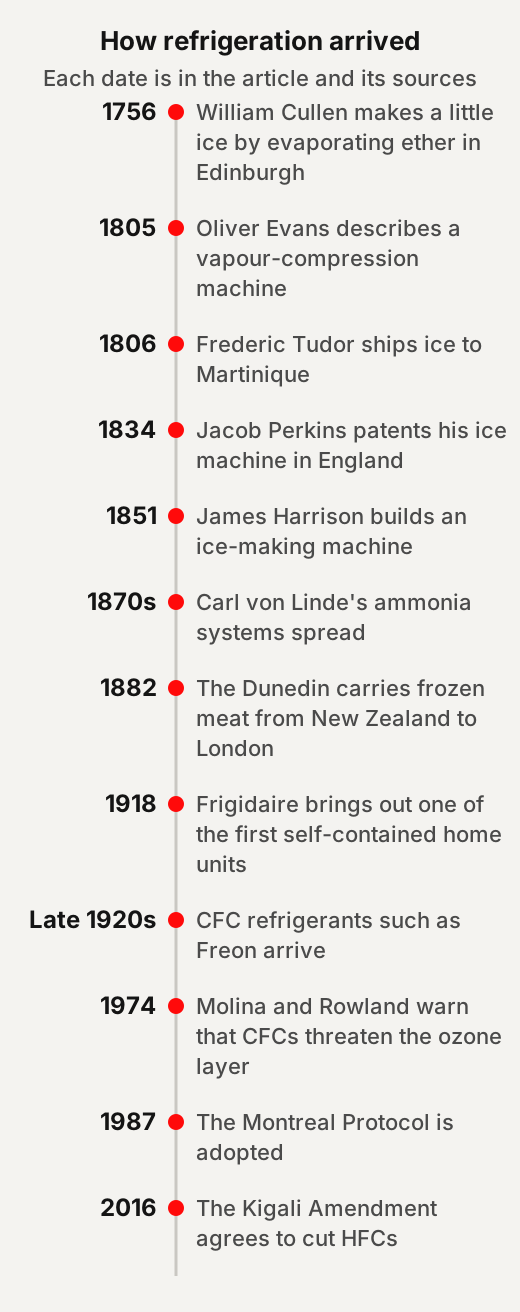
Ice itself was a luxury. For a long time, as a Boston University article on the historian Andrew Robichaud’s research puts it, only the wealthy, or people in cold climates, could get it. In 1806, Frederic Tudor of Boston sent a cargo of ice to Martinique. It melted soon after it arrived, because there was no ice house to store it. The ice trade took off in the 1820s and lasted about 100 years, until refrigeration made it unnecessary. In 1847, Robichaud says, 353 ice-packed ships left Boston Harbor, and the city exported almost 75,000 tons of ice.
The story usually told is about one bold merchant. Robichaud tells a wider one. He credits Tudor’s employee Nathaniel Wyeth, whose horse-drawn plows and cutters changed how ice was harvested, with making the business profitable.
For example, a cold drink in a warm port in the 1840s could have been cooled with ice cut from a frozen pond in New England.
2. How it changed, from pond ice to the Montreal Protocol
Cold-making machines took most of a century to reach the kitchen, and their gases later changed.
Machines that make cold
Scientists showed that evaporating liquids make cold long before anyone sold a machine that did it.
The first documented public demonstration of artificial refrigeration was in Edinburgh in 1756. There the chemist William Cullen made a small amount of ice by lowering the pressure over ether. In 1805, the American inventor Oliver Evans described a machine that would do this over and over, but there is no evidence he ever built one.
Jacob Perkins, an American engineer living in England, took out a patent for “Apparatus and means for producing ice, and in cooling fluids”, which the American Society of Mechanical Engineers dates to 14 August 1834. The American Society of Mechanical Engineers calls it the first working device to use a vapour-compression refrigeration system. Perkins did not develop any commercial use for it.
In vapour compression, a liquid that boils easily evaporates and takes heat from its surroundings. A pump then squeezes the vapour back into a liquid, and the cycle repeats. The fridge in your kitchen still works this way.
Others turned the idea into a business. The American engineer Alexander Twining made his first trials in 1848, and the Australian James Harrison built a mechanical ice-making machine in 1851. In the 1870s, the German engineer Carl von Linde’s system, which used ammonia, began the rapid commercial spread of the cycle. Early machines were usually powered by steam engines, so at first they were used almost entirely in large commercial and industrial settings.
For example, an ice works in the 1880s could run a steam-driven cold machine; a family kitchen could not.
Frozen meat crosses the world
Refrigerated ships let food travel to the other side of the world without spoiling.
On 15 February 1882, the sailing ship Dunedin left Port Chalmers, New Zealand, for London with about 5,000 frozen carcasses on board. It had been fitted with a coal-powered Bell Coleman freezing plant. When it arrived in London in late May, only one carcass had to be condemned. New Zealand’s Ministry for Culture and Heritage says the voyage paved the way for a trade in frozen meat and dairy products. That trade became the cornerstone of the country’s 20th-century economy.
Our reading: cold turned distance from a wall into a shipping problem. For example, lamb raised in New Zealand could now be eaten in London about three months after it sailed.
The fridge comes home
Small electric motors made home fridges possible after 1900, and new gases made them safer.
After 1900, small electric motors made it practical to build much smaller refrigerators for homes. The first home units were costly, with the machinery in the basement or in a room next to the cold box in the kitchen. In 1918, Frigidaire brought out one of the first self-contained units. Chlorofluorocarbon refrigerants such as Freon arrived in the late 1920s and gave a safer alternative to ammonia. The ice trade began to decline in the early 1900s, as refrigeration made carved ice and icehouses unnecessary.
A chlorofluorocarbon, or CFC, is one of a family of gases once used widely for refrigeration, air conditioning, insulation and aerosol sprays. For example, the gas that made a 1930s fridge safer than an ammonia one is the same kind that later turned up in spray cans.
CFCs and the ozone layer
The gases that made fridges safer harmed the ozone layer, so the world agreed to phase them out.
The ozone layer is a thin shield of gas high in the atmosphere that protects people from harmful levels of the sun’s ultraviolet light. In 1974, Mario Molina and Sherwood Rowland published an article in Nature on the threat to the ozone layer from CFC gases. The CFCs they meant were used in spray bottles, as the cooling medium in refrigerators and in plastic foams. In 1985, Joseph Farman and his colleagues noted a drastic depletion of the ozone layer over the Antarctic, the “ozone hole”. Molina, Rowland and Paul Crutzen shared the 1995 Nobel Prize in Chemistry for their work in atmospheric chemistry.
The Montreal Protocol, adopted on 16 September 1987, regulates nearly 100 man-made chemicals that deplete the ozone layer. It entered into force in 1989. It is one of the rare treaties to achieve universal ratification.
The replacements brought their own problem. A hydrofluorocarbon, or HFC, is a gas brought in to replace CFCs. It spares the ozone layer, but some HFCs trap far more heat than carbon dioxide. On 15 October 2016, in Kigali, Rwanda, the parties to the Protocol agreed to cut HFCs by 80 to 85 per cent by the late 2040s. The Kigali Amendment entered into force on 1 January 2019 for the countries that had ratified it.
For example, a fridge bought today and one bought in 1980 may use quite different gases for the same job.
3. What the numbers say now
Food is still lost for want of cold, and cooling now uses a large share of the world’s electricity.
The UN Food and Agriculture Organization estimates that 13.3 per cent of the world’s food was lost after harvest in 2023. That counts losses on farms and in transport, storage, wholesale and processing. In a September 2026 note, it gave the figure as an estimated 13.4 per cent. Losses were highest in sub-Saharan Africa, at 23.0 per cent, and lowest in Northern America and Europe, at 10.0 per cent. That is more than twice the share lost in Northern America and Europe. Fruits and vegetables were lost most, at 25.4 per cent.
In plain words, a little more than one part in eight of the world’s food is lost before it reaches a shop. In sub-Saharan Africa and the poorest countries, the share is far higher. The FAO calls the lack of an effective cold chain one of the major contributors to food loss. A 2022 UN report found that the lack of effective refrigeration directly results in the loss of 526 million tons of food production. That is 12 per cent of the global total. It estimated that developing countries could save 144 million tonnes of food a year with the same level of food cold chain as developed countries.
A cold chain is the unbroken run of cold stores, trucks and fridges that keeps food cold from the farm to the table.
Cooling also takes power, and these figures count air conditioners as well as fridges. In 2023, the UN Environment Programme said cooling equipment represents 20 per cent of total electricity consumption. It said about 1.2 billion people in Africa and Asia lack access to cooling services, which drives food loss and waste and hinders vaccine access. In 2025, it found that cooling demand could more than triple by 2050 under business as usual. In the United States, 99% of homes have a refrigerator, and in 2020, 34% had two or more.
For example, the fridge in your kitchen is one small part of that 20 per cent, alongside every air conditioner.
4. Half-truths people repeat
Common beliefs about cold food each hold a grain of truth, and food-safety agencies fill in the rest.
“Freezing food kills the bacteria”
Doesn't hold up Freezing kills the bacteria in food. Freezing stops most bacteria growing, but it does not kill most of them.
How sure: Strong the US and UK food-safety agencies both say freezing pauses bacteria rather than killing them.
The US Food and Drug Administration says that while freezing does not kill most bacteria, it does stop bacteria from growing. The UK Food Standards Agency says a home freezer at -18°C puts bacteria on pause. They have not been killed, and they may revive as the food defrosts. As the Food Standards Agency puts it, a freezer acts as a pause button.
For example, frozen raw chicken can still carry bacteria when it thaws.
“Never put hot food in the fridge”
Still argued Hot food must cool on the counter before it goes in the fridge. Two national food agencies give different advice on this, though both say to chill leftovers within about two hours.
How sure: Unsettled the US FDA and the UK Food Standards Agency disagree; both agree on the time limit and smaller portions.
The FDA says putting hot food in the refrigerator does not harm the appliance. It says leftovers need to be refrigerated or frozen within 2 hours. The Food Standards Agency says not to place hot or warm food in the fridge. It says to cool cooked food at room temperature and put it in the fridge within one to two hours. Both agencies say that dividing food into smaller portions helps it cool faster.
Our reading: the two agencies agree on getting leftovers cold within about two hours, and differ on where the first cooling happens. For example, a big pot of soup split into small tubs cools faster than the full pot.
“The ozone hole has been fixed”
Partly The ozone layer has healed. It is recovering, but the ozone over the Antarctic is not expected back to its 1980 level until around 2066.
How sure: Moderate it comes from the 2022 UN-backed assessment, a projection that assumes current policies stay in place.
In January 2023, a UN-backed panel of experts confirmed the phase-out of nearly 99% of banned ozone-depleting substances. If current policies remain in place, it expected the ozone layer to recover to 1980 values by around 2066 over the Antarctic. It expected the Arctic to recover by 2045 and the rest of the world by 2040. The next full assessment is due at the end of 2026.
Our reading: the treaty is working, and the repair takes decades. For example, a child born in 2026 would be about forty when the Antarctic ozone is expected back at its 1980 level.
5. One small way to use it better
A cheap fridge thermometer tells you what the dial does not.
The FDA says to keep the refrigerator at or below 40°F (4°C), and the freezer at 0°F (-18°C). The Food Standards Agency says a fridge should be between 0 and 5°C, and a freezer around -18°C. The FDA notes that few refrigerator controls show actual temperatures, and suggests an inexpensive freestanding appliance thermometer. The Food Standards Agency recommends a fridge thermometer, checked once a week.
The two agencies’ fridge figures differ by about a degree, 4°C against 5°C. Either way, the reading on a thermometer tells you more than the number on the dial. And now and then, it is worth remembering that a cold drink in summer once meant a ship full of pond ice.
For example, the dial on many fridges shows a setting, not a reading.
Quick answers
Who invented the refrigerator?
No single person. William Cullen made a little ice by evaporating ether in 1756, and Jacob Perkins patented a vapour-compression machine in 1834 that the American Society of Mechanical Engineers calls the first working one. Others, such as James Harrison and Carl von Linde, turned the idea into a business.
When did fridges come into homes?
After 1900, when small electric motors made small refrigerators practical. Frigidaire brought out one of the first self-contained units in 1918, and safer CFC refrigerants arrived in the late 1920s.
What temperature should a fridge be?
The US FDA says at or below 40°F (4°C), with the freezer at 0°F (-18°C). The UK Food Standards Agency says between 0 and 5°C, with the freezer around -18°C.
Does freezing kill bacteria?
Mostly not. The FDA says freezing does not kill most bacteria but stops them growing, and the UK Food Standards Agency says they may revive as the food defrosts.
Has the ozone hole been fixed?
It is recovering, not fixed. A UN-backed panel expected the ozone over the Antarctic to return to its 1980 level by around 2066, if current policies stay in place.
Use this
Three small ways to notice the cold you have and check it, drawn from the sources above.
What did this cost people before it became ordinary?
Quick quiz
Nothing is scored or saved. Recalling it once now is what makes it last.
1. Who took out a patent dated 1834 for an ice-making machine?
Answer: Jacob Perkins.Read it again ↑
2. What does the UK Food Standards Agency say a home freezer does to bacteria?
Answer: Puts them on pause.Read it again ↑
3. Which agreement, reached in 2016, sets a timeline to cut HFCs?
Answer: The Kigali Amendment.Read it again ↑
How we checked this · Last checked October 2026
- We read the American Society of Mechanical Engineers' landmark brochure on Perkins's machine, and a Boston University interview with a historian of the ice trade.
- The NZHistory page on the 1882 Dunedin voyage did not open for us directly, so we read the Internet Archive copy of May 2025.
- The US FDA and the UK Food Standards Agency give different advice on hot food and slightly different fridge temperatures, so the page gives both.
- The FAO gives 13.3 per cent for food lost after harvest in 2023, and 13.4 per cent in a September 2026 note, so we print both.
- The ozone recovery dates come from the 2022 assessment. The next one is due at the end of 2026, and we will recheck the page then.
Sources
- American Society of Mechanical Engineers, History and Heritage Committee, “Perkins Vapor-Compression Cycle for Refrigeration”, Historic Mechanical Engineering Landmark brochure (November 2020).Scholarly
- Boston University, The Brink, “Tracing the History of New England’s Ice Trade” (2022), with the historian Andrew Robichaud.Popular
- Brian A. Nummer, “Historical Origins of Food Preservation”, National Center for Home Food Preservation (May 2002).Scholarly
- Manatū Taonga, Ministry for Culture and Heritage, NZHistory, “First frozen meat shipment leaves New Zealand” (Internet Archive copy of May 2025; the live page did not open for us).Scholarly
- Nobel Prize, “The Nobel Prize in Chemistry 1995: press release”.Primary
- UN Environment Programme, OzonAction, “About Montreal Protocol”, and the Ozone Secretariat, “The Montreal Protocol on Substances that Deplete the Ozone Layer”.Primary
- UN Environment Programme, “Ozone layer recovery is on track, helping avoid global warming by 0.5°C” (9 January 2023).Primary
- NOAA Chemical Sciences Laboratory, “Scientific Assessment of Ozone Depletion: 2026”.Primary
- Food and Agriculture Organization of the United Nations, “12.3.1 Global food losses”, SDG data portal; “On the International Day of Awareness of Food Loss and Waste…” (29 September 2026); and “Amid food and climate crises, investing in sustainable food cold chains crucial” (12 November 2022).Primary
- UN Environment Programme, “Key measures could slash predicted 2050 emissions from cooling sector” (5 December 2023) and “Global Cooling Watch 2025” (11 November 2025).Primary
- US Environmental Protection Agency, “Ozone-Depleting Substances”.Primary
- Food and Agriculture Organization of the United Nations, “Cooling the chain, cutting the waste”.Primary
- US Energy Information Administration, “Electricity use in homes”.Primary
- US Food and Drug Administration, “Refrigerator Thermometers: Cold Facts about Food Safety” and “Are You Storing Food Safely?”.Primary
- Food Standards Agency (England, Wales and Northern Ireland), “How to chill, freeze and defrost food safely” (GOV.UK).Primary
Cold used to be a luxury
Ice was once cut from ponds and shipped by sea. For a long time, a Boston University article says, only the wealthy or people in cold climates could get ice. The FAO calls the lack of an effective cold chain one of the major contributors to food loss. Our view: a cold kitchen is recent, and not yet everyone's.
Look past the single inventor
- Separate the demonstration from the machine. In 1756 William Cullen made a little ice in Edinburgh by lowering the pressure over ether.
- Separate the design from the build. In 1805 Oliver Evans described a vapour-compression machine. There is no evidence he ever built one.
- Note whose "first" it is. The American Society of Mechanical Engineers dates Perkins's patent to 14 August 1834. It calls it the first working vapour-compression device.
- Then look for the business. Perkins did not develop any commercial use for it. Others, such as James Harrison and Carl von Linde, turned the idea into a business.
- Our suggestion. When a story names one inventor, look for the demonstration, the patent and the business.
Goes with: 2. How it changed, from pond ice to the Montreal Protocol ↑
Read a food-loss figure slowly
- Check the stage. The FAO's 13.3 per cent counts food lost after harvest and before it reaches a shop.
- Check the year. The FAO gives 13.3 per cent for 2023, and an estimated 13.4 per cent in a September 2026 note.
- Check the region. Losses were 23.0 per cent in sub-Saharan Africa, against 10.0 per cent in Northern America and Europe.
- Check what is counted. The UN Environment Programme's figure of 20 per cent of electricity for cooling covers air conditioners as well as fridges.
- Our suggestion. Before you compare two figures on food or cooling, check that they count the same stage and year.
This week: read your fridge's dial
Our suggestion: this week, look at your fridge's control. Note whether it shows a temperature or only a setting. The US Food and Drug Administration notes that few refrigerator controls show actual temperatures. If you have a fridge thermometer, write its reading beside the dial's setting. This section gives the FDA's and the UK Food Standards Agency's figures to compare against.
Keep going
- Things we take for granted: electric lightWhat light cost before electricity, how it changed, and who still lives without it.
- Things we take for granted: clean tap waterHow tap water went from dangerous to normal, and where it still is not.
- Things we take for granted: vaccinesWhat life was like before vaccines, how it changed, and what the numbers say now.
- Things we take for granted: writing and literacyWhen writing began, why reading stayed rare for so long, and how many people still cannot read.
- Things we take for granted: the internetHow messages travelled before the internet, how the network and the web arrived, and who is online now.
- Numbers that misleadTen ways true numbers tell a false story, with worked examples you can check.
- GlossaryPlain meanings of cold chain, chlorofluorocarbon and hydrofluorocarbon, the terms used on this page.