

A marketing strategy is a plan for how a business gets noticed, wins customers and keeps them. Below are 20 common ones, grouped by what they do. Each has an everyday example, what research or the rules say where that matters, and something to try or to watch for.
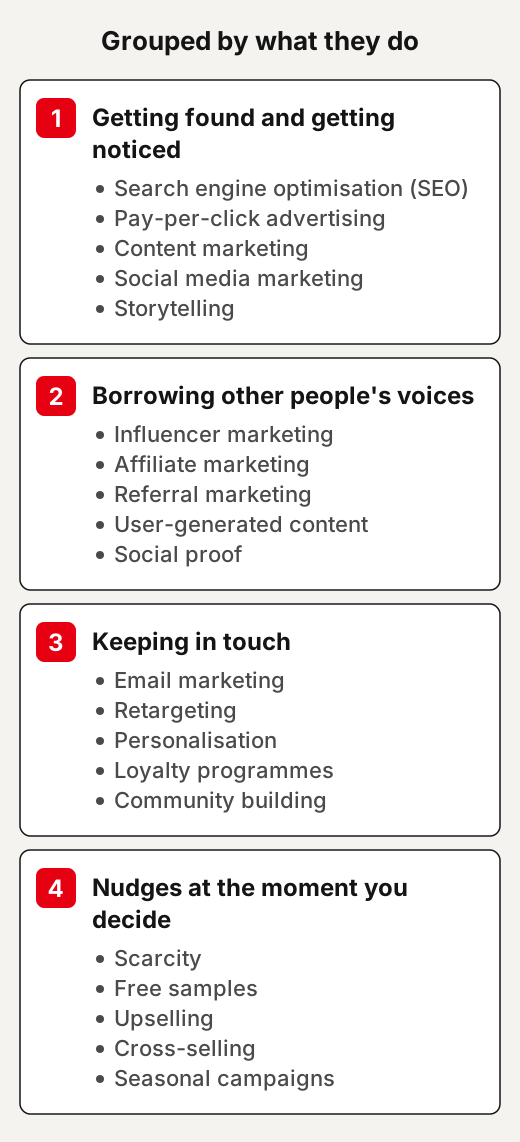
1. Getting found and getting noticed
These five help people find a business in the first place, or remember it.
Search engine optimisation (SEO)
Shaping a website so search engines understand it and people can find it.
Example: a bakery’s site names its town and its opening hours on the front page, in plain words.
How it works: Google’s own starter guide says SEO is about helping search engines understand your content, and helping users find your site. It adds that there is no guarantee any particular site will be added to Google’s index.
Try this: search for a business you know and see what its first result tells you before you click.
Pay-per-click advertising
Ads placed beside search results or on websites, where the advertiser pays when someone clicks.
Example: the top results for “plumber near me” are ads from plumbers who bid on those words.
How it works: An open marketing textbook defines pay per click as advertising where the advertiser pays only for each click on their advert, not for the advert being seen. The OpenStax textbook says the cost of each click is based on the keywords a company bids on.
Try this: look for the small “Sponsored” or “Ad” label before you click the top result.
Content marketing
Publishing useful articles, videos or guides that the right customers want to read.
Example: a paint shop posts a short guide on how to prepare a wall before painting.
How it works: The OpenStax textbook defines content marketing as creating and distributing online content that is valuable and relevant to a company’s target customers. The content earns attention first; the sale comes later, if at all.
Try this: when a guide ends in a product, ask whether the advice still holds without that product.
Social media marketing
Using social platforms to share content and talk with customers.
Example: a local café posts its daily special and replies to comments under it.
How it works: The textbook describes it as using social media platforms to deliver content that drives engagement with your brand. It mixes free posts with paid ads, which the same textbook calls paid social.
Try this: check whether a post you liked was an ad, and who paid for it.
Storytelling
Selling through a story, about a customer, a founder or the product’s journey, instead of a list of features.
Example: a coffee brand tells how one farmer grows its beans, rather than listing its roast levels.
Why it works: people who get absorbed in a story tend to accept what it implies. A 2000 study called this absorption “transportation” and found that being more transported into a story led to more story-consistent beliefs. It also found that labelling a story as fact or as fiction made little difference.
Watch for: a moving story is not evidence. Ask what the product does once the story is set aside.
| Search engine optimisation (SEO) | Shaping a website so search engines understand it and people can find it. |
| Pay-per-click advertising | Ads placed beside search results or on websites, where the advertiser pays when someone clicks. |
2. Borrowing other people’s voices
These five put another person’s voice between the seller and you. Several of them come with disclosure rules.
Influencer marketing
Paying or gifting people with a following to recommend a product.
Example: a cyclist with a large following posts about a new helmet the brand sent for free.
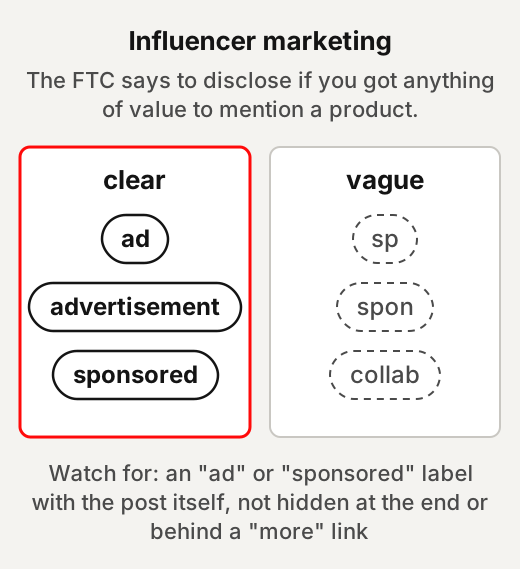
The rules: in the US, the Federal Trade Commission expects this to be labelled. The FTC says to disclose if you got anything of value to mention a product. Its influencer guide calls “ad”, “advertisement” and “sponsored” clear, and “sp”, “spon” and “collab” vague. Our page on how to label a paid clip covers the US and UK rules in detail.
Watch for: an “ad” or “sponsored” label with the post itself, not hidden at the end or behind a “more” link.
Affiliate marketing
Paying a commission to people whose links bring in a sale.
Example: a blog reviewing tents earns a small cut when a reader buys through its link.
How it works: The OpenStax textbook defines affiliates as people or companies that earn a commission for driving traffic to another company’s website where they make a purchase. The FTC’s guidance says an affiliate should disclose the relationship to the retailer clearly and conspicuously, and that the closer the disclosure is to the recommendation, the better.
Watch for: a line saying the writer earns a commission. A review can be honest and paid at the same time, but you should know which.
Referral marketing
Rewarding existing customers for bringing in new ones.
Example: a gym gives a member a free month for each friend who joins.
What research found: A study tracking about 10,000 customers of a German bank for almost three years found that referred customers had a higher retention rate than others. It estimated that the average referred customer was worth at least 16% more than a similar non-referred one. That is one bank, so other kinds of business may differ.
Try this: when a friend recommends something, ask whether they get a reward for it. It does not make the advice wrong.
User-generated content
Material that customers create themselves, like reviews, photos and videos, which a brand then shares.
Example: a hotel reposts guests’ holiday photos taken by its pool.
How it works: A learner’s dictionary defines user-generated content as material on a website contributed by the people who use the website. The appeal is that the words come from customers, not the brand. That is also why fake reviews matter. In August 2024, the FTC announced a final rule on fake reviews and testimonials.
Watch for: a run of reviews posted on the same few days, all in similar words.
Social proof
Showing that many other people buy, use or like something.
Example: “Most guests in this room reuse their towels” on a hotel sign, or a “bestseller” badge.
What research found: telling people what most others do can help, but the famous hotel example is still argued. In the original 2008 hotel study, a sign saying most guests reused their towels beat the standard environmental message: 44.1% against 35.1% reuse in one experiment. Five later replications each failed to reach significance on their own. A 2016 reanalysis that pooled the studies found strong evidence for the effect. Critics argued the pooling was flawed and that models allowing the studies to differ weaken the evidence. Our page on emotional triggers covers the later replications and the debate.
Try this: ask whether the “most people” in the message are people like you.
| Influencer marketing | Paying or gifting people with a following to recommend a product. |
| Affiliate marketing | Paying a commission to people whose links bring in a sale. |
| Referral marketing | Rewarding existing customers for bringing in new ones. |
| User-generated content | Material that customers create themselves, like reviews, photos and videos, which a brand then shares. |
3. Keeping in touch
These five aim to turn a one-time buyer into a repeat one. They depend on data about you, so privacy rules often apply.
Email marketing
Sending offers, news and reminders by email to people who signed up.
Example: a bookshop emails its subscribers when a favourite author has a new book out.
The rules: The OpenStax textbook calls email marketing a type of direct marketing that is highly personal and designed to build relationships. The EU’s Your Europe portal says your prior consent is required for direct marketing emails, with an exception for a company’s existing customers and its own similar products. In the US, the FTC’s guide to the CAN-SPAM Act says senders must tell recipients how to opt out, and honour an opt-out request within 10 business days.
Try this: once a month, unsubscribe from one list you never open.
Retargeting
Showing you ads for something you looked at earlier, on other websites.
Example: you look at running shoes in one shop, then see those shoes in ads on a news site.
How it works: The OpenStax textbook describes retargeting as consumers visiting different websites but being shown similar ads based on their online behaviour. The EU’s Your Europe portal says cookies are also used to follow your internet use as you browse, make user profiles and then display targeted online advertising. It says any website wishing to use cookies has to obtain your consent before installing them, with some exceptions.
Try this: the cookie banner is where you can say no to tracking for ads. Look for a “reject” or “only necessary” option.
Personalisation
Tailoring offers and messages to each person, often from what they bought or viewed before.
Example: an email that opens with your name and suggests a refill of the coffee you bought last month.
How it works: The OpenStax textbook notes that the digital age has let marketers engage with consumers in a highly personalized and interactive way. It runs on data about you, which is why the consent rules above matter here too.
Try this: if a suggestion feels uncannily accurate, check the privacy settings of the account that made it.
Loyalty programmes
Rewards for coming back, such as points, stamps or member prices.
Example: a coffee card that gives the tenth coffee free.
What research found: The OpenStax textbook describes loyalty programmes as a form of promotion focused on repeat purchases, often a receipt, punch card or stamp card. One review questions how much they change buying. A 2003 review argued that loyalty in repeat-purchase markets is shaped more by passive acceptance of brands than by strong attitudes, so the potential of loyalty programmes to raise demand is more limited than might be hoped.
Try this: compare the shop’s member price with what other shops charge without a card.
Community building
Bringing customers together around a shared interest, online or in person.
Example: a running shop hosts a free weekly group run that ends at the store.
How it works: An open eMarketing textbook defines community management as building and monitoring online communities generated from a brand’s blogs, forums and social pages. A 2001 study introduced the idea of a brand community: a group, not tied to one place, based on social relations among admirers of a brand.
Try this: notice which groups you belong to that are run by a company, and what each one asks of you.
4. Nudges at the moment you decide
These five come into play close to the purchase itself. They are easy to spot once you know their names.
Scarcity
Signalling that something is limited, by stock, time or access.
Example: “Only 3 left” beside a product, or a sale that ends at midnight.
What research found: scarcity cues make people value things more, at least in what they say. In a 1975 experiment, cookies in scarce supply were rated more desirable than the same cookies in abundant supply. A 2022 meta-analysis of 416 effect sizes from 131 studies starts from the finding that scarcity cues generally raise a product’s value and the intention to buy it. In the EU, falsely stating that a product will only be available for a very limited time, to rush a decision, is on the list of practices always considered unfair.
Watch for: ask whether you wanted the thing before you saw it was scarce.
Free samples
Giving a small amount of a product away so people can try it.
Example: a cheese counter offering a slice on a cocktail stick.
How it works: The OpenStax textbook lists free samples as a form of promotion. A sample lets you judge the product itself. It may also tap reciprocity: people feel obliged to give back what they have received first. Our Influence summary has the research on that.
Try this: take the sample, then decide as if you had not.
Upselling
Encouraging you to buy a bigger or more expensive version than you planned.
Example: “Would you like to make that a large for a little more?”
How it works: A learner’s dictionary defines upselling as persuading customers to buy more products or a more expensive product than they originally intended. The extra is offered at the moment you have already decided to buy.
Try this: decide on the size or model before you reach the till.
Cross-selling
Offering a related, different product alongside the one you are buying.
Example: a phone shop suggests a case and a screen protector with your new phone.
Try this: check whether the add-on is cheaper elsewhere before you say yes.
Seasonal campaigns
Marketing timed to holidays, seasons or events.
Example: gift sets before a holiday, or school bags in the weeks before term starts.
How it works: The OpenStax textbook lists seasonal catalogues among its examples of direct mail. The campaign meets a need people already have at that time of year.
Try this: write your list for the season before the campaigns begin.
| Upselling | Encouraging you to buy a bigger or more expensive version than you planned. |
| Cross-selling | Offering a related, different product alongside the one you are buying. |
Where to learn more
- OpenStax, Principles of Marketing: a free, open textbook; chapters 13 to 16 cover promotion and digital marketing.
- Google’s SEO Starter Guide: how search engines read a website, from Google itself.
- The FTC’s Disclosures 101 for Social Media Influencers and the EU’s Your Europe page on data protection online: what the rules expect.
- Our pages on how propaganda devices work, the course lesson How Does Propaganda Slip Past Your Reasons?, emotional triggers and the Influence summary go deeper on persuasion.
- Related idea guides: 20 pricing strategies, psychological triggers in marketing and how shops are laid out.
Quick answers
What is the difference between upselling and cross-selling?
Upselling is persuading customers to buy more or a more expensive product than they intended. Cross-selling is selling a different extra product to someone who is already buying from the company.
Do influencers have to say a post is an ad?
In the US, the FTC says to disclose if you got anything of value to mention a product. Its influencer guide calls "ad", "advertisement" and "sponsored" clear, and "sp", "spon" and "collab" vague.
What is retargeting?
Showing you ads for something you looked at earlier, on other websites. In the EU, a website has to obtain your consent before installing cookies like these; only cookies strictly needed for a service you asked for, or to send a communication, are exempt.
Do loyalty programmes work?
They reward repeat purchases. A 2003 review argued that their potential to raise demand is more limited than might be hoped, because loyalty is shaped more by passive acceptance of brands than by strong attitudes.
Use this
Our suggestion, built from the strategies above, for the next ad or offer that catches your eye.
If nobody else had bought it and there were no deadline, would I still want it?
Quick quiz
Nothing is scored or saved. Recalling it once now is what makes it last.
1. In SEO, what does Google's own guide say?
Answer: There is no guarantee any particular site will be added to its index.Read it again ↑
2. Under the US CAN-SPAM Act, how long do senders have to honour an opt-out?
Answer: 10 business days.Read it again ↑
3. In a 2000 study, did labelling a story as fact or fiction change how persuasive it was?
Answer: It made little difference.Read it again ↑
How we checked this · Last checked November 2026
- Definitions come from two free textbooks read on Business LibreTexts, OpenStax Principles of Marketing and Rob Stokes's eMarketing, from Google's SEO Starter Guide and from the Oxford Advanced Learner's Dictionary.
- The rules come from the US Federal Trade Commission's own guides and the EU's Your Europe portal, read in November 2026. Rules differ by country, and this page describes them without giving legal advice.
- The scarcity, social proof and influencer lines use the same wording as our pages on emotional triggers, the Influence summary and labelling a paid clip.
- For the research we read the abstracts through OpenAlex. The examples are our own and name no company.