Start hereIn one case in the Copyright Office's index, a two-second clip was found fair. In another, clips averaging about fifteen seconds were found not fair. So what decides it?
Fair use is a part of US copyright law that lets people use copyrighted material without permission in some situations, such as commentary, criticism or news reporting. Whether a particular clip is fair use is weighed case by case, and in the end it is decided in a legal dispute, not in advance. Below: what the law, the Copyright Office and a few court cases say, eight common beliefs checked, and what happens when a clip is taken down.
1. What fair use is, in the law’s own words
Fair use is weighed by courts, case by case, so nobody can stamp a clip “fair use” in advance.
Section 107 of the US Copyright Act lists purposes “such as criticism, comment, news reporting, teaching (including multiple copies for classroom use), scholarship, or research”. It says a fair use of a work “is not an infringement of copyright”.
The US Copyright Office calls fair use “a legal doctrine that promotes freedom of expression by permitting the unlicensed use of copyright-protected works in certain circumstances”. It says courts evaluate fair use claims case by case, and the outcome depends on the facts. The Copyright Office’s FAQ says that ultimately, only a federal court can determine whether a particular use is a fair use.
In plain words, fair use is not a permission you get beforehand. If a use is challenged, a court weighs it.
This page describes what official sources say, and it is not legal advice. The Copyright Office itself says it cannot give individual legal advice on fair use. It says that if you are unsure whether a use is fair, it is best to consult an attorney.
For example, a video essay that shows a film scene to criticise its editing uses the film for criticism, one of the purposes the law names. Whether that use is fair still depends on the four factors below.
2. The four factors courts weigh
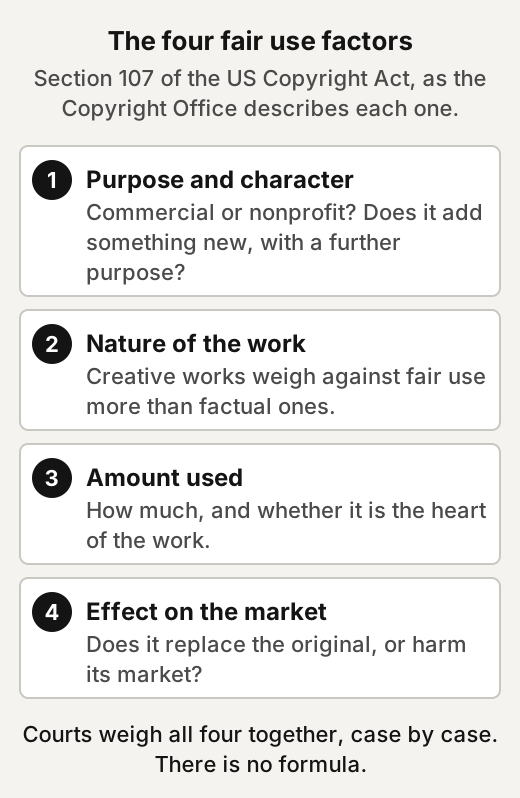
Courts weigh four factors together, and the Copyright Office says no amount or percentage is automatically safe.
| Factor in section 107 | What the Copyright Office says courts look at |
|---|---|
| 1. The purpose and character of the use, including whether it is commercial or for nonprofit educational purposes | Courts are more likely to find nonprofit educational and noncommercial uses fair, but not all of them are. Transformative uses are more likely to be considered fair. |
| 2. The nature of the copyrighted work | Using a creative work, such as a movie or song, is less likely to support fair use than using a factual one. Using an unpublished work is less likely to be considered fair. |
| 3. The amount and substantiality of the portion used | Courts look at both how much was used and how important it was. In some cases, even a small amount was found not fair because it was the “heart” of the work. |
| 4. The effect on the potential market for the work | Courts look at whether the use harms the market for the original, for example by displacing sales, or could if it became widespread. |
The Office defines transformative uses as those that “add something new, with a further purpose or different character, and do not substitute for the original use of the work”. It says some courts have found use of an entire work to be fair under certain circumstances. It says there is no formula that lets a set percentage or amount of a work be used without permission. It adds that other factors may also be considered, depending on the circumstances.
Our reading: for a clip, the factors become four questions. Why are you using this clip? What kind of work is it? How much of it, and which part? Could your video take the place of the original for a viewer?
For example, a short news clip shown to point out an error, and a film’s best scene reposted whole, give very different answers.
3. What a few court cases show
In the Copyright Office’s index, similar-looking uses went both ways; the facts decided each one.
The Office’s Fair Use Index summarises court decisions on fair use, and the Office says it “does not include all judicial opinions on fair use”. It says the index “is not a substitute for legal advice”. Below are six cases as the Office’s own summaries describe them. Each is one decision on its own facts.
| Case, as the index cites it | What was used | Outcome in the index |
|---|---|---|
| Campbell v. Acuff-Rose Music, Inc. (Supreme Court, 1994) | A commercial parody of a song | The Court reversed a ruling that the parody’s commercial nature made it presumptively unfair, and sent the case back |
| Hosseinzadeh v. Klein (S.D.N.Y. 2017) | About three minutes of a five-minute skit, in a fourteen-minute reaction video | Fair use found |
| DraftExpress, Inc. v. Whistle Sports, Inc. (C.D. Cal. 2022) | A two-second clip of an interview, at the start of a highlight reel | Fair use found |
| Sony Music Entm’t v. Vital Pharms., Inc. (S.D. Fla. 2022) | Clips of songs, about fifteen seconds on average, in videos promoting a product | Fair use not found |
| Andy Warhol Found. for the Visual Arts, Inc. v. Goldsmith (Supreme Court, 2023) | An image made from a photograph, licensed in 2016 for a magazine cover; magazines had licensed the photo itself to illustrate articles about the same subject | Fair use not found |
| Gwinn v. City of Chicago (N.D. Ill. 2025) | Ninety-seven seconds of a 102-second video, in a non-commercial use at a press conference, with commentary | Fair use not found |
In the reaction-video case, the court called the video “quintessential criticism and comment” and found it “does not serve as a market substitute” for the skit. In the two-second case, the clip was 1% of the interview and did not include its “heart”, the court found. In the song-clip case, the court observed that even a small degree of taking can weigh against fair use if it involves an essential part of the work.
In the press-conference case, the court rejected the argument that added graphics, other footage and commentary transformed the video; it said adding factual commentary, as opposed to political commentary, only served the same informative purpose. It weighed all four factors and called the first one “determinative” in that case. In the 2023 case, the Supreme Court said new expression “is not, without more, dispositive” of the first factor. It also said criticism and commentary need to “conjure up” the original. In the 1994 case, the Court held that the commercial or nonprofit educational purpose of a work is only one element of its purpose and character.
Our reading of these summaries, not a rule: the uses found fair commented on the very work they used, and did not take its place. The uses found not fair served the same purpose as the original, or used it to sell something.
4. Eight beliefs about clips, checked
Most of these beliefs turn one factor into a rule; the official pages say the factors are weighed together.
Crediting the creator makes it fair use
Doesn't hold up Name the creator and the clip is fair use. Credit is good practice, but YouTube says it does not by itself make a copy fair use. YouTube’s fair use page says giving credit “won’t by itself turn a non-transformative copy of their material into fair use”. It says phrases like “I do not own” don’t mean you have the copyright owner’s permission either. YouTube notes that credit does matter when a licence asks for it, such as Creative Commons Attribution (CC BY). Credit is not one of the four factors in section 107. In the UK, criticism, review and quotation generally need a sufficient acknowledgement, and the use must also be fair dealing.
How sure: Strong YouTube says so directly, and credit is not one of the four factors in the law.
Under a few seconds is always fine
Doesn't hold up A clip under a set number of seconds can’t cause a copyright problem. No length is automatically safe, and the Copyright Office says there is no formula. The Copyright Office’s FAQ says there are no legal rules permitting the use of a specific number of words, a certain number of musical notes, or percentage of a work. YouTube says using any amount without permission, “even if it’s just a few seconds”, may result in copyright issues. In the song-clip case, clips averaging about fifteen seconds were found not fair. In the interview case, a two-second clip was found fair. Our reading: length mattered in both, alongside the other three factors.
How sure: Strong the Copyright Office and YouTube both say no amount is automatically safe.
Adding commentary always makes it fair use
Doesn't hold up Talk over a clip and it becomes fair use. Commentary on the clip itself can help, but YouTube says adding something does not make a use fair automatically. YouTube says that even if you’ve added something to someone else’s content, “it still may not be considered fair use”. YouTube also says that if your creation doesn’t add new expression, meaning or message to the original, it probably isn’t fair use. The reaction-video case was found fair. The press-conference case, which added factual commentary, was not.
How sure: Strong YouTube says so, and the index has commentary cases decided both ways.
Non-commercial means fair use
Doesn't hold up If you don’t earn from a clip, it is fair use. Non-commercial use helps on the first factor, but the Copyright Office says it is not automatically fair. The Office says courts are more likely to find noncommercial uses fair, but not every noncommercial use is fair, and not every commercial use is unfair. YouTube says “non-profit” uses are favoured, “but it’s not an automatic defense by itself”. The press-conference use was non-commercial and was found not fair. The 1994 parody was commercial, and the Supreme Court said that alone did not decide it.
The first factor asks whether a use is of a commercial nature, and a clip posted for pay raises that question. The Copyright Office says courts balance the purpose and character of a use against the other factors.
How sure: Strong the Copyright Office and YouTube both say non-commercial use is not automatically fair.
“No copyright infringement intended” protects you
Doesn't hold up A disclaimer in the description protects the upload. YouTube says there are no magic words. YouTube says including the phrase “no infringement intended” “won’t automatically protect you from a claim of copyright infringement”. Its copyright myths page says phrases such as “all rights go to the author” don’t mean you have the rights to use the content.
How sure: Strong YouTube’s own copyright pages say so.
A platform or tool can’t decide whether a use is fair
Holds up No platform, tool or label can give a final answer. YouTube says its systems can’t decide fair use; the Copyright Office points to the courts. The Copyright Office’s FAQ says that ultimately, only a federal court can determine whether a particular use is a fair use. YouTube says automated systems like Content ID can’t decide fair use because it is “a subjective, case-by-case decision that only courts can make”. The Copyright Office’s Copyright Claims Board, a voluntary small-claims body, can also rule on defences raised in the cases brought to it. Our reading: a clip with no claim against it has not been ruled fair. It simply has not been challenged.
How sure: Strong YouTube says so in its own words, and the Office’s FAQ points to the courts.
A takedown notice means you are being sued
Doesn't hold up A copyright takedown is a lawsuit. The Copyright Office says a takedown notice does not mean you are being sued. The Office’s section 512 page answers: “No, a takedown notice does not mean you are being sued”. It says that if you are being sued, you will be served with court papers.
How sure: Strong the Copyright Office says so directly.
Fair use works the same everywhere
Doesn't hold up Fair use is a worldwide rule. Fair use as described here is US law; other countries have their own exceptions, which can work differently. YouTube says rules about copyright exceptions are often similar around the world, but “they can differ”. It names the EU’s specific categories and countries with fair dealing. Section 6 below describes the UK’s.
How sure: Strong YouTube and the UK’s Intellectual Property Office both describe different rules.
5. When a clip is taken down: notices, counter-notices and strikes
A US takedown follows set steps, and a counter-notice is a sworn statement for a mistake or misidentification.
The Digital Millennium Copyright Act, passed in 1998, created the notice-and-takedown system. A takedown notice must include a statement that the sender has a good faith belief the use is not authorized “by the copyright owner, its agent, or the law”.
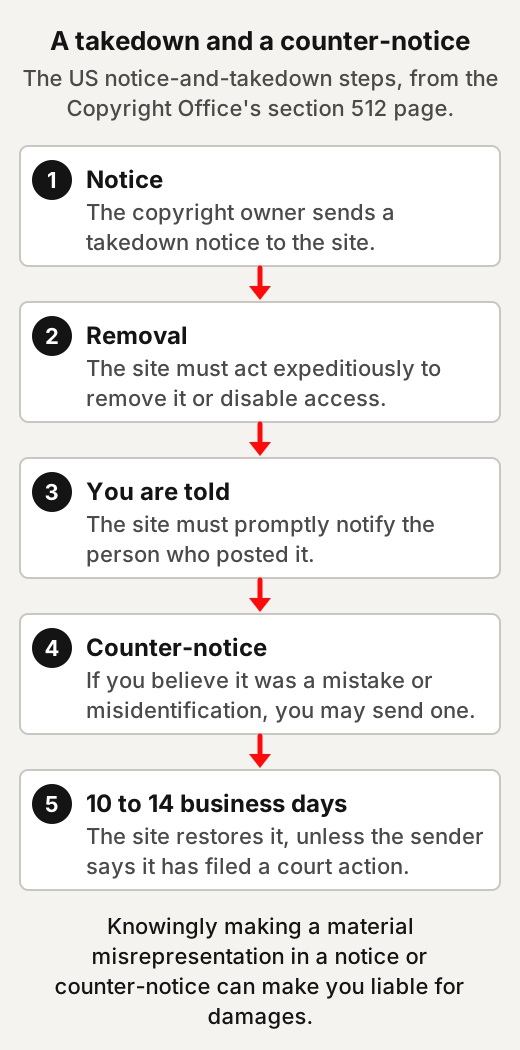
Once a site gets a compliant notice, it must act expeditiously to remove or disable access to the material, then promptly notify the user who uploaded it. A counter-notice is for when the user believes the material was removed “as a result of mistake or misidentification”. The Office’s examples include having a valid license to use the work, or material that does not include the work claimed. A counter-notice must include the user’s name, address and telephone number, and consent to the jurisdiction of a federal district court. The site must then restore access after 10 to 14 business days, unless the sender says it has filed a court action. The Office also notes that a site is never obligated to comply with a takedown notice; those that do gain limits on their liability. Knowingly making a material misrepresentation in a notice or a counter-notice can make the person liable for damages, costs and attorneys’ fees.
In plain words, a counter-notice is a sworn legal statement. It shares your name and address with the person who complained, and that person can respond by going to court.
On YouTube, the same steps have their own pages.
- YouTube says to submit a counter notification only for content removed by mistake, including misidentifications of content that may qualify for an exception such as fair use.
- It says it is legally required to share the counter notification with the claimant. If disclosing personal information is a concern, it says an authorized representative, such as an attorney, can submit it.
- It says the claimant has 10 US business days to respond with evidence of legal action, or the content is reinstated.
- A copyright strike means content was removed after a legal copyright removal request, and channels with 3 strikes in 90 days are subject to termination.
- Strikes expire in 90 days if you complete Copyright School and the channel has fewer than 3.
- YouTube says copyright claims are different from copyright strikes. It says a Content ID claim will keep you from monetizing a video “even if you only use a few seconds”.
- YouTube says you can defend a fair use position through the Content ID dispute process, and that this decision “shouldn’t be taken lightly”.
In plain words, a Content ID claim can stop a clip earning, while copyright strikes can put a whole channel at risk.
The Copyright Office’s Copyright Claims Board is a voluntary alternative to federal court for copyright disputes up to $30,000 in total. Its eligible claims include misrepresentations in notices or counter-notices under section 512.
For example, a podcast clip removed over a song you hold a licence for fits the Office’s first example.
6. Outside the US: fair dealing and other rules
Other countries have their own exceptions; several UK ones cover named purposes, only when the use is fair dealing.
YouTube says that in the EU, a use must fit specific categories, “such as quotation, criticism, review, caricature, parody, and pastiche”. It says other countries have a concept called fair dealing “that may work differently”. It says it considers local rules when it reviews copyright removal requests.
The UK’s Intellectual Property Office describes UK fair dealing like this.
- Fair dealing for criticism, review or quotation is allowed for any type of copyright work, with a sufficient acknowledgement unless that is impossible for reasons of practicality.
- Fair dealing for reporting current events is allowed for any type of work other than a photograph.
- The parody, caricature and pastiche exception applies only to the extent that the use is fair dealing.
- There is no statutory definition of fair dealing, and the IPO calls it “a matter of fact, degree and impression in each case”.
- It says the question is how a fair-minded and honest person would have dealt with the work.
- The IPO says factors courts have found relevant include whether the use affects the market for the original, and whether the amount taken was reasonable and appropriate.
In plain words, the IPO’s page lists specific purposes, and fairness is then judged within them. Section 107 names example purposes and four factors instead.
We describe these two systems only. We have not checked other countries’ rules, and we do not say how any rule applies to a particular clip.
7. Where fair use sits next to platform rules and paid campaigns
Fair use is one question; a platform’s rules and a campaign’s licence are separate ones.
YouTube says its reused-content rule is separate from its copyright enforcement and is “not based on copyright, permission, or fair use”. So a clip can pass one test and fail the other. Our page on which clips earn and which get cut covers those platform rules.
In a paid campaign, the platform’s terms also apply. In Content Rewards’ terms, where the brand provides footage, its licence to you is “limited, revocable, non-exclusive” and only for making that campaign’s clip. The same terms make clippers warrant that a clip “does not infringe anyone’s rights” and that they have cleared any third-party content it uses, including music. Our page on Whop Content Rewards covers what those terms give the brand in return. For how clip payouts work, see how clipping pays.
Asked how to get permission to use someone’s work, the US Copyright Office answers: “You can ask for it.” It adds that in cases of doubt, it recommends that permission be obtained.
Fair use is also argued in the lawsuits over AI music generators. Our AI music lawsuits page follows those cases. Labels for paid clips are another separate rule, covered on our page about labelling a paid clip.
Quick answers
Is using a few seconds of a video fair use?
Not automatically. The Copyright Office says there is no formula that lets a set amount be used without permission, and YouTube says using any amount, even a few seconds, may result in copyright issues.
Does giving credit make it fair use?
Not by itself. YouTube says giving credit won't by itself turn a non-transformative copy into fair use, and phrases like "I do not own" don't mean you have permission.
Does a takedown notice mean I am being sued?
No. The Copyright Office says a takedown notice does not mean you are being sued, and that if you are being sued, you will be served with court papers.
Is fair use the same in the UK?
No. The UK uses fair dealing, which the Intellectual Property Office describes for named purposes such as criticism, review or quotation, generally with a sufficient acknowledgement. It calls fair dealing a matter of fact, degree and impression in each case.
Use this
Before you post someone else's footage, ask the four questions the factors raise.
What does my video add, and could it take the place of the original for a viewer?
Quick quiz
Nothing is scored or saved. Recalling it once now is what makes it last.
1. According to the Copyright Office, who can ultimately determine whether a use is a fair use?
Answer: A federal court.Read it again ↑
2. What does YouTube say about giving credit to the copyright owner?
Answer: It won't by itself turn a non-transformative copy into fair use.Read it again ↑
3. After a valid counter-notice, how long until a site must restore access, unless the sender files a court action?
Answer: 10 to 14 business days.Read it again ↑
How we checked this · Last checked October 2026
- We read the official pages on 27 October 2026: section 107 and section 512 of the US Copyright Act, the Copyright Office's Fair Use Index, FAQ, section 512 and DMCA pages, YouTube's copyright help pages, and the UK Intellectual Property Office's exceptions page.
- The six court cases are described as the Copyright Office's own index summaries describe them. We did not read the full court opinions, and the index does not include every fair use decision.
- We describe what these sources say. We do not say whether any particular clip is fair use, and we have not checked countries other than the US and the UK.
- Our wording on asking for permission matches our page on AI side hustles; our YouTube reused-content wording matches our page on which clips earn and which get cut.
Sources
- U.S. Code, Title 17, section 107, “Limitations on exclusive rights: Fair use”, as published by the U.S. Copyright Office: copyright.gov/title17Primary
- U.S. Code, Title 17, section 512, as published by the U.S. Copyright Office: copyright.gov/title17Primary
- U.S. Copyright Office, “U.S. Copyright Office Fair Use Index” (index last updated July 2026): copyright.gov/fair-usePrimary
- U.S. Copyright Office, “Can I Use Someone Else’s Work? Can Someone Else Use Mine?” (FAQ): copyright.gov/help/faqPrimary
- U.S. Copyright Office, “Section 512 of Title 17: Resources on Online Service Provider Safe Harbors and Notice-and-Takedown System”: copyright.gov/512Primary
- U.S. Copyright Office, “The Digital Millennium Copyright Act”: copyright.gov/dmcaPrimary
- U.S. Copyright Office, Fair Use Index case summaries: Campbell v. Acuff-Rose Music, Inc. (1994); Hosseinzadeh v. Klein (2017); DraftExpress, Inc. v. Whistle Sports, Inc. (2022); Sony Music Entm’t v. Vital Pharms., Inc. (2022); Andy Warhol Found. for the Visual Arts, Inc. v. Goldsmith (2023); Gwinn v. City of Chicago (2025)Primary
- YouTube Help, “Fair use on YouTube” (read 27 October 2026): support.google.com/youtube/answer/9783148Primary
- YouTube Help, “Common copyright myths” (read 27 October 2026): support.google.com/youtube/answer/2797449Primary
- YouTube Help, “Submit a copyright counter notification” (read 27 October 2026): support.google.com/youtube/answer/2807684Primary
- YouTube Help, “Understand copyright strikes” (read 27 October 2026): support.google.com/youtube/answer/2814000Primary
- YouTube Help, “YouTube channel monetization policies” (read 27 October 2026): support.google.com/youtube/answer/1311392Primary
- UK Intellectual Property Office, “Exceptions to copyright” (last updated 4 January 2021): gov.ukPrimary
- Content Rewards, Creator Terms (read 27 October 2026): contentrewards.com/termsPrimary
Treat fair use as a question, not a label
The Copyright Office says that, in the end, only a federal court can determine whether a use is fair. It says it cannot give individual legal advice, and that it is best to consult an attorney if unsure. Our view: think each clip through before you post, and write your reasons down.
Keep a record for every clip you use
- Where it came from. Our suggestion: note the work, its owner, and the link or file you took the clip from.
- Why you used it. Write one line on what your video does with the clip. The first factor in section 107 is the purpose and character of the use.
- How much, and which part. Note the length and what part of the work it is. The Copyright Office says courts look at both how much was used and how important it was.
- Any permission or licence. Our suggestion: save a dated copy of any permission or licence beside the clip's file.
- A record, not a ruling. Our view: these notes help you think and remember. The Copyright Office says no amount or percentage is automatically safe.
This week: read three case summaries
Our suggestion: open the Copyright Office's Fair Use Index and pick three summaries close to how you use clips. For each, note what was used and how the court weighed it. The Office says the index does not include all judicial opinions and is not a substitute for legal advice. Our view: each one shows how a court weighed its own facts, not how yours would turn out.
If a clip is taken down
- Read the notice calmly. The Copyright Office says a takedown notice does not mean you are being sued. If you are being sued, it says, you will be served with court papers.
- Know what a counter-notice is for. The Office says it is for material removed "as a result of mistake or misidentification". YouTube says to submit one only for content removed by mistake. Its examples include misidentified content that may qualify for an exception such as fair use.
- Know what it shares. The Office says a counter-notice includes your name, address and telephone number. YouTube says it is legally required to share it with the claimant.
- Know what it commits you to. The Office says it also includes consent to the jurisdiction of a federal district court. Knowingly making a material misrepresentation can make the person liable for damages, costs and attorneys' fees, it says.
- Ask before you file. The Office says it is best to consult an attorney if you are unsure whether a use is fair. If sharing personal details is a concern, YouTube says an authorized representative, such as an attorney, can submit it.
- Keep the dates. Our suggestion: note what you received and each date. YouTube says copyright claims are different from copyright strikes.
Goes with: 5. When a clip is taken down: notices, counter-notices and strikes ↑
If you post from outside the US
- Know which law this page covers. Fair use as described here is US law. The UK section follows the Intellectual Property Office's guidance on fair dealing.
- Read your own country's official guidance. YouTube says copyright exceptions can differ between countries, and that it considers local rules when reviewing removal requests. We have not checked other countries' rules.
- Ask someone local. Our suggestion: for your own situation, a lawyer where you live can tell you what applies.
Goes with: 6. Outside the US: fair dealing and other rules ↑
When you want to use someone's work
- Start with the Office's answer. Asked how to get permission, the US Copyright Office answers: "You can ask for it." In cases of doubt, it recommends getting permission.
- Say exactly what you'll use. Our suggestion: name the clip, the length, where it will appear, and whether the post is paid.
- Keep the reply. Our suggestion: save the answer in writing, with the date, in your clip record.
- Follow a licence's credit terms. YouTube notes credit matters when a licence asks for it, such as Creative Commons Attribution. It says credit alone won't turn a non-transformative copy into fair use.
- Read campaign footage terms. In Content Rewards' terms, a brand's licence for its footage is "limited, revocable, non-exclusive". It covers only making that campaign's clip.
- YouTube's pay rule is a separate test. YouTube says its reused-content rule is "not based on copyright, permission, or fair use".
Goes with: 7. Where fair use sits next to platform rules and paid campaigns ↑
Keep going
- Which clips earn and which get cutWhat five platforms say about reused clips, and what makes a clip count as your own.
- How clipping paysHow per-view clipping campaigns pay, where a clip's pay can stop, and the other ways clippers get paid.
- Whop Content Rewards explainedWho sets the pay on Content Rewards, what it keeps, when money arrives, and what its terms say.
- AI music lawsuitsWho sued Suno and Udio, who settled, and which cases are still open.
- GlossaryThe plain meaning of fair use, fair dealing, takedown notice, counter-notice and Content ID.
Goes with: 7. Where fair use sits next to platform rules and paid campaigns ↑