Start hereThe FTC calls "sponsored" a clear label, and the UK's advertising regulator advises against it. So which words, and which place on screen, work for a paid clip?
A paid clip needs a label viewers can’t miss: in the video itself, at the start, in plain words such as “Ad”. The US Federal Trade Commission (FTC) and the UK’s advertising regulators ask for much the same thing, and each platform adds a switch of its own. Below: when a clip needs a label, what each body and platform says, and a short plan you can use on every clip.
1. When a clip needs a label
Paid in money or kind to post a clip? Every guide we read treats it as needing a label.
The FTC’s guide for influencers says a “material connection” to a brand includes a financial relationship, such as the brand paying you or giving you free or discounted products. It adds that financial relationships aren’t limited to money. The UK guide from the ASA and CAP says any incentive, even if it’s not money, counts as payment. The CMA’s guidance for content creators applies “no matter how many followers you have”.
The FTC calls this kind of tie a material connection. In plain words, under the CMA’s guidance a small account paid per 1,000 views is in the same position as a large one. The label tells viewers that someone paid for what they are watching.
Clip campaigns say the same in their own rules. Content Rewards’ compliance guide says all content made for one of its campaigns “constitutes a Material Connection requiring disclosure”. Vyro’s content requirements say you must make your connection to a client clear when you discuss or engage with that client’s campaign. Our page on how clipping pays explains how those campaigns work.
There is one gap. We did not find an FTC page that deals with a clip of a creator’s own stream, paid for by that creator. Our reading: the campaigns we read ask for a label anyway, so the gap rarely changes what you do.
The FTC says US law applies to posts from abroad if it’s reasonably foreseeable they will affect US consumers. It adds that foreign laws might also apply. So a clip can fall under more than one country’s rules at once.
2. What the FTC says about video
For video, the FTC’s pages put the label in the clip, near the start, ideally spoken and on screen.
The FTC’s guidance on endorsements is called the Endorsement Guides. Its FAQ says they were revised in 2023, including a new definition of “clearly and conspicuously”. In the Guides, that means a disclosure is difficult to miss and easily understandable by ordinary consumers. On social media, the Guides say, the disclosure should be unavoidable.
Here is where the FTC’s pages put the label in a video.
- In the video. The FTC’s guide for influencers says a video endorsement’s disclosure “should be in the video and not just in the description”. Its FAQ says a disclosure in a YouTube description is “not enough on its own”. It calls one in a TikTok text description “very unlikely to be clear and conspicuous”.
- Said and shown. The Guides say that when a message is both seen and heard, the disclosure should be in both. The influencer guide gives the reason: some viewers may watch without sound, and others may not notice words on screen.
- Near the start. The FAQ says viewers are more likely to miss a disclosure at the end of a video, and that one at the beginning would be better. When the paid part sits in the middle of a longer video, it says the best place is right before or at the start of that part.
- Not behind “more”. One example in the Guides is a disclosure seen only after clicking a link labelled “more”. The Guides say it is not unavoidable, so not clear and conspicuous.
The wording can be short. The influencer guide calls “ad”, “advertisement” and “sponsored” clear, and “sp”, “spon” and “collab” vague. The FAQ says the FTC doesn’t mandate specific wording, and that “Sponsored by XYZ” is clearer than “Sponsored” alone. Its simplest examples include “This video is paid for by BRAND”. The influencer guide adds that the disclosure should be in the same language as the endorsement. In short, a clear and conspicuous label is one a viewer who only skims will still see and understand.
For example, a 40-second clip paid for by a podcast could open with “Ad: paid for by [podcast name]” in large text. You would say the same words at the same time.
What you say in the clip matters too. The influencer guide says that if you’re paid to talk about a product and thought it was terrible, you can’t say it’s terrific.
3. What the UK guidance says
The UK asks for an “Ad” label at the very beginning, and it advises against the word “sponsored”.
The ASA and CAP published the fourth edition of their influencers’ guide in October 2026, developed with the CMA. The guide says the main rules are in the Digital Markets, Competition and Consumers Act 2024 (the DMCC Act) and the CAP Code. The CAP Code is the UK’s code for non-broadcast advertising, and the ASA enforces it.
The UK places the label first. The guide says the disclosure should be at the very beginning of the advertising content, whatever people see first. Its list of things not to do includes hiding the label behind “more” and disclosing it part-way through a video. The CMA’s guidance says that in videos the disclosure must be given at the beginning of the ad.
The UK’s word lists are stricter than the FTC’s on one point: the word “sponsored”. The ASA guide recommends labels such as #Ad, #Advert and #Advertisement. It advises against “Sponsored”, “Collab”, “Gifted” and “In partnership with”. The CMA lists #sponsored, #spon and #collab among words to avoid, along with just naming the brand.
Reposts need their own label. The ASA guide says each piece must be labelled when the same ad appears as a Story, a post and a Reel. It says the same when an ad is reposted from one format to another. In practice, the same clip posted on three platforms gets three labels, and Content Rewards’ guide asks for a disclosure on every platform.
The rules have teeth. The guide says the CMA can impose financial penalties for breaches of certain consumer laws, including Part 4 of the DMCC Act. It says the ASA can list an influencer on its non-compliant page for up to three months.
4. Three common assumptions about labels
One does not hold up, and two hold only in part, depending on whose rules apply.
A label in the description is enough
Doesn't hold up A label in the description or caption alone is enough for a paid clip. For video, the FTC and the CMA want the label in the clip itself, at or near the start.
How sure: Strong the FTC’s guide and FAQ say so for video, and the CMA puts a video’s label at its start.
The FTC’s FAQ says consumers can easily miss disclosures in the video description. The CMA says your audience should not have to scroll or select a link for more information to see the label. The ASA guide accepts a label at the start of the post text when that is what people see first. Our reading: on a clip, people usually see the video first. Campaign rules such as Content Rewards’ ask for a caption label as well, as a second label.
The platform’s switch is enough on its own
Partly Turning on the platform’s paid-partnership label covers your disclosure. The UK says it may be enough if the label is upfront and prominent; the FTC says not necessarily.
How sure: Moderate the UK says a clear platform label may be enough; the FTC says it is always best to add your own.
The FTC’s FAQ answers “Not necessarily” and says it is always best to add your own disclosure. The Guides give the example of a platform tool’s label in small white text on a light picture, shown for five seconds. They call it easy to miss, so not clear and conspicuous. The ASA guide says a platform tool may be sufficient if its label is upfront and prominent. The CMA says that if the tool does not clearly show the content is an ad, you should add #Ad in a clear, upfront position.
Our reading: turning the switch on and adding your own label fits both countries’ guidance.
“Sponsored” is a clear label
Partly The word “sponsored” tells viewers a clip is paid for. The FTC lists it as clear; the UK regulators advise against it.
How sure: Strong each regulator states its view plainly; they differ because they apply different rules.
The ASA guide says it has ruled that “Sponsored” labels are not enough because they don’t clearly show the advertiser has editorial control. The FTC’s guide, quoted above, counts “sponsored” as clear. Its FAQ is more cautious: “Sponsored” at the start of a post “might also be effective”, and “Sponsored by XYZ” would be clearer. Our reading: “Ad” is on both lists, so it suits a clip seen in both countries.
5. Each platform’s switch, step by step
Every platform here has a label setting, and each one says the duty to disclose still sits with you.
At a glance: where each platform’s switch lives and what viewers see.
| Platform | Where the switch is | What viewers see |
|---|---|---|
| YouTube | The paid promotion box in the video’s details | A disclosure at the start of the video |
| TikTok | Disclose commercial content, under Content disclosure and ads | A branded content label |
| Add paid partnership label, in the app’s More options | “Paid partnership”, with the brand’s name once it approves | |
| Tag brand, in Meta Business Suite | A paid partnership label | |
| X | The Paid Partnership disclosure, in Content Disclosure settings | A Paid Partnership label |
YouTube
On YouTube, you tick the paid promotion box, and a disclosure appears at the start of the video.
YouTube says that if a video features sponsorships, endorsements or other commercial relationships, you have to let it know by selecting the paid promotion button. Its branded content policy gives the steps in YouTube Studio: open Content, choose the video, click Show More and tick the paid promotion box. It says a disclosure will then appear at the start of the video. It also says videos with branded content are removed from the YouTube Kids app.
YouTube can step in. If its systems detect branded content you have not disclosed, the policy says, YouTube may apply a label itself and notify you. It adds that you are “ultimately responsible” for making your disclosure clear and prominent. In plain words, ticking the box gives the video a label, but YouTube still leaves the duty to disclose with you.
TikTok
On TikTok, you turn on Disclose commercial content before posting and choose Branded content.
TikTok says that when a post promotes a brand, product or service, you must turn on its commercial content disclosure setting. Its how-to page says to open Content disclosure and ads on the post screen, turn on Disclose commercial content, and choose Your brand or Branded content. TikTok’s how-to page says such posts must also follow all applicable laws and regulations. TikTok’s Branded Content Policy says that when you mark a post as made on behalf of a third party, it is labelled as branded content automatically. The policy also asks you to name the product or service out loud or in the caption, so viewers don’t need your profile or a link. In plain words, the label says a post is paid for; your words say what it promotes.
TikTok says undisclosed commercial content may not be eligible for the For You feed. Our page on which clips earn and which get cut covers TikTok’s other rules for clips.
Instagram and Facebook
On Instagram and Facebook, you add the Paid partnership label and tag the brand, which must agree.
Meta says branded content is an organic post you make with a “Paid partnership” label that discloses a brand relationship. Its Branded Content Policies say creators must use the branded content tool to tag the business partner, with the partner’s prior permission. The same policies say you must also comply with all applicable laws, including by giving all necessary disclosures. Instagram’s help centre says the label is only available in the Instagram app. For a reel, it says to tap More options, then Add paid partnership label, turn the toggle on and add the brand. Until the brand approves, it says, the label shows without the brand’s name. On Facebook, Meta’s help page says to choose Tag brand under More features when you create a post in Meta Business Suite.
One line in Meta’s policy is worth reading before a paid clip. Meta’s Branded Content Policies say creators “cannot accept anything of value to post content that does not feature themselves or that they were not involved in creating”. We did not find a Meta page that says how this applies to clip campaigns. Our reading: you can ask the campaign how it handles this before you take on a paid clip for Instagram or Facebook.
X
On X, you turn on the Paid Partnership disclosure when you create the post.
X’s Paid Partnerships Policy says an organic post that is part of a paid partnership must have the “Paid Partnership” disclosure on. It says the setting is in the Content Disclosure settings when you create the post. It says the post is then labelled automatically. It says you are responsible for following advertising laws and, where they apply, the FTC’s Endorsement Guides. It lists categories that can’t be promoted this way, including health and wellness supplements, and weight loss products. In the UK, the EU and Australia, it adds financial products and gambling. It adds that X may consider exceptions on request, case by case. In plain words, a label alone does not make every product eligible for a paid partnership on X.
6. What clip campaigns add
Campaign rules can ask for more than the platform does, and a missing label can cost the payment.
Content Rewards’ terms make you “solely responsible” for following FTC endorsement rules, with a clear disclosure at the start of the video. Content Rewards’ own guide says a spoken disclosure must come “within the first 10 seconds”. For YouTube, the guide also asks for a written disclosure in the description and the paid promotion box. The terms say Content Rewards does not pre-approve clips for FTC compliance, and that a non-compliant clip may be rejected and lose its payment. They add that political clips are not allowed on TikTok or X.
Its guide adds that content may go public before any review takes place. In plain words, the campaign does not check your label before the clip goes live.
Our page on Whop Content Rewards covers the rest of those terms. Our page on fair use covers permission to use the footage; a label is about disclosure, not permission.
Before you take a campaign, our page on clipping scams lists the signs official guides give for a fake one.
7. A label plan for one clip
Put together, the pages we read point to four labels on every paid clip.
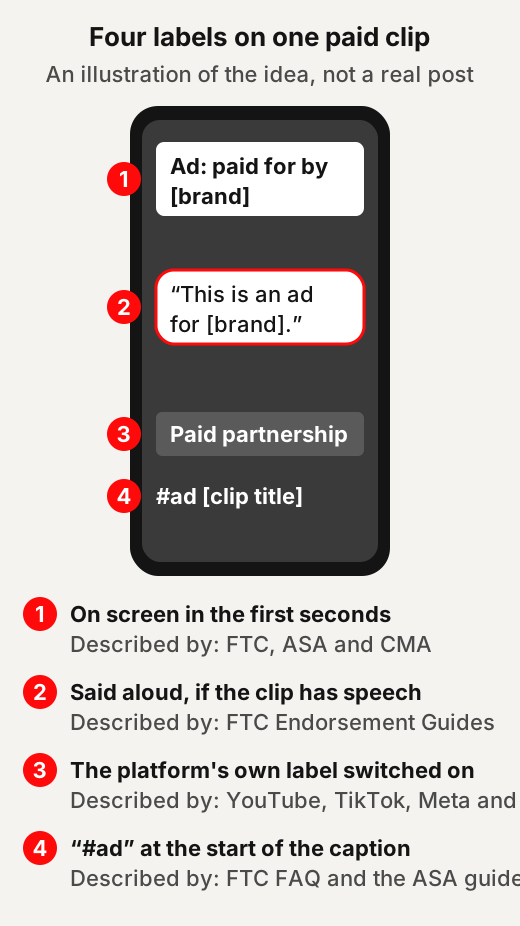
For example, take a 45-second clip from a cooking stream, paid per 1,000 views. You would open with “Ad: paid for by [stream name]” on screen and say the same words. Then you would turn on the platform’s switch and start the caption with “#ad”. If you post it again on another platform, it gets the same labels there.
The steps below set out the same plan, each with the body that describes it.
Quick answers
Do I need to label a clip if I'm only paid per view?
The guidance and campaign terms we read treat it as needing a label. The FTC says to disclose if you got anything of value to mention a product, the UK guide says any incentive counts as payment, and Content Rewards' guide says all content made for its campaigns requires disclosure.
Is "#ad" in the YouTube description enough?
Not on its own, the FTC's FAQ says, because viewers can easily miss disclosures in the video description. It says a disclosure has the best chance of working if it is in the video itself.
Is TikTok's paid partnership toggle enough?
The FTC says a platform's tool is not necessarily enough and that it is best to add your own disclosure. TikTok also says undisclosed commercial content may not be eligible for the For You feed.
Can I use "#sponsored"?
In the US, the FTC lists "sponsored" as clear. In the UK, the ASA advises against it and the CMA lists #sponsored among words to avoid, so "Ad" or "Advertisement", on both countries' lists, suits a clip seen in both.
Do the FTC's rules apply if I post from outside the US?
They can. The FTC says US law applies to posts from abroad if it's reasonably foreseeable they will affect US consumers, and that foreign laws might also apply.
Use this
Before you post a paid clip, check it carries a label a viewer cannot miss.
Would a viewer who saw only the first few seconds know this clip is paid for?
Quick quiz
Nothing is scored or saved. Recalling it once now is what makes it last.
1. Where does the FTC say a video's disclosure should go?
Answer: In the video, not just the description.Read it again ↑
2. Which label does the UK's ASA advise against?
Answer: Sponsored.Read it again ↑
3. What does the FTC's FAQ say about relying only on a platform's built-in disclosure tool?
Answer: Not necessarily; add your own disclosure.Read it again ↑
How we checked this · Last checked October 2026
- We read each body's and platform's own pages on 27 October 2026: the FTC's influencer guide, its Endorsement Guides FAQ and the Guides themselves; the UK guide from the ASA and CAP and the CMA's guidance; and the help and policy pages of YouTube, TikTok, Meta, Instagram and X.
- The UK guide we quote is its fourth edition, published in October 2026.
- We did not find an FTC page on a clip of a creator's own stream paid for by that creator, or a Meta page on how its branded content rules apply to clip campaigns.
- This page describes what the guidance and platforms say. It is not legal advice, and platform settings change often.
- Our FTC wording matches our pages on AI side hustles and on Whop Content Rewards.
Sources
- US Federal Trade Commission, “Disclosures 101 for Social Media Influencers” (November 2019, read 27 October 2026).Primary
- US Federal Trade Commission, “FTC’s Endorsement Guides: What People Are Asking” (June 2023, read 27 October 2026).Primary
- Guides Concerning the Use of Endorsements and Testimonials in Advertising, 16 CFR Part 255 (revised 26 July 2023, 88 FR 48102).Primary
- ASA and CAP, with the CMA, “Influencers’ guide to making clear that ads are ads” (fourth edition, October 2026; PDF).Primary
- Competition and Markets Authority, “Social media endorsements: guidance for content creators” (updated 3 September 2025).Primary
- YouTube Help, “Add branded content restrictions & disclosure labels” and “YouTube Branded Content Policies” (read 27 October 2026).Primary
- TikTok, “About the Commercial Content Disclosure setting for creators” (April 2026), “How to turn on the Commercial Content Disclosure setting in TikTok” (January 2026) and “Branded Content Policy” (published 4 August 2026, in effect from 31 August 2026).Primary
- Meta, “Branded Content Policies”, “How to add a branded content tag” and Facebook for Creators, “Earn from brands” (read 27 October 2026).Primary
- Instagram Help Center, “How to use the paid partnership label to tag organic branded content on Instagram” (read 27 October 2026).Primary
- X Help Center, “Paid Partnerships Policy” (read 27 October 2026).Primary
- Content Rewards, “Creator Terms” (4 October 2026) and “FTC Compliance & Transparency Guide” (12 February 2025).Primary
- Vyro, “Clipper Content Requirements” (read 27 October 2026).Primary
Plan the label before you cut the clip
The US FTC says financial relationships with a brand aren't limited to money. The UK's CMA says its guidance applies "no matter how many followers you have". Our view: if a campaign pays you per view, decide the label first, then edit around it.
One label for a clip seen in both countries
- Pick words on both lists. The US FTC calls "ad" and "advertisement" clear. The UK's ASA recommends
- Say who paid. The US FTC's FAQ says it doesn't mandate specific wording. Its simplest examples include "This video is paid for by BRAND".
- Put it first. The UK's ASA guide puts the label at the very beginning, whatever people see first. The US FTC's FAQ says one at the beginning would be better than at the end.
- Say it and show it. The US FTC's Guides say that when a message is both seen and heard, the disclosure should be in both.
- Match the language. The US FTC's influencer guide says the disclosure should be in the same language as the endorsement.
- Keep the words honest. Paid to talk about a product you thought was terrible? The US FTC's guide says you can't say it's terrific.
Which switch to turn on, platform by platform
- YouTube. YouTube's branded content policy gives the steps in YouTube Studio. It says to open Content, choose the video, click Show More and tick the paid promotion box.
- TikTok. TikTok's how-to page says to turn on Disclose commercial content under Content disclosure and ads. Then, it says, choose Your brand or Branded content.
- Instagram. For a reel, Instagram's help centre says to tap More options, then Add paid partnership label. It says to turn the toggle on and add the brand, and that the label is only in the app.
- Facebook. Meta's help page says to choose Tag brand under More features in Meta Business Suite. Meta's policies say you need the partner's prior permission.
- X. X's policy says to turn on the Paid Partnership disclosure in Content Disclosure settings. It lists categories that can't be promoted this way. It says X may consider exceptions on request, case by case.
- Ask first for Instagram or Facebook. Meta's policies say creators cannot accept anything of value to post content without them in it. The same goes for content they were not involved in creating. We found no Meta page on clip campaigns. Our suggestion: ask the campaign how it handles this.
- Add your own label as well. The US FTC's FAQ says the switch is not necessarily enough, and it is always best to add your own. The UK's ASA says a platform label may be enough if it is upfront and prominent.
What to keep on record for each paid clip
- The campaign's rules. Our suggestion: save a dated copy of the campaign's disclosure rules when you join. Content Rewards' terms, for one, say a non-compliant clip may be rejected and lose its payment.
- The label you used. Our suggestion: note the exact words, where they sit on screen, and when you say them aloud.
- The switch. Our suggestion: keep a dated screenshot of the platform's label setting turned on.
- Every repost. Our suggestion: list each platform you post the clip on. Content Rewards' guide asks for a disclosure on every platform. The UK's ASA guide asks for a label each time an ad is reposted in another format.
- Who checks it. Content Rewards' terms say it does not pre-approve clips for FTC compliance. Its guide says content may go public before any review takes place.
- A record, not a ruling. Our view: these notes help you remember what you did. They do not decide whether a label meets anyone's rules.
This week: check one paid clip you have posted
Our suggestion: pick one paid clip you have already posted. Watch only its first few seconds, first with the sound off, then on. The US FTC notes some viewers may watch without sound. Check it for the four labels in this section's picture, and note any that are missing. Our view: a gap is worth fixing where you can, and planning for in your next clip.
Keep going
- How clipping paysHow per-view clipping campaigns pay, where a clip's pay can stop, and the other ways clippers get paid.
- Whop Content Rewards explainedWho sets the pay on Content Rewards, what it keeps, when money arrives, and what its terms say.
- Clipping marketplaces comparedContent Rewards and Vyro side by side, not ranked, from their own terms and help pages.
- Which clips earn and which get cutWhat five platforms say about reused clips, and what makes a clip count as your own.
- Fair use, describedWhat US law, the Copyright Office and YouTube say about using other people's clips.
- Clipping scamsThe scam patterns official consumer guides describe, applied to clipping, with the signs to watch.
- Free tools for cutting clipsSeven free tools for cutting clips, how to start with each, and what their terms say about your footage.
- GlossaryThe plain meaning of material connection, endorsement, branded content and clear and conspicuous.