

Different problems call for different kinds of thinking. This guide shares nine of them, grouped by the job each one does, with an everyday example and one small thing to try.
Some of these have a long research history, like divergent thinking and reflective thought. Others are everyday labels for a way of working. Where a source exists, we say what it says. Where none does, we simply describe the idea.
For the skills underneath all nine, such as metacognition and curiosity, see our guide to 7 thinking skills. For named tools like inversion and second-order thinking, see Mental Models, Checked.
1. Opening up: when you need more options
These two modes belong early, before you know the answer. They make more possibilities instead of judging them. Our suggestion: hold back the judging for a few minutes; the judging modes come later.
Expansive (divergent) thinking
Divergent thinking produces many different ideas, especially ones off the usual path.
The APA Dictionary of Psychology describes divergent thinking as solving a problem or reaching a decision with strategies that deviate from commonly used or previously taught ones. It credits both this term and its opposite, convergent thinking, to Joy Paul Guilford in 1967.
Example: you need a birthday present, so you list twenty ideas before ruling any of them out.
When it helps: at the start of a project, when you feel stuck, or when the obvious answer feels wrong.
Try this: set a timer for five minutes and list every use you can think of for a paperclip. Don’t judge them. Just count.
Creative thinking
Creative thinking puts pieces you already have together in a new way.
The APA dictionary describes creative thinking as the mental processes that lead to a new invention, solution or synthesis. It adds that a creative solution may use existing elements but create a new relationship between them.
Our reading: divergent thinking makes the pile of ideas, and creative thinking is the new combination you keep.
Example: a cook turns leftover rice into fritters instead of reheating it.
When it helps: when the usual solution is too costly, too slow or simply missing.
Try this: pick two objects on your desk and write down one new product that combines them.
2. Narrowing down: when you need to judge or choose
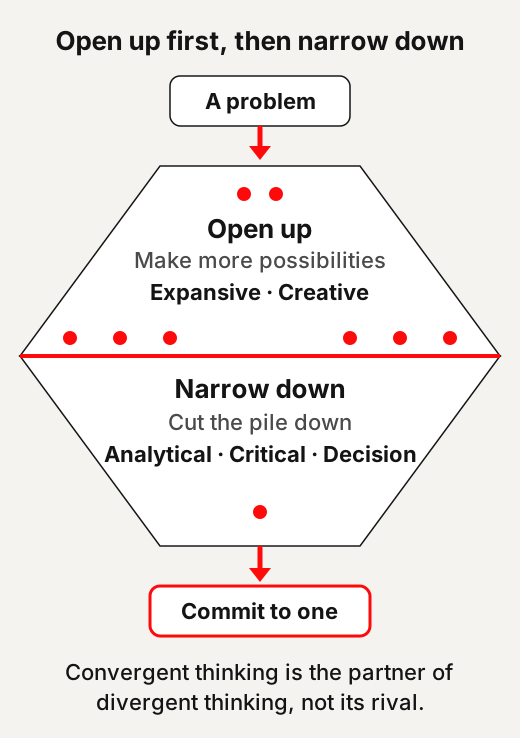
These three modes take a pile of options and cut it down. The APA dictionary describes convergent thinking as using logical steps to analyse the solutions on the table and pick the right one, or the likeliest to work. Convergent thinking is the partner of divergent thinking, not its rival.
Analytical thinking
Analytical thinking breaks something into its parts to see how they fit together.
The Cambridge Dictionary defines analytical as examining or liking to examine things in detail, in order to discover more about them. A related idea in psychology is analytical intelligence. In the triarchic theory of intelligence, the APA dictionary says, it means the skills measured by conventional intelligence tests, such as analysis, comparison, evaluation, critique and judgment.
Example: your phone bill jumped, so you split it into calls, data and extras to find the line that changed.
When it helps: when a problem feels like one big knot.
Try this: pick one monthly bill and break it into its three biggest parts.
Critical thinking
Critical thinking tests an idea for errors before you accept it.
The APA dictionary calls it directed, problem-focused thinking in which a person tests ideas or possible solutions for errors or drawbacks. The philosopher Robert Ennis puts it more briefly, in his 2011 wording: critical thinking is “reasonable and reflective thinking focused on deciding what to believe or do”.
It is the mode we lean on most across this site. Our page on critical thinking in the age of AI and Module 2 of our free course, Think critically, go into it lesson by lesson.
Example: before forwarding a shocking headline, you look for who first reported it.
When it helps: whenever a claim would change what you believe, buy or share.
Try this: next time you read a strong claim, ask: “How would I know if this were wrong?”
Decision thinking
Decision thinking weighs the options and then commits to one.
Psychologists who study goals separate the weighing stage from the doing stage. In mindset research by Peter Gollwitzer and colleagues, a deliberative mindset is described as open to information around you, while an implemental mindset filters it. One 1995 paper’s results suggest that people think more realistically when setting goals and more positively when carrying them out.
Our reading: the weighing stage is the time to look for bad news, because that is when it can still change the choice. For tools such as the pre-mortem, see Deciding Under Uncertainty. For fast and slow thinking, see our Thinking, Fast and Slow summary.
Example: choosing between two job offers, you write down what each one would make you give up.
When it helps: before any choice that is hard to undo.
Try this: before your next choice, finish this line: “I would pick the other option if…”
| Divergent (expansive) | Strategies that deviate from commonly used or previously taught ones, to produce many different ideas. |
| Convergent | Logical steps to analyse the solutions on the table and pick the right one, or the likeliest to work. |
Partners, not rivals: open up first, then narrow down.
3. Seeing the bigger picture
These two modes zoom out, from the next step to where things are heading. One looks at your own route. The other looks at how the parts of a situation push on each other.
Strategic thinking
Strategic thinking starts from where you want to end up and plans the route there.
Our reading: the same habit works for one person. Pick the destination first, then the few moves that matter most.
Example: instead of applying for every job, you pick the field you want to be in, then choose the next role that leads there.
When it helps: when you are busy but not sure you are getting anywhere.
Try this: write your goal for this year in one line, then circle the one move that would help it most.
Systems thinking
Systems thinking looks at how the parts affect each other over time, not at one part alone.
A 2015 paper by Ross Arnold and Jon Wade notes that many different definitions of systems thinking can be found in the systems community. In a 1999 essay, Donella Meadows described leverage points: places in a complex system where a small shift in one thing can produce big changes in everything. Her list of places to look includes the length of delays and the strength of negative feedback loops.
Example: you skip sleep to finish work, feel tired, work more slowly, and end up staying late again. That is a loop, not a one-off.
When it helps: when the same problem keeps coming back after you fix it.
Try this: pick one problem that keeps returning and draw it as a circle. What causes it, and what does it cause in turn?
4. Doing and learning
The last two modes act on a plan and then learn from how it went. One switches off the debate. The other switches it back on, afterwards.
Execution thinking
Execution thinking stops weighing options and focuses on getting a chosen plan done.
In the mindset research above, this is close to the implemental mindset. In the eye-tracking part of a 2014 study, people in an implemental mindset focused on foreground objects; those in a deliberative mindset looked more evenly across the scene.
Our reading: that narrow focus helps once the choice is made. It is worth pausing when new information suggests the plan itself is wrong.
Example: once you have booked the gym class, you pack the bag the night before instead of deciding again in the morning.
When it helps: when you keep reopening a decision you have already made.
Try this: write the next step on one task as a single line that starts with a verb, such as “email Sam the draft”. For if-then plans, see From Big Goal to Today.
Reflective thinking
Reflective thinking looks back at what happened, so the next attempt goes better.
In How We Think (1910), John Dewey described reflective thought as “active, persistent, and careful consideration” of a belief “in the light of the grounds that support it”. Donald Schön’s 1983 model, as a Macquarie University guide sums it up, includes reflection-in-action, which happens in the moment, and reflection-on-action, after the event.
Example: after a tense meeting, you note what you said, how it landed, and what you would change.
When it helps: after anything you will do again: a talk, a hard conversation, a project.
Try this: three short questions are enough to start. The University of Edinburgh’s reflection toolkit calls “What? So what? Now what?” one of the simplest frameworks for reflection. Ask them about one moment from today.
| Deliberative mindset | Open to information around you. One paper's results suggest people think more realistically when setting goals. |
| Implemental mindset | Filters that information. The same paper's results suggest people think more positively when carrying goals out. |
From the mindset research by Peter Gollwitzer and colleagues, as this page describes it.
| Reflection-in-action | Happens in the moment. |
| Reflection-on-action | Happens after the event. |
Donald Schön's model, as a Macquarie University guide sums it up.
How to pick the mode
Match the mode to the moment. Most tasks pass through several in turn.
| If you are… | Try | Ask yourself |
|---|---|---|
| Stuck with no ideas | Expansive | How many options can I list? |
| Holding a pile of ideas | Creative | What could I combine? |
| Facing a tangled problem | Analytical | What are the parts? |
| Hearing a strong claim | Critical | How would I know if this is wrong? |
| Choosing between options | Decision | What would make me pick the other one? |
| Planning the year | Strategic | Where do I want to end up? |
| Seeing a problem return | Systems | What keeps causing this? |
| Ready to act | Execution | What is the next step? |
| Finished something | Reflective | What would I do differently? |
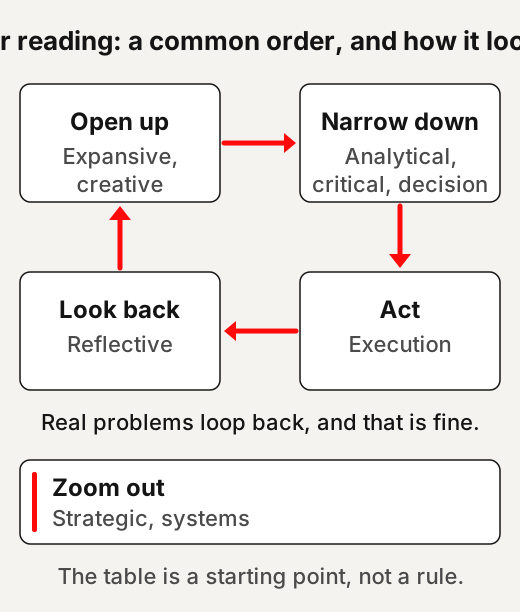
Our reading: a common order is to open up, narrow down, act, then look back. The table is a starting point, not a rule. Real problems loop back, and that is fine.
Where to learn more
- 7 Thinking Skills: the skills under all nine modes, with the research and one way to practise each.
- Mental Models, Checked: named thinking tools and where they come from.
- Think critically: Module 2 of our free course, lesson by lesson.
- Deciding Under Uncertainty: seven decision tools and their origins.
- The University of Edinburgh Reflection Toolkit: free guides to several reflection models.
- The Donella Meadows Project: her essays on systems, including the one on leverage points.
- How We Think by John Dewey: the 1910 book, free on Project Gutenberg.
- Related idea guides: areas worth learning about and goal-setting methods.
Quick answers
What is the difference between divergent and convergent thinking?
Divergent thinking looks for many ideas, using strategies away from the usual ones. Convergent thinking uses logical steps to find the right answer, or the most likely one, among the options already on the table. The APA dictionary credits both terms to Joy Paul Guilford in 1967.
Is critical thinking the same as analytical thinking?
They overlap. The Cambridge Dictionary defines analytical as examining things in detail to discover more about them. Critical thinking, in the APA dictionary's words, tests ideas or possible solutions for errors or drawbacks.
What is systems thinking?
It looks at how the parts of a situation affect each other over time. A 2015 paper notes that many different definitions exist. Donella Meadows wrote about leverage points, where a small shift can produce big changes.
What is reflective thinking?
It means looking back at an experience so the next attempt goes better. John Dewey described reflective thought in 1910 as active, persistent and careful consideration of a belief in the light of the grounds that support it.
Use this
Before you start a task, name the kind of thinking it needs.
Do I need more options, a choice, or the next step?
Quick quiz
Nothing is scored or saved. Recalling it once now is what makes it last.
1. How does the APA dictionary describe the strategies used in divergent thinking?
Answer: They deviate from commonly used or previously taught ones.Read it again ↑
2. In mindset research, which mindset is described as filtering information?
Answer: Implemental.Read it again ↑
3. Which three questions make up the simple reflection framework in the University of Edinburgh's toolkit?
Answer: What? So what? Now what?.Read it again ↑
How we checked this · Last checked November 2026
- We read the APA Dictionary of Psychology entries in a browser in November 2026, and the other definitions on their publishers' own pages.
- The two mindset studies were read as their PubMed abstracts. They are lab studies.
- We could not open Guilford's 1950 paper on creativity or Mintzberg's 1994 article on strategic thinking, so neither is cited.
- The examples and the Try this lines are our own suggestions, not research findings.