

Start hereIn 25 experiments, people told to imagine another person's view were no more accurate about that person. In a final experiment, one thing did help: getting their view in conversation.
Seven thinking skills have research behind them. They are judging how sure to be, changing course, staying clear under pressure, understanding other people, curiosity, telling real patterns from chance, and updating your views. Below: what the studies found on each, how each relates to IQ where researchers measured it, and one small way to practise it.
An IQ score captures some kinds of thinking well and others only in part. A 1996 American Psychological Association task force wrote that standardized tests do not sample all forms of intelligence. Its examples included creativity, wisdom, practical sense and social sensitivity. In seven studies, many classic thinking biases were unrelated to cognitive ability, though some others were related.
Practice helps several of these skills, usually in narrow ways.
1. The seven at a glance
Each skill has research behind it, but practice mostly improves the exact thing you practise.
| Skill | In plain words | What the studies we read found |
|---|---|---|
| Metacognition | Judging how well you know something | One lab study found training helped; a 2022 repeat did not |
| Cognitive flexibility | Switching approach when things change | In children, gains stayed with the skill that was trained |
| Emotion regulation | Thinking clearly while feeling strongly | Rethinking the situation helped; suppressing the feeling did not |
| Perspective-taking | Understanding what others think | Training helped young children; in one experiment, asking beat imagining |
| Curiosity | Wanting to find out | Memory improved for what people were curious about |
| Pattern recognition | Telling real patterns from chance | Reliable intuition needs a predictable setting and a chance to learn it |
| Intellectual humility | Updating your views on evidence | Short exercises raised people’s own ratings for a while; few have been repeated |
2. The seven skills
Each section says what the skill is, what the research shows, how sure the evidence is, and one small way to practise it.
Metacognition: knowing how sure to be
Metacognition means judging your own thinking; whether lab training can sharpen it is still debated. It is awareness of your own thinking, such as knowing whether you really know an answer. For example, a word on the tip of your tongue is a common case: you know that you know it, but you can’t reach it yet.
In a 2019 study, people who got feedback on their confidence over eight sessions became better calibrated than a group given feedback only on their answers. The gain carried over to a memory task they had not trained on. A 2022 preregistered replication that removed two possible confounds found moderate evidence of no training effect. Its authors concluded that earlier claims about metacognitive training are premature.
For schools, the Education Endowment Foundation rates teaching metacognition and self-regulation as high impact for very low cost, based on extensive evidence. It estimates eight months of extra progress for pupils, on average.
In one small study of secondary-school students, the quality of their metacognitive skills predicted maths results on top of intelligence among the older group. In that study, it added something the intelligence score did not show.
One brain-imaging study here shows a link; three others tested cause, with mixed results. A 2010 imaging study found that people who judged their own perceptual decisions more accurately had more grey matter in the anterior prefrontal cortex. In a 2014 study, seven patients with damage there judged their perceptual decisions less accurately, but judged their memory normally.
A 2010 study that dampened another frontal region with magnetic stimulation impaired these judgements. A 2017 attempt to repeat it found no impairment in two experiments. With one result and one failed repeat, that question is still open.
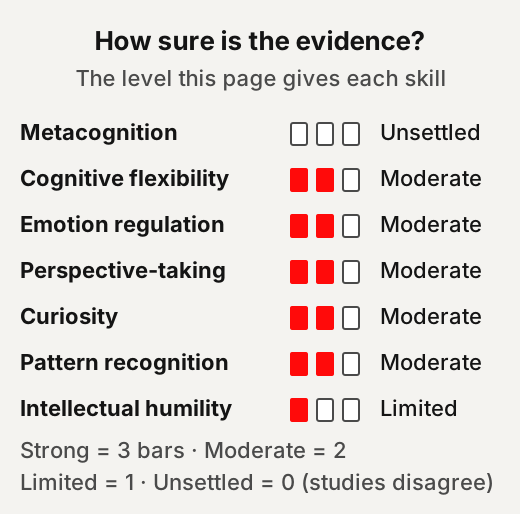
How sure: Unsettled a lab training gain did not appear in a preregistered repeat; a school review rates teaching it highly; brain studies are few.
Try it (our suggestion): before you check an answer, note how sure you are: a guess, fairly sure, or certain. After a week, see how often your “certain” answers were right.
Cognitive flexibility: changing course
Cognitive flexibility is switching approach when things change; training it mostly improves the trained task. It is one of the executive functions, the mental skills you use to plan, focus and hold back impulses. For example, when your usual route is closed, flexibility is finding another way rather than waiting at the barrier.
A 2013 review lists the core executive functions as inhibition, working memory and cognitive flexibility. It describes flexibility as including seeing anything from different perspectives and quickly adapting to changed circumstances.
A 2019 meta-analysis found that training one of children’s executive functions improved that skill. It found no convincing evidence that the gains spread to the skills that were not trained. Researchers call that kind of spread far transfer.
In 2017 Giovanni Sala and Fernand Gobet reviewed studies of chess, music and working-memory training. The better the experimental design, the smaller the effect. They “conclude that far transfer of learning rarely occurs”. The weight of the evidence we read leans towards far transfer being rare, with action games and music training the main exceptions claimed. Our Range summary covers that debate.
In a 2006 study of young adults, updating working memory was strongly related to intelligence scores. Shifting between mental tasks was not, once the other skills were accounted for. Its authors suggested that intelligence measures do not equally assess every control ability.
How sure: Moderate children’s gains stayed with the trained skill; far transfer is still argued, and the evidence we read leans against it.
Try it (our suggestion): once a week, solve a familiar problem a second way. Expect it to help with that kind of problem; in the studies, gains stayed close to what was practised.
Emotion regulation: thinking clearly under pressure
How you handle a strong feeling matters; rethinking the situation tended to work better than pushing the feeling down. Emotion regulation is how you manage your own feelings, on purpose or without noticing. For example, reading a curt email as “they’re rushed” rather than “they’re angry with me” changes how you feel about it.
A 2012 meta-analysis of 306 experimental comparisons found that changing how people thought about a situation had a small-to-medium effect on their emotions. Suppressing the outward expression of an emotion helped, but trying to suppress the feeling itself did not. Among ways of rethinking, taking a different perspective did better than reappraising your own reaction.
Stress changes how well you think in the moment. A 2016 meta-analysis found that acute stress impaired working memory and cognitive flexibility, with more nuanced effects on inhibition. Its authors described a stressed state with more reactive processing of salient things but greater control over actions. A 2009 review stated that even quite mild acute uncontrollable stress can cause a rapid and dramatic loss of prefrontal cognitive abilities.
These are lab findings about single moments. If strong feelings often overwhelm you or get in the way of daily life, talk to a doctor or a mental health professional. Our overthinking guide describes when worry is worth that conversation.
How sure: Moderate a large meta-analysis supports rethinking over suppressing the feeling, but these are lab tests of single moments.
Try it (our suggestion): when you notice a strong feeling before a decision, write down one other way to read what happened. Then decide.
Perspective-taking: understanding other minds
In one experiment, asking someone improved accuracy about their thoughts; in 25, imagining their view did not. The ability behind it is called theory of mind: understanding that other people have beliefs, wants and feelings different from your own.
In 25 experiments published in 2018, people told to imagine another person’s perspective did not judge that person’s thoughts or feelings more accurately. If anything, accuracy fell overall, while confidence sometimes rose. In a final experiment, getting the other person’s perspective through conversation did increase accuracy.
For young children, a 2016 meta-analysis of 45 studies found that theory-of-mind training worked better than control activities. A 2015 analysis of a popular test of reading feelings from photographs of eyes found its short form strongly related to vocabulary. Our reading: measuring social understanding apart from word knowledge is hard.
Brain studies point to a network used for this, and researchers still debate how specialised it is. A 2003 imaging study reported a region where the temporal and parietal lobes meet that was involved specifically in reasoning about another person’s mind. A 2014 meta-analysis found overlapping activity across theory-of-mind tasks in two areas, supporting the idea of a core network. A 2008 study found that the right-side region also responded to a task with no social content that required redirecting attention. A 2009 study with sharper scans found neighbouring but distinct regions there, one for theory of mind and one for shifting attention.
For example, you may feel sure you know why a colleague is upset. Asking “what’s bothering you most?” tests that guess.
How sure: Moderate imagining was tested in 25 experiments and asking in one final experiment, all by one team; the brain findings are still debated.
Try it (our suggestion): swap one guess a day for a question, such as “what did you mean by that?”
Curiosity: wanting to find out
Curiosity helps you remember what you were curious about; its effect on unrelated things is mixed. For example, the answer to a trivia question you badly wanted to know tends to stick.
In a 2009 study, people recalled surprising trivia answers better one to two weeks later when they had been more curious. In the same work’s brain scans, curiosity about trivia questions correlated with activity in regions previously suggested to be involved in anticipated reward.
A 2014 study found better memory for answers people were curious about, and for unrelated faces shown while they waited. It found more activity in the midbrain and nucleus accumbens during high curiosity. A 2021 study found the boost for unrelated faces only when they appeared shortly after the question. In three 2023 experiments on guessing before seeing an answer, which some theories link to curiosity, people remembered the answers better but not the unrelated material. In a 2024 study, people remembered unrelated school facts worse when they came after a trivia question that had made them very curious.
A 2011 analysis found intelligence the single strongest predictor of academic performance, but curiosity and effort together rivalled it. So curiosity added something an intelligence score did not. The studies we read raised or measured curiosity in the moment; they did not train it as a lasting trait.
How sure: Moderate the boost for answers is consistent; for unrelated things it is mixed, and one study found worse recall of school facts.
Try it (our suggestion): before you read about something, write one question you want answered, and guess the answer first.
Pattern recognition: real patterns or chance
Spotting patterns is part of some IQ tests and of expertise, but people also see patterns that aren’t there. For example, three wins in a row can feel like a hot streak; the useful question is how often that would happen by luck alone.
A 1990 analysis of Raven’s Progressive Matrices, a widely used nonverbal intelligence test, looked at what set higher scorers apart. It was mainly the ability to work out abstract relations and to keep track of many problem-solving goals in working memory. So this skill is, in part, what some IQ tests measure.
A 1996 study supported the usual estimate that chess masters store some 50,000 chunks, familiar patterns of pieces, in memory. A 2009 model showed that natural selection can favour links that are often wrong, as long as the occasional correct response carries a large benefit. Our reading: that helps explain superstitions.
In 2009 Daniel Kahneman and Gary Klein concluded that judging an intuition means asking two things. Is the environment predictable, and has the person had the chance to learn its regularities? They add that “subjective experience is not a reliable indicator of judgment accuracy”.
One theory treats the brain as built around prediction. In 2013 the philosopher Andy Clark called the hierarchical prediction machine approach the best clue yet to a unified science of mind and action. The same article examined its pitfalls and challenges, including evidential ones. Critics argued in 2020 that its models are seldom empirically validated and that calling it a unifying theory is premature.
How sure: Moderate the test and chess findings come from detailed lab studies; the evolution model and the prediction approach are theories still being tested.
Try it (our suggestion): write down a prediction before you find out, such as how long a task will take, then check. Our correlation vs causation guide helps when two things seem linked.
Intellectual humility: updating on evidence
Intellectual humility is recognising that your beliefs might be wrong; brief exercises raised it, but few have been repeated. Researchers at Duke University defined it as “the degree to which people recognize that their beliefs might be wrong”. A 2022 review found that the common element across definitions was a metacognitive ability to recognise the limits of one’s beliefs and knowledge. That makes it a close cousin of the first skill on this list.
The 2022 review describes short exercises that raised it for a while, such as reflecting on a situation from the view of a distant observer. In another, people who first listed two things they did not know reported less confidence in their answer. Most of these experiments used small to medium samples and have not been replicated; the distant-observer effect is one exception.
Feelings may play a part in changing your mind. In a 2016 imaging study, 40 liberals read arguments against their political and non-political views. Those who changed their minds more showed less activity in the insula and amygdala as they weighed the counterevidence. The authors said the results highlight the role of emotion in resisting belief change.
For example, before a family debate about a news story, you might notice you have only read one report of it. Our Think Again summary looks at rethinking in more depth.
How sure: Limited the exercises raised it briefly in mostly small studies, few have been repeated, and the brain finding is one study of 40 people.
Try it (our suggestion): before an argument or a big decision, list two things you don’t know about it.
3. Putting it together
Pick one skill, practise it for a week, and check whether anything changed. The seven tries from this page:
- Metacognition: note how sure you are before you check an answer.
- Flexibility: solve one familiar problem a second way each week.
- Emotion regulation: write one other way to read what happened before you decide.
- Perspective-taking: swap one guess about someone for a question.
- Curiosity: write a question and a guess before you read.
- Patterns: write down predictions, then check them.
- Intellectual humility: list two things you don’t know before you argue.
Our How to Learn Faster guide covers the study habits behind several of these. Our cognitive biases page looks at famous thinking-error findings, including the Dunning-Kruger effect.
Quick answers
What is metacognition?
Metacognition is awareness of your own thinking, such as knowing whether you really know an answer. A 2019 lab study found that feedback on confidence improved it; a 2022 preregistered replication found moderate evidence of no training effect.
Does IQ measure all kinds of intelligence?
A 1996 American Psychological Association task force wrote that standardized tests do not sample all forms of intelligence. Its examples included creativity, wisdom, practical sense and social sensitivity.
Is IQ related to these thinking skills?
Some more than others. In a 2006 study of young adults, updating working memory was strongly related to intelligence scores, while shifting between mental tasks was not. On Raven's Progressive Matrices, what set higher scorers apart was mainly the ability to work out abstract relations and to keep track of many problem-solving goals in working memory.
Can you train cognitive flexibility?
In children, training improved the skill that was practised. A 2019 meta-analysis found no convincing evidence that the gains spread to skills that were not trained.
Does curiosity improve memory?
For what you were curious about, yes. For unrelated things the results are mixed: a 2021 study found a boost for faces only shortly after the question, and a 2024 study found worse memory for unrelated school facts.
Use this
Our suggestion, one small practice per skill; try one a week and check whether anything changed.
What would change my mind, and how would I find out?
Quick quiz
Nothing is scored or saved. Recalling it once now is what makes it last.
1. In the 2018 experiments, what improved accuracy about another person's thoughts?
Answer: Asking them in conversation.Read it again ↑
2. What did a 2019 meta-analysis find about training children's executive functions?
Answer: The trained skill improved, with no convincing spread to others.Read it again ↑
3. What set higher scorers apart on Raven's Progressive Matrices, in a 1990 analysis?
Answer: Working out abstract relations and juggling goals in working memory.Read it again ↑
How we checked this · Last checked October 2026
- We read the abstract of every study through PubMed, OpenAlex, Europe PMC or the publisher's page, and the full text of the 2022 intellectual-humility review.
- We read the 1996 APA task force's summary of findings from a copy of that summary, and cite it by its DOI.
- Brain-imaging results are described as links, not causes. Where a brain-injury or stimulation study tested cause, we say so, and we show the 2017 study that did not repeat a stimulation result.
- The 2019 metacognition training study is shown beside the 2022 preregistered replication that did not find the effect.
- Our wording on far transfer and on judging intuitions matches our Range summary.
- A 2024 study that found worse memory for unrelated school facts is shown beside the earlier curiosity studies.
Sources
- American Psychological Association, APA Dictionary of Psychology: “metacognition”, “cognitive flexibility”, “executive functions” and “theory of mind”.Scholarly
- U. Neisser and colleagues, “Intelligence: Knowns and unknowns”, American Psychologist 51(2), 1996.Scholarly
- J. Carpenter and colleagues, “Domain-general enhancements of metacognitive ability through adaptive training”, Journal of Experimental Psychology: General 148(1), 2019.Scholarly
- Education Endowment Foundation, Teaching and Learning Toolkit, “Metacognition and self-regulation”.Scholarly
- M. van der Stel, M. V. J. Veenman, K. Deelen and J. Haenen, “The increasing role of metacognitive skills in math: a cross-sectional study from a developmental perspective”, ZDM 42, 2010.Scholarly
- A. Diamond, “Executive functions”, Annual Review of Psychology 64, 2013.Scholarly
- R. Kassai and colleagues, “A meta-analysis of the experimental evidence on the near- and far-transfer effects among children’s executive function skills”, Psychological Bulletin 145(2), 2019.Scholarly
- N. P. Friedman and colleagues, “Not all executive functions are related to intelligence”, Psychological Science 17(2), 2006.Scholarly
- T. L. Webb, E. Miles and P. Sheeran, “Dealing with feeling: a meta-analysis of the effectiveness of strategies derived from the process model of emotion regulation”, Psychological Bulletin 138(4), 2012.Scholarly
- T. Eyal, M. Steffel and N. Epley, “Perspective mistaking: Accurately understanding the mind of another requires getting perspective, not taking perspective”, Journal of Personality and Social Psychology 114(4), 2018.Scholarly
- S. G. Hofmann and colleagues, “Training children’s theory-of-mind: A meta-analysis of controlled studies”, Cognition 150, 2016.Scholarly
- S. Olderbak and colleagues, “A psychometric analysis of the reading the mind in the eyes test: toward a brief form for research and applied settings”, Frontiers in Psychology 6, 2015.Scholarly
- M. J. Kang and colleagues, “The wick in the candle of learning: epistemic curiosity activates reward circuitry and enhances memory”, Psychological Science 20(8), 2009.Scholarly
- M. J. Gruber, B. D. Gelman and C. Ranganath, “States of curiosity modulate hippocampus-dependent learning via the dopaminergic circuit”, Neuron 84(2), 2014.Scholarly
- M. Rouy and colleagues, “Metacognitive improvement: Disentangling adaptive training from experimental confounds”, Journal of Experimental Psychology: General 151(9), 2022.Scholarly
- N. E. Keller and colleagues, “States of epistemic curiosity interfere with memory for incidental scholastic facts”, npj Science of Learning 9, 2024.Scholarly
- C. Murphy and colleagues, “Temporal proximity to the elicitation of curiosity is key for enhancing memory for incidental information”, Learning & Memory 28(2), 2021.Scholarly
- T. J. Hollins and colleagues, “Pre-testing effects are target-specific and are not driven by a generalised state of curiosity”, Memory 31(2), 2023.Scholarly
- S. von Stumm, B. Hell and T. Chamorro-Premuzic, “The Hungry Mind: Intellectual Curiosity Is the Third Pillar of Academic Performance”, Perspectives on Psychological Science 6(6), 2011.Scholarly
- P. A. Carpenter, M. A. Just and P. Shell, “What one intelligence test measures: a theoretical account of the processing in the Raven Progressive Matrices Test”, Psychological Review 97(3), 1990.Scholarly
- F. Gobet and H. A. Simon, “Recall of random and distorted chess positions: implications for the theory of expertise”, Memory & Cognition 24(4), 1996.Scholarly
- K. R. Foster and H. Kokko, “The evolution of superstitious and superstition-like behaviour”, Proceedings of the Royal Society B 276, 2009.Scholarly
- D. Kahneman and G. Klein, “Conditions for intuitive expertise: a failure to disagree”, American Psychologist 64(6), 2009.Scholarly
- M. R. Leary and colleagues, “Cognitive and Interpersonal Features of Intellectual Humility”, Personality and Social Psychology Bulletin 43(6), 2017.Scholarly
- T. Porter and colleagues, “Predictors and consequences of intellectual humility”, Nature Reviews Psychology 1, 2022.Scholarly
- L. Zmigrod and colleagues, “The psychological roots of intellectual humility: The role of intelligence and cognitive flexibility”, Personality and Individual Differences 141, 2019.Scholarly
- S. M. Fleming and colleagues, “Relating introspective accuracy to individual differences in brain structure”, Science 329, 2010.Scholarly
- S. M. Fleming and colleagues, “Domain-specific impairment in metacognitive accuracy following anterior prefrontal lesions”, Brain 137(10), 2014.Scholarly
- E. Rounis and colleagues, “Theta-burst transcranial magnetic stimulation to the prefrontal cortex impairs metacognitive visual awareness”, Cognitive Neuroscience 1(3), 2010.Scholarly
- D. Bor and colleagues, “Theta-burst transcranial magnetic stimulation to the prefrontal or parietal cortex does not impair metacognitive visual awareness”, PLoS One 12(2), 2017.Scholarly
- R. Saxe and N. Kanwisher, “People thinking about thinking people: the role of the temporo-parietal junction in ‘theory of mind’”, NeuroImage 19(4), 2003.Scholarly
- M. Schurz and colleagues, “Fractionating theory of mind: a meta-analysis of functional brain imaging studies”, Neuroscience & Biobehavioral Reviews 42, 2014.Scholarly
- J. Scholz and colleagues, “Distinct regions of right temporo-parietal junction are selective for theory of mind and exogenous attention”, PLoS One 4(3), 2009.Scholarly
- J. P. Mitchell, “Activity in right temporo-parietal junction is not selective for theory-of-mind”, Cerebral Cortex 18(2), 2008.Scholarly
- G. S. Shields, M. A. Sazma and A. P. Yonelinas, “The effects of acute stress on core executive functions: A meta-analysis and comparison with cortisol”, Neuroscience & Biobehavioral Reviews 68, 2016.Scholarly
- A. F. T. Arnsten, “Stress signalling pathways that impair prefrontal cortex structure and function”, Nature Reviews Neuroscience 10(6), 2009.Scholarly
- A. Clark, “Whatever next? Predictive brains, situated agents, and the future of cognitive science”, Behavioral and Brain Sciences 36(3), 2013.Scholarly
- P. Litwin and M. Miłkowski, “Unification by Fiat: Arrested Development of Predictive Processing”, Cognitive Science 44(7), 2020.Scholarly
- J. T. Kaplan, S. I. Gimbel and S. Harris, “Neural correlates of maintaining one’s political beliefs in the face of counterevidence”, Scientific Reports 6, 2016.Scholarly
- K. E. Stanovich and R. F. West, “On the relative independence of thinking biases and cognitive ability”, Journal of Personality and Social Psychology 94(4), 2008.Scholarly
- G. Sala and F. Gobet, “Does far transfer exist? Negative evidence from chess, music, and working memory training”, Current Directions in Psychological Science 26(6), 2017.Scholarly
Practise on the problem you have
A 1996 American Psychological Association task force wrote that standardized tests do not sample all forms of intelligence. In the studies on this page, practice helped several of these skills, usually in narrow ways. Our view: pick the skill closest to a problem you face, and practise on that problem.
Five questions for a thinking-skill study
- Was it repeated? In a 2019 study, confidence feedback improved people's calibration. A 2022 preregistered replication found moderate evidence of no training effect.
- Did it spread? A 2019 meta-analysis found children's training improved the trained skill. It found no convincing evidence the gains spread to untrained skills.
- How many experiments? In 25 experiments, imagining another person's view did not improve accuracy. Asking them improved accuracy in one final experiment, by the same team.
- Are the results mixed? Curiosity helped people remember the answers they wanted. For unrelated things, results are mixed. In a 2024 study, people remembered unrelated school facts worse after a very curious moment.
- Link or cause? Brain-imaging studies here mostly show links. A few studies tested cause, with mixed results.
- Our suggestion. Ask these five questions of the next study you read about a thinking skill.
This week: one skill, one real problem
Our suggestion: choose one problem you will meet this week, such as a decision or a hard conversation. Pick the try from section 3 that fits it best. Each time you use it, note the date, what you tried and what happened. At the end, ask whether that kind of problem felt easier. In the studies, gains stayed close to what was practised.
Keep going
- Think Again, summarisedAdam Grant's Think Again in plain words, and what the research says about each big idea.
- Range, summarisedDavid Epstein's case for breadth and late specialisation, and what the research behind it found.
- How to learn fasterStudy methods the research supports, and a plan you can start this week.
- How to stop overthinkingHow to tell worry from problem-solving, and which common tips the research supports.
- Cognitive biasesWhat happened when scientists re-ran famous psychology studies, including the Dunning-Kruger effect.
- Correlation vs causationWhy two things moving together is not the same as one causing the other.
- Why information is more powerful than everHow much information exists, how fast it moves, and habits that help you use it.
- GlossaryPlain meanings of metacognition, cognitive flexibility, executive functions, emotion regulation, theory of mind, intellectual humility and far transfer.