

Start hereIn studies published in 2018, people systematically underestimated how much their conversation partners liked them. In experiments published in 2022, people underestimated how much others appreciated being reached out to. If both sides expect too little, who goes first?
Adult friendships grow from hours spent together, often unplanned and relaxed, and from small moves like reaching out. Adult life rarely supplies those hours by itself, so they usually take a plan. Below: what the research says, what it means day to day, and a three-month plan.
1. Why it feels harder as an adult
Adult life often removes the conditions that let friendships form on their own.
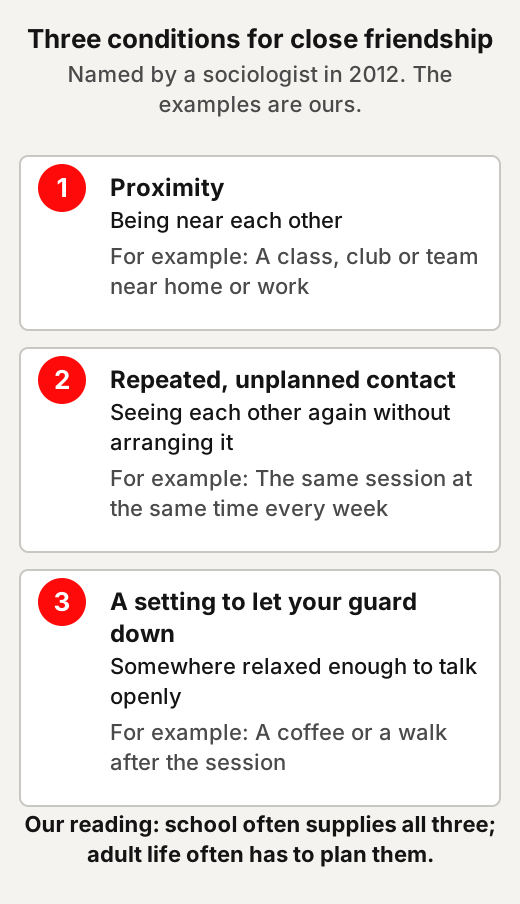
Quoted in a 2012 New York Times article, the sociologist Rebecca G. Adams named three conditions that sociologists since the 1950s have considered crucial to making close friends. They are proximity; repeated, unplanned interactions; and a setting that encourages people to let their guard down and confide in each other. She added that this is why so many people meet their lifelong friends in college.
Our reading: school and university often supply all three without anyone trying. Work may supply the first two; the third depends on the workplace. For example, you can see a colleague every day and still know little about their life.
2. What the research says
Five findings, each with a line on how sure the evidence is.
| Finding | What it means for you | How it holds up |
|---|---|---|
| Friendship takes many hours together | Expect months, not weeks | Partly |
| People like us more than we think | The chat probably went better than it felt | Holds up |
| Follow-up questions help people like you | Ask about what they just said | Partly |
| Reaching out is valued more than we expect | Send the message | Holds up |
| Loneliness is linked to worse health | Treat connection as part of looking after yourself | Holds up |
Friendship takes many hours
Partly It takes about 200 hours together to make a close friend. Friendship does take many hours, but the exact figures are rough estimates from two groups of people.
How sure: Limited one researcher’s two studies, hours estimated by the people themselves, and write-ups give different figures.
In a study published in 2018, the communication researcher Jeffrey Hall asked 355 adults who had recently moved to estimate the time they had spent with a new acquaintance. In a second study, 112 first-year students reported the hours they spent with two new acquaintances three times over nine weeks. In both, more hours together went with closer friendships. Time spent on leisure together also predicted closeness.
The University of Kansas’s summary of the study put it at roughly 50 hours together to move from acquaintance to casual friend. It gave 90 hours to go from that stage to “friend”, and more than 200 hours before someone is a close friend. It said hours spent working together don’t count as much.
Greater Good Magazine, at UC Berkeley, reported separate figures: about 43 hours for students and 94 hours for adults to turn acquaintances into casual friends. It said students became good or best friends after about 119 hours. It also said adults needed an additional 100 hours to get there, which by our sum is about 219 in all.
The university’s release and Greater Good report the figures differently, and we could not open the paper itself to check which set matches it. Both say friendship takes many hours, and Greater Good’s figures suggest adults may need more time than students. Treat the figures as a rough guide, not a target.
Hall’s advice in that summary: “You can’t make people spend time with you, but you can invite them.” He suggested switching the setting, such as going to lunch with someone you work with.
Our arithmetic: two relaxed hours a week add up to about 50 hours in six months and about 100 in a year. For example, a weekly walk with a neighbour or a regular game night adds up the same way.
People like us more than we think
Holds up After a conversation, people like us more than we think they do. Most of us underestimate how much a new acquaintance enjoyed talking to us. Researchers call this the liking gap.
How sure: Moderate several teams have found it, mostly after first conversations between strangers.
In studies published in 2018, people systematically underestimated how much their conversation partners liked them and enjoyed their company. The gap showed up between strangers in a laboratory, first-year students getting to know their dorm mates, and members of the public at a workshop. For the dorm mates, it lasted for several months.
Other teams have found it too, including in children from age 5. A study published in 2025 that pooled pairs of strangers from several studies found the gaps robust across them.
One limit: a 2025 study of three large samples, 2,753 people in all, found the gaps were not reliably linked to how good the conversation was. People with lower self-esteem or more social anxiety tended to show a larger gap between how much they liked others and how much they thought they were liked.
For example, if you leave a chat replaying an awkward pause, the other person may well remember it as pleasant. That is a reason to suggest a second meeting rather than wait.
Asking questions
Partly Asking questions, especially follow-up questions, makes people like you. Supported in one team’s experiments; we found no independent replication.
How sure: Limited one team’s work, and a reanalysis disputed its speed-dating part.
In two online experiments and an observational study of speed dates, people who asked more questions, particularly follow-up questions, were better liked. Responsiveness (listening, understanding, validation and care) explained the effect. People did not expect it.
A 2019 reanalysis of the speed-dating data argued that a second date is not the same as liking, and that asking questions is not the same as listening. The original authors replied that the reanalysis tested the wrong variables. The reanalysis covered only the speed-dating study, not the two experiments. A 2025 correction reports that an independent audit confirmed all the paper’s conclusions.
Our How to Win Friends and Influence People summary looks at these studies alongside the rest of the book.
For example, when a new acquaintance mentions a trip, ask how it went or what surprised them before you talk about your own.
Reaching out
Holds up People appreciate a message out of the blue more than the sender expects. Someone you have not talked to in a while is likely to value hearing from you more than you think.
How sure: Moderate one team’s preregistered experiments, plus one independent replication that found a small effect.
In a series of preregistered experiments published in 2022, people underestimated how much others appreciated being reached out to. The experiments involved more than 5,900 participants. In 2023 an independent replication project repeated one of the experiments with 742 people and found the same result. It noted that the effect was small.
In some, people sent a short note, or a note and a small gift, to someone in their social circle they had not contacted for a while. The researchers then asked the recipients to rate their appreciation. The underestimation was larger when the contact was more surprising, or when the two people were less close.
Our reading: the people you have drifted from may appreciate it even more than you would guess. For example, send an old classmate a photo that reminded you of them, with one line asking how they are.
Loneliness and health
Holds up Loneliness is linked to worse health and earlier death. The World Health Organization now calls social connection a public health priority.
How sure: Moderate large reviews show a strong, consistent link, but cause is hard to prove.
The World Health Organization describes loneliness as the painful feeling that arises from a gap between desired and actual social connections. It describes social isolation as the objective lack of sufficient social connections. In plain words, loneliness is how it feels, and social isolation is how few connections you have. For example, you can feel lonely in a busy office, or spend a quiet weekend alone without feeling lonely.
In 2025 a WHO commission reported that 1 in 6 people worldwide is affected by loneliness. It linked loneliness to an estimated 100 deaths every hour, more than 871,000 a year. It said loneliness and social isolation increase the risk of stroke, heart disease, diabetes, cognitive decline and premature death.
A wider review points the same way. Across 148 studies with 308,849 people, those with stronger social relationships had a 50% greater likelihood of survival over an average follow-up of 7.5 years. The authors add that “causality is not easily established”, because people cannot be randomly assigned to be isolated or married. They note the same is true of smoking, and point to experimental, cross-sectional and long-term evidence linking relationships with pathways associated with death. They judge the effect comparable with well-established risk factors for mortality. Our good life article looks at that review and a long study of adult lives.
If loneliness has lasted a long time or weighs on you, a doctor or counsellor can help you find support. WHO says that if the problem is more serious, finding out about available support and services is important. This section describes research only. It is not medical advice.
3. Everyday ways to create the three conditions
You can’t schedule a friendship, but you can schedule the conditions for one.
Our examples, one for each condition:
- Proximity. Choose a regular activity near home or work, such as a class, a choir, a running group or a book club. Our hobby guide helps you pick one that fits your life.
- Repeated, unplanned contact. Go at the same time every week, so the same faces become familiar. For example, the same evening class or the same Saturday volunteer shift.
- A setting to let your guard down. Move from the group to something smaller, such as a coffee after the class, a walk or a shared meal.
- If you are introverted. Smaller, quieter settings count too. Whether acting more outgoing costs introverts anything depends on the study; our Quiet summary looks at them.
4. A three-month plan
This is our suggestion, not a tested programme. It uses only the findings above, and it asks for one regular activity and a few messages.
| Month | Focus | What to do |
|---|---|---|
| 1 | Show up | Pick one weekly group or class and go every week. Learn names. Ask one follow-up question in each chat. |
| 2 | Step outside the setting | Invite one or two people to something small, such as coffee or a walk. Message two people you have lost touch with. |
| 3 | Make it regular | Turn one invitation into a repeating plan. Keep going to the group, and say yes when someone invites you. |
If it isn’t working
If the plan stalls, try one of these.
- Nobody says yes. One no is about a plan, not about you. Offer another time or a different activity.
- It feels slow. It is meant to. Even the rough estimates above run to many weeks of time together.
- Loneliness feels heavy. A doctor or counsellor can help you find support where you live.
Quick answers
How many hours does it take to make a friend?
A University of Kansas summary of one researcher's two studies put it at roughly 50 hours together to become casual friends, and more than 200 for a close friend. Greater Good Magazine's write-up of the same paper gave about 94 hours for adults and 43 for students to become casual friends. The hours were estimated by the people themselves, so treat the figures as a rough guide.
Why is it so hard to make friends as an adult?
A sociologist named three conditions for close friendship, quoted in The New York Times in 2012. They are proximity; repeated, unplanned interactions; and a setting that encourages people to let their guard down. Our reading is that adult life often removes them, so they take planning.
Do people like you more than you think?
Often, yes. In studies published in 2018, people systematically underestimated how much their conversation partners liked them and enjoyed their company, an effect researchers call the liking gap.
Is it weird to message someone you haven't talked to in years?
Probably less than you fear: in experiments published in 2022, people underestimated how much others appreciated being reached out to. The gap was larger when the contact was more surprising, or when the two people were less close.
Is loneliness bad for your health?
A WHO commission said in 2025 that loneliness and social isolation increase the risk of stroke, heart disease, diabetes, cognitive decline and premature death. The authors of a large review add that cause is hard to establish, though they judge the effect comparable with well-established risk factors for mortality.
Use this
Our suggestion, built from the findings above, over three months.
Who could I see again this week, and what could I invite them to?
Quick quiz
Nothing is scored or saved. Recalling it once now is what makes it last.
1. In the University of Kansas summary, roughly how many hours together did it take to move from acquaintance to casual friend?
Answer: About 50.Read it again ↑
2. What is the liking gap?
Answer: After a conversation, we underestimate how much the other person liked us.Read it again ↑
3. When did senders underestimate the recipient's appreciation more?
Answer: When the contact was more surprising.Read it again ↑
How we checked this · Last checked October 2026
- We read the abstracts of the studies through PubMed, Crossref and Europe PMC, the WHO news release, the American Psychological Association's press release and the University of Kansas news release. We also read the Clearer Thinking replication report and the full text of the 2010 PLoS Medicine review.
- We could not open the 2018 friendship-hours paper itself; the publisher's site showed a bot check, and we found no open copy. Its design comes from its abstract. Its hour figures come from the university's release and from Greater Good Magazine, which report them differently; we give both.
- The sociologist's three conditions come from The New York Times (2012) as quoted by The Society Pages; we could not open the newspaper's own page.
- Our wording on question-asking matches our How to Win Friends summary, and on relationships and survival our good life article.
Sources
- J. A. Hall, “How many hours does it take to make a friend?”, Journal of Social and Personal Relationships 36(4), 2019 (online 2018).Scholarly
- University of Kansas News, “How to make friends? Study reveals how many hours it takes”, 2018.Popular
- K. M. Newman, “How Long Does It Take to Make a Friend?”, Greater Good Magazine (UC Berkeley), 25 May 2018.Popular
- The Society Pages, “Life Course Leads to Loneliness?”, 15 July 2012, quoting The New York Times.Popular
- E. J. Boothby, G. Cooney, G. M. Sandstrom and M. S. Clark, “The Liking Gap in Conversations: Do People Like Us More Than We Think?”, Psychological Science 29(11), 2018.Scholarly
- W. Wolf, A. Nafe and M. Tomasello, “The Development of the Liking Gap”, Psychological Science 32(5), 2021.Scholarly
- H. Tissera and colleagues, “Evaluating the psychological and social nature of actual and perceived liking gaps”, Journal of Personality and Social Psychology 128(4), 2025.Scholarly
- S. Sprecher, “Liking gap(s) in getting-acquainted interactions”, The Journal of Social Psychology 166(5), 2026.Scholarly
- K. Huang, M. Yeomans, A. W. Brooks, J. Minson and F. Gino, “It doesn’t hurt to ask: Question-asking increases liking”, Journal of Personality and Social Psychology 113(3), 2017, and its 2025 correction.Scholarly
- A. N. Kluger and T. E. Malloy, “Question asking as a dyadic behavior”, Journal of Personality and Social Psychology 117(6), 2019, and the authors’ reply.Scholarly
- P. J. Liu, S. Rim, L. Min and K. E. Min, “The surprise of reaching out: Appreciated more than we think”, Journal of Personality and Social Psychology 124(4), 2023 (online 2022).Scholarly
- American Psychological Association, “Friends enjoy being reached out to more than we think”, press release, 11 July 2022.Popular
- Clearer Thinking, Transparent Replications, “Report #7: Replication of a study from ‘The Surprise of Reaching Out: Appreciated More Than We Think’”, 26 October 2023.Scholarly
- World Health Organization, “Social connection linked to improved health and reduced risk of early death”, news release, 30 June 2025.Primary
- J. Holt-Lunstad, T. B. Smith and J. B. Layton, “Social relationships and mortality risk: a meta-analytic review”, PLoS Medicine 7(7), 2010.Scholarly
- R. Jacques-Hamilton, J. Sun and L. D. Smillie, “Costs and benefits of acting extraverted: A randomized controlled trial”, Journal of Experimental Psychology: General 148(9), 2019, and its 2026 correction.Scholarly
- S. Margolis and S. Lyubomirsky, “Experimental manipulation of extraverted and introverted behavior and its effects on well-being”, Journal of Experimental Psychology: General 149(4), 2020.Scholarly
Put the hours in your diary
Friendship grows from hours together, and adult life rarely hands them out. So book repeated time with people, and let closeness follow. Expect months, not weeks.
This week: count your relaxed hours
Note the hours you spent with friends or new acquaintances outside work. The university's summary said hours working together don't count as much. Look at where the relaxed hours could grow.
Turn an acquaintance into a regular
- Move a work contact to a new setting. The study's author suggested switching the setting, such as going to lunch with someone you work with.
- Invite them into something you already do. Our view: a walk, a market trip or a gym session costs you no extra time.
- Keep a note of what they told you. Our view: ask about it next time. A follow-up shows you were listening.
- Keep a short contact list. Our view: list a few people you'd like to see more, and message one each week.
- Know where to find support. If loneliness has lasted a long time or weighs on you, a doctor or counsellor can help you find support.
Help others find their people
- Write a local guide to regular activities near you, with the days and times each one meets.
- Help new arrivals settle in, pointing them to weekly activities that match their interests.
- Help companies plan onboarding that gives new staff repeated, relaxed time with colleagues.
Ideas to explore, not financial or business advice. No result is promised.
Keep going
- How to remember names and make small talkNames, openers, follow-ups and kind exits.
- Pick a hobby that fits your lifeFind a regular activity to show up to.
- Quiet, summarisedWhat the research says about introverts and social settings.
- What makes a good lifeRelationships and well-being, from old traditions and modern research.