Start hereIt is much harder to recall that someone's surname is Baker than that they are a baker. Yet in a 2000 study, a group game built on recalling each other's names still beat pairwise introductions, a widely used method, eleven months later. So what helps?
To remember a name, catch it as it is said, then recall it a few minutes later and again before you leave. Recalling a name, rather than just hearing it again, has the strongest research behind it.
For small talk, studies of strangers found that conversations go better than people expect.
1. The short list
Recalling a name later has the strongest support; the picture trick works in the lab but is hard at a real event.
| Habit or belief | What it means | How it holds up |
|---|---|---|
| Catch the name as it is said | Listen to the name, not your next line | Partly |
| Recall the name later, more than once | Bring it back after a few minutes, then again | Holds up |
| Give the name a meaning | Link it to something you know | Partly |
| Use the face-name picture trick | Picture the name on a feature of the face | Partly |
| Say the name back at once | Repeat it straight away | Doesn’t hold up |
| Deeper talk goes better than you expect | Deep chats felt less awkward than predicted | Holds up |
| People like you more than you think | People underestimate how much they were liked | Holds up |
| Follow-up questions make you better liked | Ask about what they just said | Partly |
| Small talk is bad for your well-being | Light chat lowers happiness | Doesn’t hold up |
| Conversations end when both people want them to | Chats stop when both are ready | Doesn’t hold up |
2. Why names are hard to remember
A name tells you almost nothing about the person, so memory has little to hold it by.
In a 1987 experiment, people learned the surnames and jobs of 16 unfamiliar faces, and names were much harder to recall than jobs. This held even for words that can be both, so it is much harder to recall that someone’s surname is Baker than that they are a baker. Researchers call this the Baker-baker paradox.
The likely reason is meaning. A job brings a picture with it, and a surname brings nothing. As one 2022 paper puts it, the word “baker” suggests what a person probably does, such as making bread and cakes.
In 1990 experiments, when names were made meaningful and jobs were made meaningless, the usual gap in name recall disappeared. A 1998 study found that cartoon characters with arbitrary names were harder to name than those with descriptive names.
A 1993 review describes proper names as having “a frustrating propensity to be forgotten”. It notes that recalling familiar names is especially affected in old age.
There is a second, everyday problem: attention. Researchers call it the next-in-line effect. People who take turns speaking in front of a group recall less of what was said just before and after their own turn. A 1985 study found it is a failure to take the information in, not a failure to find it later.
For example, in a round of introductions, you may miss the name of the person just before you because you were rehearsing your own line.
3. What helps you remember a name
These five habits start with the most strongly supported.
Recall the name later, more than once
Holds up Recalling a name from memory a few times, with gaps between, helps you keep it. Bringing a name back to mind after a delay works better than simply hearing or reading it again. Researchers call this retrieval practice.
How sure: Strong lab and real-life studies agree, and a 2019 review found it worked in both.
In two 2005 experiments, people who recalled names did about 250% better than people who restudied them. That means about three and a half times as many names. In a third experiment at a party, recalling names led to 50% higher recall one to three days later.
In a 2000 study, a group game built on recalling each other’s names beat a widely used method, pairwise introductions, after 30 minutes, 2 weeks and 11 months. A 2002 follow-up found that a few refresher rounds two weeks later helped every group.
A well-known schedule stretches the gaps: recall after a minute, then a few minutes, then longer. This schedule, expanding retrieval practice, goes back to Landauer and Bjork in 1978, and was regarded as the better one.
A 2021 meta-analysis found no significant difference between gaps that grow longer and gaps that stay even. Growing gaps did better the more times learners were tested. Our guide to learning faster covers spacing in more detail.
For example, meet Priya at a work event. Say her name to yourself a minute later, again while you fetch a drink, and once more before you leave.
Catch the name as it is said
Partly You forget names because you were not paying attention when you heard them. Attention matters, but names are also hard in themselves, even when people are trying to learn them.
How sure: Moderate the attention studies used material said in turn, not names, and name studies show names are hard anyway.
When people were told beforehand to make a special effort to remember what came just before their turn, the deficit reversed. A 1991 study found that thinking about what was said removed the effect, while eye contact did not.
These studies used things said in turn, not names. In the name studies, people were trying to learn names and still found them hard.
For example, when someone says their name, stop planning your reply for a second and listen to the name alone.
Give the name a meaning
Partly Linking a name to something you already know helps you remember it. Meaning helped a lot in lab experiments; we found no test of it at a real event.
How sure: Limited lab studies only; the 2005 party experiment did not test this habit.
In the 2005 lab experiments, names learned with a meaningful link were recalled about 200% better than without one. That means about three times as many. Together, recall practice and meaningful links improved recall by 300 to 400%. This fits the 1990 finding that the name gap disappeared when names were made meaningful.
For example, link a new colleague called Rose to the flower, or a Martin to a friend of the same name.
The face-name picture trick
Partly Turning a name into a picture tied to the person’s face helps you remember it. The trick works in the lab, but it takes effort, and at a party it did no better than simply trying.
How sure: Moderate lab studies support it, but the one real-life test found no benefit.
A 1980 study broke the trick into three parts: a prominent facial feature, an image for the name (Bryant became “bride ant”), and a picture joining the two. All three parts were needed for it to work.
At the 2005 party, the picture trick was no more effective than plain instructions to learn the names. The 2019 review calls such techniques “particularly effortful” and hard to use in a real conversation. It found spaced recall appeared more efficient than imagery.
The picture idea is not useless. A 2024 study with random word pairs, not names, found that imagining a scene beat recall practice without feedback on memory for which words went together.
Our reading: pictures can help when you have time, as in studying; in a live conversation, a quick recall is easier. Our guide to learning faster covers a related picture method, the memory palace.
For example, use the trick on a list of names before a meeting, not in the middle of a chat.
Say the name back at once
Doesn't hold up Repeating a name straight after you hear it fixes it in memory. In lab tests, saying a name aloud while learning it did not help people recall it later.
How sure: Limited one team’s lab experiments with faces and names, not real conversations.
In a 2016 experiment, people studied faces with names, reading half the names aloud and half silently. Saying them aloud did not improve recall of the name from the face. Repeating the name aloud for the whole trial did not help either. The authors wrote that saying names aloud “shows little promise” for remembering people we have just met.
In a 2007 experiment with vocabulary word pairs, delaying the first test improved long-term retention. Our reading: saying a name back is still useful to check you heard it right; the later recall is what helps you keep it.
For example, “Nice to meet you, Siobhan. Did I say that right?” Then recall it again a few minutes later.
4. When you forget a name
A cue to the sound of a name may bring it back; if it does not, our suggestion is to ask kindly.
People who forget a name tend to search for facts about the person, such as where they met. Yet earlier experiments found that a cue to the sound of the name may help, while facts about the person usually do not.
Our reading: if a name will not come, try its first letter or its rhythm for a moment. If that fails, ask.
In 1995 experiments, being remembered by name was taken as a compliment. In the first of those experiments, forgetting a name did not make people less willing to agree to a request. Our reading: asking again is a way of saying you want to get it right.
Our summary of How to Win Friends and Influence People looks at names and liking.
Some ways to ask (our suggestions):
- “I’m sorry, your name has slipped my mind. Can you tell me again?”
- “Remind me how you spell your name?” This works when you half remember it.
- Introduce them to someone else: “Have you two met?” They may say their own name.
One caution. A 2026 retail study found that staff using a customer’s name could raise satisfaction and sales, but that overusing it lowered satisfaction. Use the name once or twice, not in every sentence.
5. Small talk: what the research found
Conversations with strangers go better than people expect, and deeper topics are less awkward than they fear.
Deeper talk goes better than you expect
Holds up Deeper conversations with strangers go better than people expect. People overestimated how awkward deep talk would be, and felt more connected afterwards than after shallow talk.
How sure: Moderate one team’s many experiments agree; other studies found talks with strangers go better than expected, but did not compare deep and shallow topics.
In a 2022 set of experiments, conversations between strangers felt less awkward, and created more connectedness and happiness, than people expected. People were especially likely to overestimate how awkward deep conversations would be compared with shallow ones. After trying both, they felt more connected to deep conversation partners.
A 2021 analysis of seven studies with 2,304 people found that fears about talking to strangers were overblown. In 2014 experiments, commuters told to talk to a stranger on trains and buses reported a more positive journey. Others predicted the opposite.
For example, after “How do you know the host?”, try “What’s been a highlight of your year so far?”
People like you more than you think
Holds up After a conversation, the other person likes you more than you think. People underestimated how much their conversation partners liked them, in the lab, in dorms and at a workshop. Researchers call this the liking gap.
How sure: Strong found in several settings and in children, by more than one team.
The name comes from a 2018 study. It appeared among strangers in a lab, first-year students in dorms, and members of the public at a workshop. Among the dorm mates it lasted for several months. A 2021 study of 241 US children found it from about age 5.
A 2025 study of 2,753 people found that the gap was not reliably linked to how good the conversation was. Our reading: the worry is common, and it tends to be wrong, so it is a poor reason to skip a chat.
For example, you may replay a chat on the way home and think it went badly. The other person probably liked it more than you think.
Follow-up questions
Partly Asking questions, especially follow-up questions, makes people like you more. Supported in one team’s experiments; we found no independent replication.
How sure: Moderate one team’s three studies, a disputed reanalysis of one of them, and an independent audit.
In two online experiments and an observational study of speed dates, people who asked more questions, particularly follow-up questions, were better liked. Responsiveness (listening, understanding, validation and care) explained the effect. People did not expect it.
A 2019 reanalysis of the speed-dating data argued that a second date is not the same as liking, and that asking questions is not the same as listening. The original authors replied that the reanalysis tested the wrong variables.
The reanalysis covered only the speed-dating study, not the two experiments. A 2025 correction reports that an independent audit confirmed all the paper’s conclusions.
For example, if someone says they just got back from a trip, ask “What surprised you there?” before you mention your own travels.
Is small talk bad for you?
Doesn't hold up Small talk is bad for your well-being. A larger repeat of the study behind this idea found no reliable link between small talk and life satisfaction.
How sure: Moderate one larger pooled replication; it measures links between daily talk and life satisfaction, not causes.
A 2010 study reported that well-being was related to having less small talk and more substantive conversations. A 2018 replication pooled the original sample with three more and found moderate links between life satisfaction and substantive conversations, but no reliable link with small talk. These studies show links, not causes.
Our reading: small talk is a way in, not a waste. It can be how a deeper conversation starts. If small talk drains you, our summary of Quiet looks at what research says about introverts acting extraverted.
For example, “Busy week?” can lead to what kept them busy, and from there to what they care about.
6. Openers and follow-ups
A good opener is about the shared moment; a good follow-up is about what the other person just said.
These are our suggestions, not tested scripts.
| Moment | Opener | Follow-up |
|---|---|---|
| At a party | “How do you know the host?” | “What’s the story there?” |
| At work | “What are you working on this week?” | “What’s the hardest part of it?” |
| At a course or club | “What brought you here?” | “How did you get into it?” |
| Waiting in line | “Have you been here before?” | “What would you recommend?” |
| Going a bit deeper | “What’s been a highlight of your year so far?” | “Why that one?” |
For example, if they know the host from a climbing club, ask about climbing, not about the host.
7. Ending a conversation
Most conversations do not end when people want them to, so a kind, clear exit helps both of you.
Conversations end when both people want them to
Doesn't hold up Conversations end when both people want them to. In two studies of 932 conversations, they almost never ended when both people wanted them to.
How sure: Moderate two studies by one team, one with close partners and one with strangers.
A 2021 study asked people when they had wanted a conversation to end, and when they thought their partner had. In Study 1 the partner was someone close; in Study 2, a stranger.
Conversations almost never ended when both wanted them to, and rarely when even one did. On average, the gap between the length people wanted and the real length was roughly half the conversation. People had little idea when their partner wanted to stop.
Our reading: you can rarely tell when the other person is ready to go, so you do not need to wait for a perfect moment.
Some exits (our suggestions):
- Sum up and thank them: “I loved hearing about the climbing trip. Thanks for telling me.”
- Name a next step: “Let me send you that book title. How can I reach you?”
- Bring someone in: “Have you met Sam? You both love hiking.”
- Use their name as you leave: “Great to meet you, Priya.” It doubles as one more recall.
8. A checklist for your next event
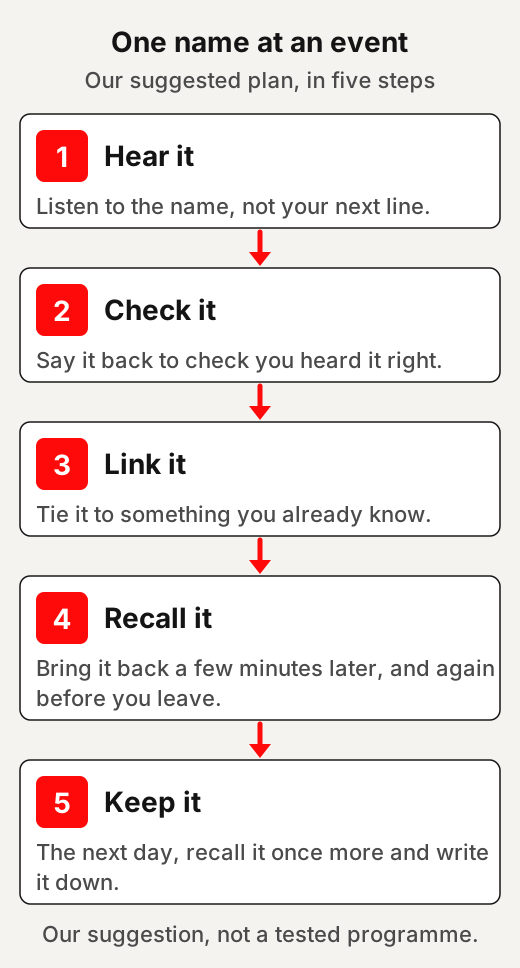
One name, five steps: this is the shape of the checklist below the article.
If it isn’t working
If names still slip away, try one of these.
- Too many names at once. Pick the three people you most want to remember, and recall only theirs.
- The conversation stalls. Go back to something they said earlier and ask one more question about it.
Quick answers
Why is it so hard to remember names?
A name tells you almost nothing about the person, so memory has little to hold it by. In a 1987 experiment, names were much harder to recall than jobs, even for words that can be both, such as Baker.
How can I remember someone's name?
Recall it from memory a few times, with gaps between. In a 2005 party experiment, recalling names led to 50% higher recall one to three days later.
What should I say if I forget someone's name?
Ask kindly, for example "Your name has slipped my mind. Can you tell me again?" In 1995 experiments, being remembered by name was taken as a compliment. Our reading: asking again shows you want to get it right.
Is small talk bad for you?
A 2018 replication found no reliable link between small talk and life satisfaction. It did find moderate links with substantive conversations, and these studies show links, not causes.
How do I end a conversation politely?
Sum up, thank the person, and leave. In two studies, conversations almost never ended when both people wanted them to, and people had little idea when their partner wanted to stop.
Use this
Our suggestion for your next event, built mostly from the habits above that hold up or partly hold up.
Could I say their name now, without looking it up?
Quick quiz
Nothing is scored or saved. Recalling it once now is what makes it last.
1. In a 2005 party experiment, how did the face-name picture trick compare with plain instructions to learn names?
Answer: It was no more effective.Read it again ↑
2. What is the liking gap?
Answer: People underestimate how much others like them after a chat.Read it again ↑
3. In two studies of 932 conversations, how often did a chat end when both people wanted it to?
Answer: Almost never.Read it again ↑
How we checked this · Last checked October 2026
- For the studies and reviews we read the abstracts through PubMed, OpenAlex and Europe PMC, and the 2022 Scientific Reports paper in full.
- We could not open the full text of the 2021 study on when conversations end (the pages were behind bot checks), so the page reports only what its abstract says.
- We did not open the 1978 chapter where expanding retrieval practice began; its origin is as cited in a 2007 paper.
- The test of saying a name aloud was a lab study of faces and names; we found no test in real conversations.
- Our wording on spacing matches our guide to learning faster, and on follow-up questions and names our summary of How to Win Friends and Influence People.
- The openers, exits and the plan for one name are our suggestions, not tested scripts.
Sources
- K. H. McWeeny, A. W. Young, D. C. Hay and A. W. Ellis, “Putting names to faces”, British Journal of Psychology 78(2), 1987.Scholarly
- S. M. Fresnoza and colleagues, “Modulation of proper name recall by transcranial direct current stimulation of the anterior temporal lobes”, Scientific Reports 12, 2022.Scholarly
- G. Cohen, “Why is it difficult to put names to faces?”, British Journal of Psychology 81(3), 1990.Scholarly
- S. Brédart and T. Valentine, “Descriptiveness and proper name retrieval”, Memory 6(2), 1998.Scholarly
- G. Cohen and D. M. Burke, “Memory for proper names: A review”, Memory 1(4), 1993.Scholarly
- J. M. Innes, “The next-in-line effect and the recall of structured and unstructured material”, British Journal of Social Psychology 21(1), 1982.Scholarly
- C. F. Bond, “The next-in-line effect: Encoding or retrieval deficit?”, Journal of Personality and Social Psychology 48(4), 1985.Scholarly
- C. F. Bond, U. Pitre and M. D. Van Leeuwen, “Encoding operations and the next-in-line effect”, Personality and Social Psychology Bulletin 17(4), 1991.Scholarly
- K. L. Hourihan and A. R. S. Smith, “Production does not improve memory for face–name associations”, Canadian Journal of Experimental Psychology 70(2), 2016.Scholarly
- P. E. Morris, C. O. Fritz, L. Jackson, E. Nichol and E. Roberts, “Strategies for learning proper names: expanding retrieval practice, meaning and imagery”, Applied Cognitive Psychology 19(6), 2005.Scholarly
- P. E. Morris and C. O. Fritz, “The name game: using retrieval practice to improve the learning of names”, Journal of Experimental Psychology: Applied 6(2), 2000.Scholarly
- P. E. Morris and C. O. Fritz, “The improved name game: better use of expanding retrieval practice”, Memory 10(4), 2002.Scholarly
- S. Brédart, “Strategies to Improve Name Learning”, European Psychologist 24(4), 2019.Scholarly
- J. D. Karpicke and H. L. Roediger, “Expanding retrieval practice promotes short-term retention, but equally spaced retrieval enhances long-term retention”, Journal of Experimental Psychology: Learning, Memory, and Cognition 33(4), 2007.Scholarly
- A. Latimier, H. Peyre and F. Ramus, “A Meta-Analytic Review of the Benefit of Spacing out Retrieval Practice Episodes on Retention”, Educational Psychology Review 33, 2021.Scholarly
- D. L. McCarty, “Investigation of a visual imagery mnemonic device for acquiring face-name associations”, Journal of Experimental Psychology: Human Learning and Memory 6(2), 1980.Scholarly
- A. Jaeger and colleagues, “The benefits of elaborative encoding over retrieval practice for associative learning”, Memory & Cognition 53(5), 2025 (online 2024).Scholarly
- S. Brédart and M. Geurten, “Strategies to resolve recall failures for proper names: New data”, Memory & Cognition 48(8), 2020.Scholarly
- D. J. Howard, C. Gengler and A. Jain, “What’s in a name?”, Journal of Consumer Research 22, 1995.Scholarly
- “Call me by my name”, Journal of Retailing, 2026.Scholarly
- M. Kardas, A. Kumar and N. Epley, “Overly shallow?: Miscalibrated expectations create a barrier to deeper conversation”, Journal of Personality and Social Psychology 122(3), 2022.Scholarly
- G. M. Sandstrom and E. J. Boothby, “Why do people avoid talking to strangers? A mini meta-analysis of predicted fears and actual experiences talking to a stranger”, Self and Identity 20(1), 2021 (online 2020).Scholarly
- N. Epley and J. Schroeder, “Mistakenly seeking solitude”, Journal of Experimental Psychology: General 143(5), 2014.Scholarly
- E. J. Boothby, G. Cooney, G. M. Sandstrom and M. S. Clark, “The liking gap in conversations: Do people like us more than we think?”, Psychological Science 29(11), 2018.Scholarly
- W. Wolf, A. Nafe and M. Tomasello, “The development of the liking gap”, Psychological Science 32(5), 2021.Scholarly
- H. Tissera and colleagues, “Evaluating the psychological and social nature of actual and perceived liking gaps”, Journal of Personality and Social Psychology 128(4), 2025.Scholarly
- K. Huang, M. Yeomans, A. W. Brooks, J. Minson and F. Gino, “It doesn’t hurt to ask”, Journal of Personality and Social Psychology 113 (2017), and its correction (2025).Scholarly
- A. N. Kluger and T. E. Malloy, “Question asking as a dyadic behavior”, Journal of Personality and Social Psychology 117 (2019).Scholarly
- M. Yeomans and colleagues, “It helps to ask”, Journal of Personality and Social Psychology (2019).Scholarly
- M. R. Mehl, S. Vazire, S. E. Holleran and C. S. Clark, “Eavesdropping on happiness”, Psychological Science 21(4), 2010.Scholarly
- A. Milek and colleagues, ""Eavesdropping on Happiness” revisited”, Psychological Science 29(9), 2018.Scholarly
- A. M. Mastroianni, D. T. Gilbert, G. Cooney and T. D. Wilson, “Do conversations end when people want them to?”, PNAS 118(10), 2021.Scholarly
Treat a name as something to bring back
Hearing a name is only the start. Recalling it later is what the research supports most. And if one slips, asking again is a way of saying you want to get it right.
Keep names past the first meeting
- Recall before you meet again. Our view: before a second meeting, try each name from memory first. Then check your notes.
- Note one link per name. Write the name beside the thing you linked it to. In lab tests, a link like that helped recall.
- Start a new group with a recall round. In one study, a group game built on recalling each other's names beat pairwise introductions.
- Use the name, but lightly. Once or twice in a chat is plenty. In one retail study, overusing a customer's name lowered satisfaction.
This week: test your own forecast
Before one conversation, guess how awkward a deeper question will feel. Ask it after the usual opener. Afterwards, compare your guess with how it went.
Put people skills to work
- Host meetups that open with a name round, so newcomers leave knowing a few people by name.
- Make a pocket card of openers, follow-ups and kind exits for conferences or community groups.
- Help event hosts plan introductions, so guests meet in small groups and hear names more than once.
Ideas to explore, not financial or business advice. No result is promised.
Keep going
- How to Win Friends, summarisedNames, listening and liking, and what holds up.
- Quiet, summarisedIf small talk drains you, what the research says about introverts.
- How to learn fasterRecall and spacing, the habits behind keeping a name.
- GlossaryPlain meanings for retrieval practice and other terms.