
Start hereOn average, feedback had a moderate positive effect on performance. But over 38% of the effects were negative. So what decides which way a comment goes?
To take criticism without getting defensive, pause before you reply, restate the comment as a point about the work, and ask one question before you decide. Feeling stung is normal. Below: why criticism stings, what feedback research found, what helps in the moment, and how to tell criticism from mistreatment.
1. What helps, at a glance
Most of what helps is slowing down and turning the comment into a question about the work.
| Idea | How it holds up | What it means for you |
|---|---|---|
| Being judged is a real stressor | Holds up, in lab studies | The sting is normal, not a flaw |
| Feedback always helps | Doesn’t hold up | Some comments won’t help, even true ones |
| Feedback works better aimed at the task | Partly | Turn each comment into a point about the work |
| The feedback sandwich helps people improve | Can’t confirm | Look for the middle; it’s the part to use |
| Writing about what you value first | Partly, small effects | Worth trying before a hard conversation |
| It is our view of an insult that stings | A philosophy, not a finding | A pause gives you a choice |
Each row is explained below, with how sure the evidence is.
2. Why criticism stings
Being judged by others is a real stressor, and criticism of your work can feel like criticism of you.
Being judged is a stressor
Holds up Your body reacts to being judged by others as a stressor. In lab studies, tasks where others could judge you badly raised cortisol, a stress hormone.
How sure: Moderate a review of 208 lab studies agrees, but everyday criticism at work was not what they tested.
A 2004 meta-analysis of 208 laboratory studies found that performance tasks raised cortisol when they were uncontrollable or carried social-evaluative threat. The authors defined that threat as a task where your performance could be negatively judged by others. Tasks with both elements brought the largest hormone changes and the longest times to recovery.
For example, a meeting where your work is picked apart in front of colleagues has both elements. You can’t control it, and people are judging you.
It can feel like a threat to who you are
People tend to protect their sense of being capable and decent, and criticism can press on it.
In a 2014 review, Geoffrey Cohen and David Sherman write that events threatening self-integrity “arouse stress and self-protective defenses that can hamper performance and growth”. They mean a global sense of being an adequate person. Two education researchers note that students often respond defensively to feedback, especially when comments are critical or grades are low.
Our reading: the urge to defend yourself is common, so it says little about you. Treat it as a cue to slow down.
For example, a comment about one report can feel like a verdict on whether you’re good at your job.
Our How to Win Friends and Influence People summary looks at the same problem from the giver’s side. Criticism, the book argues, makes people defend themselves rather than change.
3. What feedback research found
Feedback helps on average, but in a large share of results it made performance worse.
“Feedback always helps”
Doesn't hold up Any feedback on your work makes you better at it. In a large review, feedback helped on average but made things worse in more than a third of cases.
How sure: Strong a review of 607 results found it even after removing extreme studies, and a 2020 review also found negative effects.
In 1996, Avraham Kluger and Angelo DeNisi pooled 607 effect sizes from 131 papers, covering 12,652 participants. On average, feedback had a moderate positive effect on performance. But over 38% of the effects were negative. After they set aside one researcher’s studies of extreme negative feedback, 33% were still negative.
The authors wrote that the negative effects could not be explained by sampling error, by whether the feedback was positive or negative, or by existing theories. Their definition was broad: information from someone else about some aspect of how you performed a task.
Our reading: a comment can be accurate and still not help you. What you do with it decides much of that.
For example, a long list of corrections handed back with no way to ask about them may leave you less keen on the next draft, not more.
What the feedback points at
Partly Feedback works better when it points at the task than when it points at you. Feedback helped less when it drew attention away from the task and toward the self.
How sure: Moderate one 1996 review’s tests gave “reasonable support” to this part of a theory its authors called preliminary.
Kluger and DeNisi proposed that feedback becomes less effective as attention moves away from the task and closer to the self. In their analyses, praise and feedback that threatened self-esteem both weakened its effect. They called the support for this part of their theory “reasonable”, and for the theory as a whole “partial”.
A 2020 meta-analysis of 435 education studies found a medium effect of feedback on learning overall. In that analysis, 17% of the effects were negative. How much it helped depended on how much information the feedback carried. Feedback that only rewarded or punished had a low effect. Feedback that also corrected the work and helped students monitor their attention, emotions or motivation had a very large one.
For example, you’re careless points at you and tells you nothing. Two totals in the table are wrong points at the work and tells you what to fix.
Four ways people respond
When feedback shows a gap, people close it in one of four ways, and rejecting the message is one of them.
Kluger and DeNisi describe four ways people close the gap between feedback and their goal: try harder, give up the goal, lower it, or reject the feedback. They note that negative feedback seems more likely than positive feedback to be rejected. They add that this may differ between cultures.
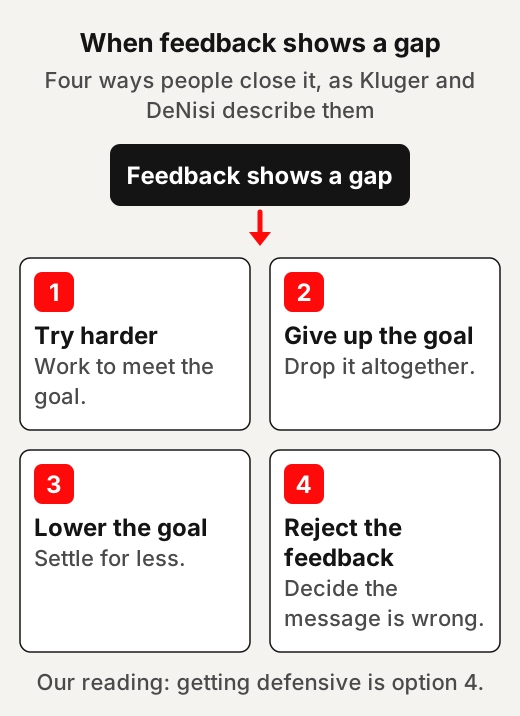
Our reading: getting defensive is the fourth option. Sometimes it is the right one, because the comment is wrong. The aim is to choose it on purpose, not by reflex.
For example, say a teacher marks your essay down for its structure. You can rework it, decide essays aren’t for you, settle for a lower mark, or decide the teacher is wrong. If the teacher is right, only the first keeps your goal and improves the work.
4. What helps in the moment
Slow down, find the part about the work, and ask one question before you decide.
Separate the message from the delivery
A comment can be rude and right, or polite and wrong, so judge what it says on its own.
This is our suggestion, not a tested method. It follows from the review above, where feedback helped less when attention went to the self. In practice, rewrite the comment in neutral words, as a statement about the work.
For example, “This is sloppy” becomes “The numbers in table 2 don’t add up.” Now you can check whether that is true.
Ask one clarifying question
A short question turns a vague comment into something you can act on.
This is also our suggestion. In a framework they propose for “feedback literate” students, two education researchers list being “proactive in eliciting suggestions from peers or teachers and continuing dialogue with them as needed”. It fits the 2020 finding above, too: feedback that carried more information helped more.
For example, you might ask “Can you show me where?”, “What would better look like?” or “Which part matters most?”
One limit. A 2015 meta-analysis found that seeking feedback in general had only a small relationship with performance. Our reading: ask to understand the comment, not to look keen.
The feedback sandwich
Can't confirm Wrapping criticism between two compliments helps people improve. People often like it, but the few small tests of what it does to later performance point different ways.
How sure: Limited a handful of small studies, and they disagree about whether it helps later performance.
A 2013 paper notes that the sandwich, positive comments, then critique, then positive comments, is commonly recommended despite scant evidence that it works. In its two studies of written peer feedback among third-year medical students, students thought sandwiches improved later performance when there was no evidence that they did.
In a 2015 study of undergraduates doing simulated office tasks, the sandwich was not the most effective order of feedback. But in a 2020 experiment, 91 university students got sandwich feedback, only the corrections, or no feedback on maths problems. Those given the sandwich spent more time preparing and solved more problems in a second set than the other two groups. Its authors call this “only partial evidence” from one specific condition, and say further replications are needed.
In a 2023 study of 69 dental students, students tended to favour the sandwich, though overall ratings did not differ significantly from another method. A 2020 paper by medical educators argues that involving learners in feedback could make the sandwich redundant.
Our reading: if you are handed a sandwich, the filling is the part to use. For example, from “Great energy! The middle ran long. Loved the ending”, take away the middle ran long.
Write about what you value
Partly Writing briefly about a value you care about makes hard messages easier to accept. It helped in many experiments, but the effects are small, and a large school replication found no effect on school results.
How sure: Moderate a meta-analysis of 144 tests found small effects; a well-powered school replication found none on school results.
The idea comes from self-affirmation theory. It says people want to see themselves as moral, competent and in control, and feel uncomfortable when that picture is challenged.
Cohen and Sherman write that self-affirmation exercises typically have people write about core personal values. A 2008 paper notes that earlier research had repeatedly found that writing about an important value, rather than an unimportant one, reduces defensiveness to threatening information. In its second study, with smokers reading that smoking harms health, loving and connected feelings, not feelings about the self, accounted for the effect.
A 2015 meta-analysis by Epton and colleagues pooled 144 experimental tests of self-affirmation alongside health-risk information. It found “small but reliable positive effects” on accepting the message, on intentions to change and on later behaviour. But in schools, values-writing has been tried as a way to narrow achievement gaps. A well-powered 2017 replication, in a setting where an earlier large experiment had found benefits and using the same procedures, showed no evidence of effects.
Much of this research tested health messages and schools, not criticism at work. Our affirmations guide covers it in more depth. For example, before a performance review, spend five minutes writing about why a value you hold, such as doing careful work, matters to you.
The Stoic angle
Epictetus taught that what upsets us is our view of what was said, and that view is ours to examine. This is a philosophy, not a study.
For example, when a colleague’s remark stings, the Stoic move would be to notice what you are telling yourself about it before you answer.
Epictetus’s handbook says: “Men are disturbed not by things, but by the views which they take of things”. On being provoked, he wrote: “When, therefore, anyone provokes you, be assured that it is your own opinion which provokes you”. He suggests gaining “time and respite” before responding. If someone speaks ill of you, his suggested reply is: “He was ignorant of my other faults, else he would not have mentioned these alone”.
Our reading: Epictetus isn’t saying the critic is right or wrong. He moves the moment of choice from the critic to you. Our Enchiridion summary and guide to Stoicism go further.
Two of our book summaries add related ideas. Think Again asks who is in your “challenge network” of thoughtful critics. Mindset covers the argument that how you see ability shapes how you meet setbacks, an idea whose lab tests are mixed.
5. When criticism is mistreatment
Fair criticism is about your work; mistreatment targets you, keeps coming or humiliates, and official guidance draws that line too.
Some hard comments are not feedback at all. The guidance below is written for workplaces, and rules differ from country to country.
The Canadian Centre for Occupational Health and Safety says bullying usually involves repeated incidents or a pattern of behaviour meant to intimidate, offend, degrade or humiliate. Its examples include “Criticizing a person persistently or constantly”. It adds that bullying may be one incident, “especially one with a lasting effect”. Citing WorkSafeBC, it says that offering constructive feedback, guidance or advice about work-related behaviour is not bullying.
The UK’s Acas says there is no legal definition of bullying. It describes bullying as unwanted behaviour that is offensive, intimidating, malicious or insulting, or an abuse or misuse of power that undermines, humiliates or causes harm. It adds that bullying can be a regular pattern or a one-off incident. Unlike the Canadian page, it says behaviour can still be bullying even if the person does not intend it. Its examples include “constantly criticising someone’s work”.
| Constructive feedback | Bullying, as the guidance describes it | |
|---|---|---|
| Meant to | Assist you with your work | Intimidate, offend, degrade or humiliate (Canada); Acas says it can be bullying even when not intended |
| How often | — | Usually a pattern, though both say a single incident can count |
| What it says | Feedback, guidance or advice about work-related behaviour | Criticising someone persistently or constantly |
For anyone who thinks they are being bullied, the Canadian centre suggests keeping a factual record of dates, times, what happened and any witnesses. It also suggests learning your organisation’s policies and reporting it to the person your workplace policy names, or to a supervisor. And it adds: “Understand that if you begin to question your own competence, the problem may not be you.”
What applies to you depends on where you live and work. Your HR team, a union or a local employment adviser can tell you. If the way you are treated is affecting your sleep, mood or health, talk to a doctor.
6. A simple routine for next time
This is our suggestion, built from the ideas above; it has not been tested as a routine.
- Pause. Say you’d like to think about it, rather than answering straight away.
- Restate it. Write the comment as a neutral point about the work.
- Ask one question. What would better look like? is often enough.
- Sort it. Is it accurate, partly accurate, or not? Keep what holds up.
- Act on one thing. Pick one change and make it.
If the comment targets you rather than the work, or keeps coming, go back to section 5.
Quick answers
Why do I get defensive when someone criticises me?
Being judged is a real stressor. In lab studies, tasks where others could judge your performance negatively raised cortisol, and a 2014 review says threats to self-integrity arouse stress and self-protective defences.
Does the feedback sandwich work?
We can't say yet. The few studies are small and disagree: two studies with medical students found no evidence that sandwiches improved later performance, though students thought they did, while a 2020 experiment with 91 university students found a benefit on maths problems.
Does feedback always improve performance?
No. A 1996 review of 607 results found that feedback helped on average, but over 38% of the effects were negative.
When does criticism at work become bullying?
Canada's occupational health centre lists criticising a person persistently or constantly as an example of bullying, and says constructive feedback about work-related behaviour is not bullying. Rules differ by country, so check the guidance where you work.
What did Epictetus say about insults?
In his handbook, Epictetus wrote that when anyone provokes you, "it is your own opinion which provokes you". He suggests gaining "time and respite" before responding.
Use this
Our suggestion, built from the ideas above; it has not been tested as a routine.
Is this about the work, and what is one thing I can use?
Quick quiz
Nothing is scored or saved. Recalling it once now is what makes it last.
1. In the 1996 review of feedback studies, what share of the effects were negative?
Answer: Over 38%.Read it again ↑
2. What did the 2013 study of medical students find about the feedback sandwich?
Answer: Students thought it helped, but there was no evidence that it did.Read it again ↑
3. Which of these does Canada's occupational health centre list as an example of bullying?
Answer: Criticizing a person persistently or constantly.Read it again ↑
How we checked this · Last checked October 2026
- For the research we read abstracts through PubMed and OpenAlex, and the full text where we could, including the 1996 feedback review, the 2020 feedback meta-analysis and the accepted manuscript of the 2018 feedback-literacy paper.
- We read Epictetus in T. W. Higginson's translation, and the official bullying guidance on the CCOHS (Canada) and Acas (UK) websites.
- The routine is our own suggestion. We found no study that tests it as a whole.
- On the feedback sandwich, the few studies we found disagree, so we give each one and do not lean either way.
- We could not open the publisher's page for the 1996 review, so its figures come from the paper's full text and the abstract record.
- Our wording on self-affirmation, Epictetus and Carnegie matches our affirmations guide and our Enchiridion and How to Win Friends summaries.
Sources
- S. S. Dickerson and M. E. Kemeny, “Acute stressors and cortisol responses: a theoretical integration and synthesis of laboratory research”, Psychological Bulletin 130(3), 2004.Scholarly
- G. L. Cohen and D. K. Sherman, “The psychology of change: self-affirmation and social psychological intervention”, Annual Review of Psychology 65, 2014.Scholarly
- D. Carless and D. Boud, “The development of student feedback literacy: enabling uptake of feedback”, Assessment & Evaluation in Higher Education 43(8), 2018.Scholarly
- A. N. Kluger and A. DeNisi, “The effects of feedback interventions on performance: A historical review, a meta-analysis, and a preliminary feedback intervention theory”, Psychological Bulletin 119(2), 1996.Scholarly
- B. Wisniewski, K. Zierer and J. Hattie, “The Power of Feedback Revisited: A Meta-Analysis of Educational Feedback Research”, Frontiers in Psychology 10, 2020.Scholarly
- F. Anseel and colleagues, “How Are We Doing After 30 Years? A Meta-Analytic Review of the Antecedents and Outcomes of Feedback-Seeking Behavior”, Journal of Management 41(1), 2015.Scholarly
- J. Parkes, S. Abercrombie and T. McCarty, “Feedback sandwiches affect perceptions but not performance”, Advances in Health Sciences Education 18(3), 2013.Scholarly
- A. J. Henley and F. D. DiGennaro Reed, “Should You Order the Feedback Sandwich? Efficacy of Feedback Sequence and Timing”, Journal of Organizational Behavior Management 35(3-4), 2015.Scholarly
- J. Procházka, M. Ovčaří and M. Ďuriník, “Sandwich feedback: The empirical evidence of its effectiveness”, Learning and Motivation 71, 2020.Scholarly
- G. S. S. Lin and colleagues, “The use of feedback in teaching undergraduate dental students: feedback sandwich or Ask-Tell-Ask model?”, BMC Oral Health 23, 2023.Scholarly
- E. Molloy and colleagues, “Challenging feedback myths: Values, learner involvement and promoting effects beyond the immediate task”, Medical Education 54(1), 2020.Scholarly
- American Psychological Association, APA Dictionary of Psychology, “self-affirmation theory”.Scholarly
- J. Crocker, Y. Niiya and D. Mischkowski, “Why does writing about important values reduce defensiveness? Self-affirmation and the role of positive other-directed feelings”, Psychological Science 19(7), 2008.Scholarly
- T. Epton and colleagues, “The impact of self-affirmation on health-behavior change: a meta-analysis”, Health Psychology 34(3), 2015.Scholarly
- P. Hanselman and colleagues, “New Evidence on Self-Affirmation Effects and Theorized Sources of Heterogeneity from Large-Scale Replications”, Journal of Educational Psychology 109(3), 2017.Scholarly
- Epictetus, The Enchiridion, chapters 5, 20 and 33, translated by T. W. Higginson (Project Gutenberg).Primary
- Canadian Centre for Occupational Health and Safety, “Bullying in the Workplace”, OSH Answers.Primary
- Acas, “What bullying is”.Primary
- MedlinePlus, “Cortisol Test”, US National Library of Medicine.Scholarly
Make defending yourself a choice
Rejecting a comment is one of four ways people respond, and sometimes it's right. Our view: the aim is to choose it on purpose, not by reflex. A pause is what gives you that choice.
Keep a feedback file
- Log each comment in neutral words. Our view: note the date, the point about the work, and what you changed, if anything.
- Look for repeats. Our view: a point two people raise separately deserves more of your attention than a one-off.
- Mark which comments helped. In a 2020 review of education studies, feedback that carried more information helped more. Your file will show which kind you get.
- Close the loop. Our view: tell the person what you changed. It shows the comment was used.
This week: ask about one piece of work
Ask one person for feedback on a single piece of work, and name the part you'd like looked at. Ask to understand the answer, not to look keen.
If you think it may be bullying
- Keep a factual record. The Canadian guidance suggests noting dates, times, what happened and any witnesses.
- Read your workplace policy. If there is one, it may name who to report to. Rules differ from country to country.
- Ask who can tell you what applies. Your HR team, a union or a local employment adviser can tell you.
- Look after your health. If the way you are treated is affecting your sleep, mood or health, talk to a doctor.
Turn useful feedback into work
- Review documents for small businesses, with each note tied to a specific line or figure.
- Help managers rewrite vague review comments as specific points about the work.
- Give written notes on presentations or pitches, slide by slide, with one main change marked.
Ideas to explore, not financial or business advice. No result is promised.
Keep going
- The Enchiridion, summarisedEpictetus on the views we take of things.
- Think Again, summarisedBuilding a challenge network of thoughtful critics.
- The science behind affirmationsMore on values-writing and what the research found.
- Stoic journalA checked Stoic line each day, with a question to write about.