Start hereIn 1974, when WHO's programme to vaccinate every child began, fewer than 5% of infants worldwide could get routine vaccinations. In 2025, 85% of infants got three doses of the DTP vaccine. How did the world get from one to the other?
For most of history, about half of all children died young, and smallpox killed people around the world. Below: what life was like before vaccines, how it changed, what the numbers say now, and one small way to see it for yourself.
1. Life before vaccines
For most of history, about half of all children died young, and smallpox was one of the great killers.
Child deaths were a normal part of family life almost everywhere. Our World in Data’s review of the historical research found that, “No matter where in the world a child was born, about half of them died”. That review rests mostly on studies gathered by the researchers Anthony Volk and Jeremy Atkinson.
For example, in a class of 30 children back then, about 15 would not have grown up, on those estimates.
Smallpox was a contagious disease caused by the variola virus. WHO says it plagued humanity for at least 3,000 years and killed 300 million people in the 20th century alone. It killed up to 30% of the people who caught it.
Other diseases took their share. In the early 20th century, polio paralysed hundreds of thousands of children every year in industrialised countries.
Life expectancy was short on average. Life expectancy is the average number of years a person could expect to live if the death rates of that year held for the rest of their life. Rough long-run estimates put the world average at 28.5 years in 1800 and 32 years in 1900.
These old figures are estimates pieced together from records and skeletons, so treat them as rough.
2. How it changed
It took nearly two centuries, from one country doctor’s test in 1796 to the end of smallpox in 1980.
Variolation came first
People were protecting themselves against smallpox long before the word “vaccine” existed.
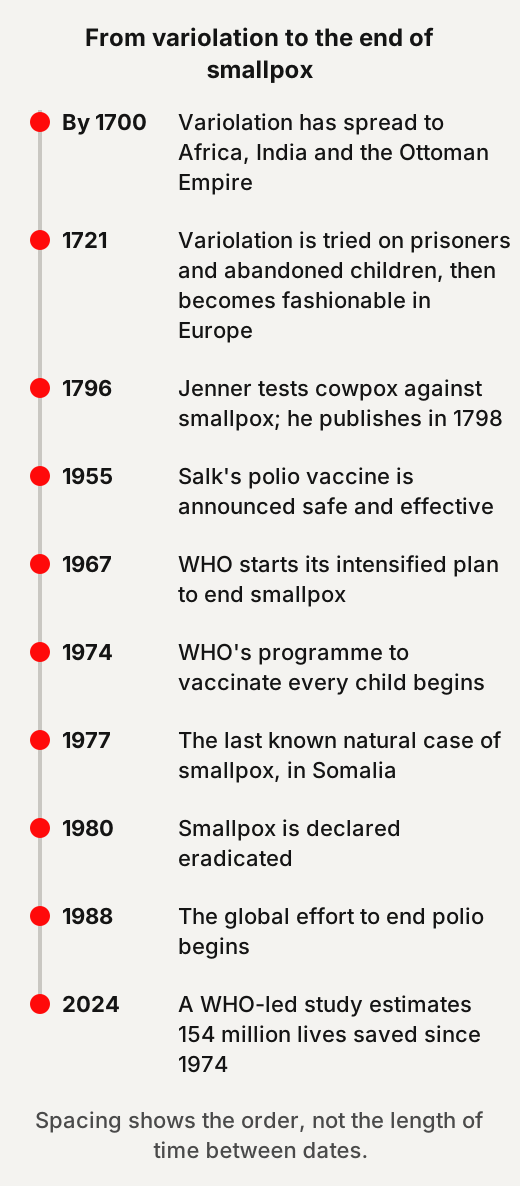
The older method, called variolation, gave a healthy person a mild case of smallpox on purpose. Practitioners in Asia blew dried smallpox scabs into the nose. By 1700 the practice had spread to Africa, India and the Ottoman Empire. Between 1% and 2% of people who were variolated died, compared with 30% of those who caught smallpox naturally.
It was safer than catching smallpox, but never risk-free: the person could die, or pass the disease on. For example, think of it as a controlled fire, which still burned some houses down.
Jenner’s cowpox, 1796
In 1796 Edward Jenner showed that cowpox, a milder disease caught from cows, could protect against smallpox.
Jenner noticed that milkmaids who had caught cowpox did not catch smallpox. On 14 May 1796 he put matter from a dairymaid’s cowpox sore into the arm of a healthy boy of about eight. He later exposed the boy, James Phipps, to smallpox, which the boy did not catch. Jenner published his findings in 1798.
WHO calls Jenner’s smallpox vaccine the first successful vaccine. A vaccine trains the immune system to recognise a disease before you meet it.
Jenner was not the first to try cowpox: in 1774 a farmer, Benjamin Jesty, inoculated his wife and two sons with it. Those earlier tries were not written up and spread, which is why Jenner’s published work is the one remembered.
A programme for every child
In the 20th century more vaccines arrived, and from 1974 WHO set out to reach every child.
In 1974 the World Health Assembly founded the Expanded Programme on Immunization (EPI), to vaccinate all children against diphtheria, measles, pertussis, polio, tetanus, tuberculosis and smallpox. When it began, fewer than 5% of infants worldwide could get routine vaccinations.
The programme still runs, now under the name Essential Programme on Immunization.
The end of smallpox
Smallpox was declared eradicated in 1980, after a worldwide campaign stepped up in 1967.
Eradicated means gone from the whole world, not just kept low. WHO launched an intensified plan to eradicate smallpox in 1967. The last known natural case was in Somalia in 1977.
A panel of scientists from 19 nations certified the world free of smallpox in December 1979. In May 1980 the World Health Assembly declared that “the world and all its peoples have won freedom from smallpox”.
Polio, nearly there
Wild polio cases have fallen by over 99% since 1988, but the disease is not gone yet.
In most of the world, a disease that once paralysed children every year is now rare. The Global Polio Eradication Initiative began in 1988. Since then, cases caused by wild poliovirus have fallen by over 99%, from an estimated 350,000 cases in more than 125 countries. In 2020 Africa became the fifth WHO region certified free of wild poliovirus. Of the three types of wild poliovirus, types 2 and 3 have been certified eradicated, and only type 1 remains. A second form, circulating vaccine-derived poliovirus, can also spread within communities; GPEI says such cases are rare but have been increasing in recent years because of low immunization rates in some communities.
So the job is down to one wild type in two countries, plus outbreaks of the vaccine-derived form.
3. What the numbers say now
A WHO-led study estimates that vaccines saved about 154 million lives between 1974 and 2024, most of them babies.
A 2024 modelling study in The Lancet, led by WHO, estimated that vaccination against 14 diseases averted 154 million deaths since 1974. Of those, 101 million were babies under one year old.
A model compares the real world with an imagined world without vaccines, so the figure is an estimate, not a count.
The authors call it “a minimum conservative estimate of vaccine impact”. It leaves smallpox out, because the model assumed a world already free of it. They also say they could not carry the uncertainty through every level of the estimate.
Most babies are now reached, but not all. WHO reports that 85% of infants got three doses of the DTP vaccine in 2025, while 13.5 million children got no vaccines at all. The DTP vaccine protects against diphtheria, tetanus and pertussis (whooping cough).
Far more children now reach their fifth birthday. The under-five mortality rate is the chance that a newborn dies before age five. WHO says it has fallen by about 60% since 1990. Even so, an estimated 4.9 million children under five died in 2024. Progress has slowed markedly since 2015.
People live much longer too. The UN puts global life expectancy at birth at 73.3 years in 2024. That is 8.4 years more than in 1995.
During the COVID-19 pandemic it fell to 70.9 years, from 72.6 in 2019, and it has since recovered in nearly all countries. Next to the rough estimate of 32 years in 1900, that is more than double.
Many causes, not one
Vaccines are a big part of the story, but the sources credit several causes working together.
The WHO-led study gives vaccines a large share, not all of it. It estimated that vaccination accounted for 40% of the fall in the global infant death rate since 1974. That leaves the larger part, 60%, to other causes.
WHO links the fall in child deaths since 1990 to more vaccination, better nutrition, better care of childhood illnesses and more skilled health workers at birth. The UN credits the longer human lifespan to improvements in public health, nutrition, personal hygiene and medicine.
In practice, it is a team effort: food, hygiene, care at birth and vaccines each do part of the work.
4. Half-truths people repeat
Most of these hold a grain of truth; the details are what make them useful.
“People in the past died at 30”
Doesn't hold up Before modern medicine, most people died around the age of 30. An average near 30 included the many children who died; adults who got through childhood often lived much longer.
How sure: Moderate long-run estimates and studies of hunter-gatherer groups agree, though old records are patchy.
A low average does not mean most people died at that age. For example, if half of a group die as babies and the other half live to 60, the average is only about 30.
Our World in Data says high child mortality “contributed significantly to short lifespans in the past”. A 2007 study of hunter-gatherer and small-scale farming groups found that living past the child-bearing years is “not only a recent phenomenon”.
“Longer lives only mean fewer children dying”
Partly Life expectancy rose only because fewer children died. Fewer child deaths did much of the work, but people now live longer at every age.
How sure: Moderate a long-run data compilation shows gains at all ages; we did not re-check the age-by-age figures ourselves.
Fewer child deaths explain a big share of the rise, not all of it. Our World in Data calls it “a common misconception that life expectancy has only increased because of declines in child mortality”. It adds that in recent decades, falling child deaths have added much less to life expectancy.
“Vaccines are why we live longer”
Partly Vaccines are the reason people live so much longer today. In one major estimate, vaccines are the biggest single help to babies’ survival, but not the only cause.
How sure: Moderate one large WHO-led model supports it; models rest on assumptions about a world without vaccines.
Vaccines lead the list for babies, alongside food, hygiene and care. The WHO-led study judged that the vaccination programme (EPI) “has provided the single greatest contribution to improved infant survival over the past 50 years”. WHO’s own summary adds that social, economic and educational changes also helped cut deaths.
“Jenner invented immunisation”
Partly Edward Jenner invented the idea of protecting people against smallpox. WHO calls his the first successful vaccine, but variolation and earlier cowpox tries came before him.
How sure: Strong WHO, the US National Library of Medicine and medical historians tell the same history.
Jenner improved on an older idea rather than starting from nothing. In 1721, urged by Lady Mary Wortley Montagu and the Princess of Wales, doctors tried variolation on prisoners and abandoned children, and it then became fashionable in Europe.
“Smallpox is the only disease ever eradicated”
Holds up Smallpox is the only human disease ever eradicated. It is; the only other disease declared eradicated, rinderpest, struck cattle.
How sure: Strong WHO and the World Organisation for Animal Health both say so.
Smallpox remains the only human example. WHO calls smallpox “the only human disease ever eradicated”. The World Organisation for Animal Health calls rinderpest “the second infectious disease, after smallpox for humans”, to be eradicated.
“Polio is gone, like smallpox”
Doesn't hold up Polio has been eradicated, like smallpox. Not yet: two of the three wild types are gone, but type 1 still spreads in two countries.
How sure: Strong WHO and the Global Polio Eradication Initiative both say wild type 1 still circulates.
The end is close, not here. WHO says wild poliovirus is still passed on in parts of Afghanistan and Pakistan. In October 2026 the Global Polio Eradication Initiative was also still reporting cases of vaccine-derived polio in several African countries.
5. One small way to appreciate it
Look up your country’s vaccination schedule: one table lists the vaccines offered where you live, by age.
WHO publishes each country’s vaccination schedule, as countries report it every year on a joint WHO and UNICEF form. Each country sets its own schedule, so the list differs from place to place. For example, read down the list and count how many of those diseases you have ever seen yourself.
This page describes history and data; it is not medical advice. For anything about your own or your child’s vaccinations, talk to a doctor or your health service.
For a wider look at how the world has changed, see our summary of Factfulness. For an older story of disease, see the Black Death.
Quick answers
Who invented the smallpox vaccine?
Edward Jenner made what WHO calls the first successful vaccine, against smallpox, testing it in 1796 and publishing in 1798. A farmer, Benjamin Jesty, had already used cowpox on his family in 1774, and the older method, variolation, was in use in Asia, Africa and Europe.
When was smallpox eradicated?
The last known natural case was in Somalia in 1977. A panel of scientists from 19 nations certified the world free of smallpox in December 1979, and the World Health Assembly declared it in May 1980.
How many lives have vaccines saved?
A WHO-led modelling study estimated 154 million deaths averted between 1974 and 2024, 101 million of them babies. Its authors call it a minimum conservative estimate.
Did people in the past really die at 30?
Mostly not. Rough estimates put world life expectancy at 28.5 years in 1800, but that average included the many children who died; adults who got through childhood often lived much longer.
Is polio eradicated?
Not yet. Wild polio cases have fallen by over 99% since 1988, and two of the three wild types have been certified eradicated. WHO says type 1 is still passed on in parts of Afghanistan and Pakistan, and outbreaks of vaccine-derived polio are still reported.
Use this
Our suggestion: three small ways to see this history for yourself. None of them is medical advice.
Is this a question about history, or one for my doctor or health service?
Quick quiz
Nothing is scored or saved. Recalling it once now is what makes it last.
1. What did variolation involve?
Answer: Giving a healthy person a mild case of smallpox on purpose.Read it again ↑
2. When was the last known natural case of smallpox?
Answer: 1977.Read it again ↑
3. In the WHO-led study, what share of the fall in the infant death rate since 1974 came from vaccination?
Answer: About 40%.Read it again ↑
How we checked this · Last checked October 2026
- We read WHO's pages on smallpox, polio, child deaths and vaccine coverage, the WHO-led 2024 Lancet study in full, and the UN's 2024 population report.
- The history comes from the US National Library of Medicine's smallpox exhibit, Jenner's own 1798 book and the Salk Institute.
- Figures from before 1950 are rough estimates. We used Our World in Data's long-run compilation and could not open the original 2013 study of child deaths it summarises.
- This page covers history and data only. It gives no medical advice.
Sources
Life before vaccines and how it changed
- Our World in Data, M. Roser, “Mortality in the past: every second child died” (June 2019, last updated November 2024), drawing on Volk and Atkinson, Evolution and Human Behavior 34 (2013).Popular
- Our World in Data, “Life expectancy” long-run data (Riley 2005 for regions before 1950; UN World Population Prospects 2024 after), and the life expectancy topic page.Popular
- World Health Organization, “Smallpox”, health topic page.Primary
- World Health Organization, “WHO commemorates the 40th anniversary of smallpox eradication” (13 December 2019).Primary
- US National Library of Medicine, Smallpox: A Great and Terrible Scourge, “Variolation” and “Vaccination” (last reviewed 5 March 2024).Popular
- E. Jenner, An Inquiry into the Causes and Effects of the Variolae Vaccinae (London, 1798), Case XVII (Project Gutenberg #29414).Primary
- J. G. Breman, “Smallpox”, The Journal of Infectious Diseases 224 Suppl 4 (2021), S379–S386.Scholarly
- D. A. Montero et al., “Two centuries of vaccination: historical and conceptual approach and future perspectives”, Frontiers in Public Health 11 (2023), 1326154.Scholarly
- Salk Institute, “Jonas Salk”.Primary
- Global Polio Eradication Initiative, “History of polio”.Primary
- World Health Organization, “Poliomyelitis”, fact sheet.Primary
- World Health Organization, “Two out of three wild poliovirus strains eradicated” (24 October 2019).Primary
- Global Polio Eradication Initiative, “Vaccine-derived polioviruses” and “Polio this week” (country updates as of 21 October 2026).Primary
- World Organisation for Animal Health, “Rinderpest”.Primary
What the numbers say now
- A. J. Shattock et al., “Contribution of vaccination to improved survival and health: modelling 50 years of the Expanded Programme on Immunization”, The Lancet 403 (2024), 2307–2316 (full text).Scholarly
- World Health Organization, “Global immunization efforts have saved at least 154 million lives over the past 50 years” (24 April 2024).Primary
- World Health Organization, “Immunization coverage”, fact sheet (15 July 2026).Primary
- World Health Organization, “Child mortality (under 5 years)”, fact sheet.Primary
- United Nations, Department of Economic and Social Affairs, World Population Prospects 2024: Summary of Results.Primary
- M. Gurven and H. Kaplan, “Longevity among hunter-gatherers: a cross-cultural examination”, Population and Development Review 33 (2007).Scholarly
Finding your schedule
- World Health Organization, Immunization Data portal, “Vaccination schedule”.Primary
A big change, with many hands in it
Our World in Data's review of historical research found that about half of all children died young. A WHO-led model credits vaccination with 40% of the fall in the infant death rate since 1974. WHO and the UN also credit nutrition, hygiene and medical care. Our view: give vaccines their large share, and keep the other causes in the picture.
Tell the story with everyone in it
- Start before Jenner. Variolation gave a healthy person a mild case of smallpox on purpose. By 1700 it had spread to Africa, India and the Ottoman Empire.
- Keep its risk in view. The US National Library of Medicine says 1% to 2% of variolated people died. Of those who caught smallpox naturally, 30% died.
- Name the earlier cowpox tries. Medical historians record that in 1774 a farmer, Benjamin Jesty, inoculated his wife and two sons with cowpox. They say such tries were not written up and spread.
- Credit what WHO credits. WHO calls Jenner's smallpox vaccine the first successful vaccine. He inoculated a boy with cowpox on 14 May 1796 and published in 1798.
- Count the campaign years too. WHO stepped up its plan in 1967. The last known natural case was in Somalia in 1977. The World Health Assembly declared smallpox eradicated in May 1980.
Four questions for a big health figure
- Is it a count or a model? The 154 million comes from a WHO-led model in The Lancet. It compares the real world with an imagined one without vaccines.
- How sure are the authors? They call it "a minimum conservative estimate of vaccine impact". They also say they could not carry the uncertainty through every level.
- What is left out? The model leaves smallpox out, because it assumed a world already free of it.
- Who is still missed? WHO reports that 85% of infants got three doses of the DTP vaccine in 2025. Yet 13.5 million children got no vaccines at all that year.
- Reuse the questions. Our suggestion: ask the same four questions of the next big figure you read.
This week: read one schedule as history
Our suggestion: set aside a few minutes this week and open WHO's Immunization Data portal. Find your country's vaccination schedule, and note which vaccines come in the first year of life. Set that beside the WHO-led estimate that 101 million of the deaths averted since 1974 were babies under one. Treat this as learning, not a health check. For your own or your child's vaccinations, talk to a doctor or your health service.
Keep going
- Factfulness, summarisedHans Rosling's ten instincts, his test of world facts, and which figures still hold.
- The Black DeathWhere it began, how far it spread, how many died, and nine famous stories set beside the record.
- Clean tap waterHow tap water went from dangerous to normal, and where it still is not.
- Electric lightWhat light cost before electricity, how it changed, and who still lives without it.
- The internetHow messages travelled before the internet, how the network and the web arrived, and who is online now.
- How to read a studyNine plain-language questions for reading any scientific study, with the sources behind each point.
- GlossaryPlain meanings of vaccine, variolation, life expectancy and under-five mortality rate.