

Start hereIn 1854, within 250 yards of one London street corner, there were upwards of 500 fatal cholera attacks in ten days. The doctor John Snow linked them to a public pump. Why was water once so dangerous, and what changed?
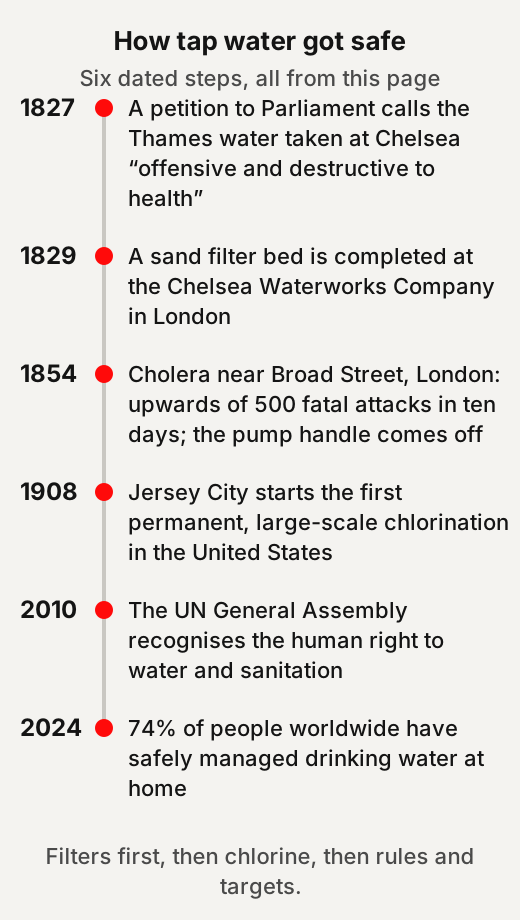
Safe water from a tap is recent. In 1827, a petition called the Thames water supplied to part of London “offensive and destructive to health”. In 2024, about three in four people had safely managed drinking water at home, and one in four still did not. Here is how it changed, and one small way to use what you have.
1. Before: water that made people ill
In 1800s London, drinking water came from a polluted river and from street pumps. One of the city’s water companies, Chelsea Waterworks, took its water from the Thames.
In 1827 a petition to Parliament said the Thames water taken at Chelsea was “offensive and destructive to health”. It said the river carried “the drainings from dunghills” and “the refuse of hospitals”.
Water like that can carry disease. WHO lists diarrhoea, cholera, dysentery, typhoid and polio among the illnesses that contaminated drinking water can spread.
In the United States in 1900, diarrhoea and enteritis were among the three leading causes of death, with pneumonia and tuberculosis. Together with diphtheria, they caused one third of all deaths.
The Broad Street pump, 1854
In 1854, cholera killed hundreds of people around one London street in ten days. The doctor John Snow linked it to a public pump.
Within 250 yards of the spot where Cambridge Street joins Broad Street, near Golden Square, there were upwards of 500 fatal attacks of cholera in ten days. Snow found no particular rise in cholera in that part of London except among people in the habit of drinking from one pump-well. He put this to the parish’s Board of Guardians on the evening of 7 September, and the pump’s handle was removed the next day.
Snow added that the toll would have been much greater if so many people had not fled the area. He also compared the customers of two water companies. Our page on correlation and causation walks through his figures.
2. How it changed
Water got safer in steps: first filters, then chlorine, then national rules and a global target.
Sand filters
Running river water slowly through sand was one of the first big fixes. In practice, the water trickles down through the sand. A thin living layer near the top does the cleaning.
James Simpson, chief engineer of the Chelsea Waterworks Company, completed a prototype sand filter bed at the company’s works by 1829. It used beds of loose brick, gravel and sand. Sand filters work through a gelatinous layer, or biofilm, in the top few millimetres of fine sand.
Modern sand filters can cut the count of bacteria in water by 90 to 99%.
Chlorine
From the early 1900s, adding chlorine to kill germs, called chlorination, became normal practice.
Chlorination and other treatments of drinking water began in the early 1900s and became widespread, further cutting waterborne disease. In 1908 the Jersey City Water Works became the first system in the United States to practise large-scale chlorination on a permanent basis.
Chlorine left in the water can still act in the pipes, against germs that may get in through leaks and breaks. For example, it lets water treated at a plant miles away carry some protection on its way to you.
Rules and a right
Today WHO’s guidelines are a common basis for national drinking-water rules, and safe water is recognised as a human right. In practice, the rules that apply to your tap come from where you live. Some supplies, such as many private wells, sit outside them.
WHO’s drinking-water guidelines, in their 2022 edition, build on over 60 years of WHO guidance and have formed an authoritative basis for national regulations and standards. In 2010 the UN General Assembly explicitly recognised the human right to water and sanitation.
3. What the numbers say now
About three in four people had safely managed drinking water at home in 2024; one in four did not. Safely managed means water at home, free from contamination and there when you need it.
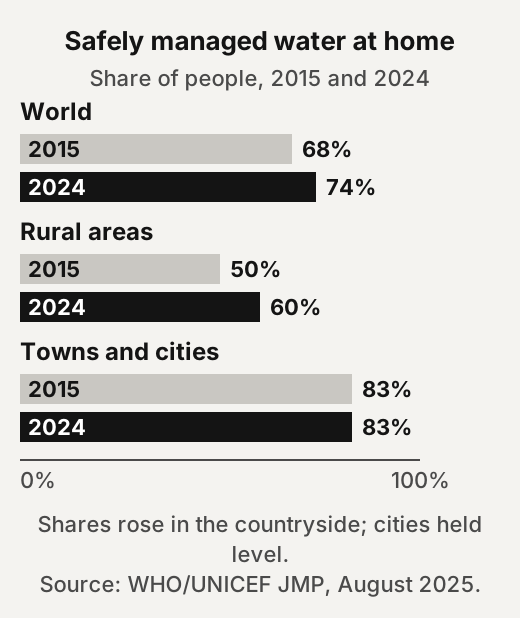
Between 2015 and 2024, coverage rose from 68% to 74%. In rural areas it rose from 50% to 60%, while in towns and cities it stayed level at 83%. So the share rose in the countryside and held level in towns and cities. Counted in people, though, three out of five who gained safely managed drinking water between 2000 and 2024 lived in towns and cities, because city populations grew so fast.
That still left 2.1 billion people without safely managed drinking water, including 106 million who drank directly from untreated surface sources. Surface water means lakes, ponds, rivers and streams.
In most countries with data, women and girls are mainly responsible for collecting water. Many in sub-Saharan Africa and Central and Southern Asia spend more than 30 minutes a day doing it.
Unsafe water is still estimated to kill hundreds of thousands of people a year. In its 2023 fact sheet, WHO estimates that microbiologically contaminated drinking water causes about 505,000 deaths from diarrhoea each year.
The world’s goal, UN target 6.1, is safe and affordable drinking water for all by 2030, tracked as safely managed water. WHO and UNICEF say universal coverage of safely managed services “appears increasingly out of reach”. At the current pace, their report projects 77% coverage by 2030.
4. Things people often repeat
Three popular ideas about clean water, and what the sources say.
“Taking the pump handle off ended the outbreak”
Partly The Broad Street outbreak ended because John Snow had the pump handle removed. The handle did come off, but Snow’s own count shows the outbreak was already fading. So the pump story fits Snow’s evidence about the cause, and is too neat about the ending.
How sure: Moderate it rests on Snow’s own day-by-day count of the outbreak, published the next year.
The most attacks in one day came on 1 September, at 143. On 8 September, the day the handle was removed, there were 12. Snow wrote that the attacks had so far diminished before the water was stopped that it was impossible to decide whether the well was still dangerous.
“Clean water was the main reason city deaths fell”
Still argued Clean water was the main reason deaths fell in early 1900s American cities. Both teams found that filtered water went with fewer deaths; they disagree on how much. For a reader, that shared finding is the safe takeaway.
How sure: Unsettled two teams studied early-1900s US city data and, after an exchange in one journal, still disagree on the size.
A 2005 study of major US cities credited clean water, meaning filtration and chlorination, with nearly half the fall in deaths. It credited clean water with three quarters of the fall in infant deaths. A 2022 reanalysis of 25 cities from 1900 to 1940 linked filtration to an 11 to 12% fall in infant deaths. None of the other measures it studied, including chlorination, sewage treatment and milk standards, appeared to have contributed to the declines. In a comment in the same journal, the 2005 authors corrected data mistakes and estimated that filtration explained 38% of the fall in total deaths in their sample. They called that result not very different from their original estimate of 43%. They added that the effects on infant deaths were smaller than in their original analysis.
A separate study of the Boston area, 1880 to 1920, credited clean water and sewers together with about a third of the drop in child mortality, by its measure. So the size of the effect is the open question, and so is the part played by chlorine.
“Safe water at home is normal everywhere now”
Doesn't hold up Almost everyone now has safe water at home. One person in four still lacks safely managed drinking water. That is real progress and a long way still to go.
How sure: Strong it is the official WHO and UNICEF global estimate, covering 2000 to 2024.
Between 2000 and 2024, about a quarter of the world’s population, 2.2 billion people, gained safely managed drinking water. The same report found 2.1 billion people still without it.
5. One small way to use it better
Find out where your water comes from and who checks it, by reading your supplier’s latest water quality report. For example, look up the river, lake or groundwater your tap draws on, and find it on a map.
In the United States, that report is called a Consumer Confidence Report. Community water systems must send their customers this annual drinking water quality report each year by July 1. It names the lake, river, aquifer or other source of the water and the regulated contaminants found in it. If you did not get one, you can call your water supplier or use EPA’s online search tool.
Private wells are different. EPA says private wells are not regulated by the federal government under the Safe Drinking Water Act, nor by most state governments. It says private well owners are responsible for delivering safe drinking water to their households.
In England and Wales, the Drinking Water Inspectorate has a map to find your local water company and the water quality in your area. If you are concerned about the quality of your drinking water, it says to contact your water company in the first instance.
Elsewhere, start with your water supplier or your local health authority. Our suggestion: the next time you fill a glass, remember that one person in four cannot yet do that safely at home.
Quick answers
When did tap water become safe to drink?
It came in steps. A sand filter bed was completed in London by 1829, and chlorination of drinking water began in the early 1900s. Even in 2024, one person in four still lacked safely managed drinking water.
Did removing the Broad Street pump handle stop the cholera outbreak?
Partly. The handle came off on 8 September 1854, but John Snow's own count shows the attacks had already fallen sharply, and he wrote that it was impossible to decide whether the well was still dangerous by then.
How many people lack safe drinking water today?
According to WHO and UNICEF, 2.1 billion people, one in four, still lacked safely managed drinking water in 2024. That includes 106 million who drank directly from untreated surface sources.
How do I find out what is in my tap water?
Start with your water supplier's latest water quality report. In the United States that is the Consumer Confidence Report, sent each year by July 1; in England and Wales, the Drinking Water Inspectorate's map leads to your water company.
Use this
Our suggestion, built from the official pages in section 5.
Where does my water come from, and who checks it?
Quick quiz
Nothing is scored or saved. Recalling it once now is what makes it last.
1. By John Snow's account, when was the Broad Street pump handle removed?
Answer: The day after he spoke to the parish board.Read it again ↑
2. About what share of people had safely managed drinking water at home in 2024?
Answer: About three in four.Read it again ↑
3. Where did the first permanent, large-scale chlorination in the United States start?
Answer: Jersey City.Read it again ↑
How we checked this · Last checked October 2026
- We read John Snow's 1855 book in the Project Gutenberg text, and the WHO and UNICEF figures in their August 2025 report and news release.
- The CDC report dates from 1999. Its page blocks automated reading, so we checked it in the Internet Archive's copy.
- For how much clean water cut deaths, we read the abstracts of the 2005 study, the 2022 reanalysis and the exchange that followed, not the full papers.
- We left out EU water law because the official text site blocked our reader, and we would not quote it second-hand.
- Snow's comparison of two water companies is on our correlation and causation page, with its source.
Sources
- John Snow, On the Mode of Communication of Cholera, second edition, London: John Churchill, 1855 (Project Gutenberg).Primary
- Institution of Civil Engineers, “London’s water supply and the introduction of sand filtration”.Popular
- Centers for Disease Control and Prevention, “Achievements in Public Health, 1900-1999: Control of Infectious Diseases”, MMWR 48(29), 1999.Primary
- Washington State Department of Health, “Chlorination of Drinking Water”.Primary
- World Health Organization, Guidelines for drinking-water quality, fourth edition incorporating the first and second addenda, 2022.Primary
- World Health Organization, “Drinking-water”, fact sheet, 13 September 2023.Primary
- WHO/UNICEF Joint Monitoring Programme, Progress on household drinking water, sanitation and hygiene 2000-2024: special focus on inequalities, August 2025.Primary
- World Health Organization, “1 in 4 people globally still lack access to safe drinking water – WHO, UNICEF”, 26 August 2025.Primary
- D. Cutler and G. Miller, “The role of public health improvements in health advances: the twentieth-century United States”, Demography 42(1), 2005.Scholarly
- D. M. Anderson, K. K. Charles and D. I. Rees, “Reexamining the Contribution of Public Health Efforts to the Decline in Urban Mortality”, American Economic Journal: Applied Economics 14(2), 2022.Scholarly
- D. M. Cutler and G. Miller, “Reexamining the Contribution of Public Health Efforts to the Decline in Urban Mortality: Comment”, American Economic Journal: Applied Economics 14(2), 2022.Scholarly
- D. M. Anderson, K. K. Charles and D. I. Rees, “Reexamining the Contribution of Public Health Efforts to the Decline in Urban Mortality: Reply”, American Economic Journal: Applied Economics 14(2), 2022.Scholarly
- M. Alsan and C. Goldin, “Watersheds in Child Mortality: The Role of Effective Water and Sewerage Infrastructure, 1880-1920”, Journal of Political Economy 127(2), 2019.Scholarly
- U.S. Environmental Protection Agency, “CCR Information for Consumers” and “Private Drinking Water Wells”.Primary
- Drinking Water Inspectorate (England and Wales), “Welcome to the Drinking Water Inspectorate”.Primary
Safe tap water is recent, and unfinished
A sand filter bed was completed in London by 1829, and chlorination spread from the early 1900s. In 2024, one person in four still lacked safely managed drinking water at home. Two research teams still disagree on how much of the fall in early-1900s US city deaths clean water explains. The part chlorine played is open too. Our view: a safe glass of tap water is a recent result, not a given.
Read a "one fix ended it" story slowly
- Check the timing. By John Snow's own count, attacks peaked at 143 on 1 September. On 8 September, when the handle came off, there were 12.
- Ask what else shaped the toll. Snow wrote that the toll would have been much greater if so many people had not fled the area.
- Keep the cause and the ending apart. Snow linked the outbreak to the pump. His own count shows it was already fading when the handle came off.
- Expect a range, not one number. For early-1900s US cities, both teams found filtered water went with fewer deaths. They disagree on how much.
- Our suggestion. When a story credits one fix, look for the numbers from before it arrived.
This week: find out where your water comes from
Our suggestion: set aside a few minutes this week. Find your supplier's latest water quality report, where one is published. The last section lists official pages for the US, England and Wales, and where to start elsewhere. Write down your water's source and who checks it. When the next report comes out, check whether the source has changed.
Keep going
- Correlation vs causationWhy two things moving together is not the same as one causing the other, with Snow's two water companies.
- Trial, observational study or meta-analysis?Three ways to study a question, what each can show, and how to read a headline about one.
- Things we take for granted: vaccinesWhat life was like before vaccines, how it changed, and what the numbers say now.
- Things we take for granted: electric lightWhat light cost before electricity, how it changed, and who still lives without it.
- Things we take for granted: the internetHow messages travelled before the internet, how the network and the web arrived, and who is online now.
- Factfulness, summarisedHans Rosling's ten instincts, his test of world facts, and which figures still hold.
- GlossaryPlain meanings of cholera, chlorination, sand filter and other terms on this page.