

Start hereIn a 2008 study, students who read conspiracy theories about the death of Princess Diana underestimated how much their own views had been influenced. What makes these stories so easy to absorb, and how do you talk with someone who believes one?
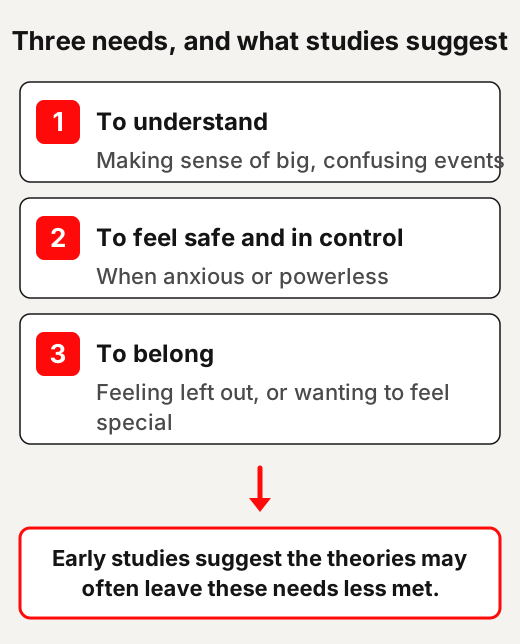
Conspiracy theories can appeal because they promise to meet real needs. People want to make sense of what happened, to feel safe, and to feel good about themselves and their group. The studies so far suggest they often leave those needs less met, not more.
On changing minds, warnings given before people met a theory did better in studies than arguments given afterwards. A large 2024 study also found that patient, evidence-based conversations lowered belief by about a fifth. Below is what researchers mean by the term and why these beliefs appeal. Then comes who is more likely to hold them, and what research found about talking with someone who believes one.
1. What researchers mean by a conspiracy theory
A conspiracy theory explains an event as a secret plot by powerful people; the label alone does not settle whether it is true. A 2017 review by Karen Douglas, Robbie Sutton and Aleksandra Cichocka describes them as “explanations for important events that involve secret plots by powerful and malevolent groups”. A 2023 review in Nature Reviews Psychology uses the term “in a way that is agnostic about whether the theory is true”.
For example, “the referee was paid to lose the match” is a conspiracy theory in this sense. It explains an event with a secret plan by people with power, and it could be true or false. The label tells you the shape of the claim, not whether it holds.
Some conspiracies were real
Real conspiracies have happened, and researchers in this field say so plainly. Douglas and colleagues write that “history has repeatedly shown that corporate and political elites do conspire against public interests”.
Two documented cases show what that looks like. A special prosecutor’s office was set up to investigate alleged offences arising from the Watergate break-in of June 17, 1972. In March 1974 a grand jury indicted seven White House aides for perjury and obstruction of justice. President Richard Nixon was named an “unindicted coconspirator”. He resigned on August 9, 1974.
In 1996 a US company agreed to plead guilty for its role in two international conspiracies to fix prices. It agreed to pay a $100 million criminal fine.
The 2023 review’s authors write that they are “sympathetic to the notion that the motives of powerful elites should be interrogated”. They also hold that “not all subjective truths are equally valid proxies for reality”. So a useful question is not “is this a conspiracy theory?” but what is the evidence for this particular one?
Not a new trend
Surveys over many years have not found belief in conspiracy theories rising. A 2022 study tracked how many Americans believed 46 conspiracy theories, some over half a century, and six theories in six European countries. It found no systematic evidence of an increase. The 2023 review adds that historical analyses find no support for the idea that we live in a new “golden age” of conspiracy theories.
How sure: Moderate large surveys agree, but they cover mainly the United States and Europe.
2. Why they appeal: three kinds of need
Researchers sort the pull of these theories into three needs: understanding, safety and control, and belonging. Douglas and colleagues call these motives epistemic (understanding your world), existential (being safe and in control) and social (keeping a good image of yourself and your group).
Their review found that the research so far “does not indicate that conspiracy belief fulfills people’s motivations”. They concluded that, for many people, conspiracy belief “may be more appealing than satisfying”. In short, the theories promise more than they deliver, in the studies so far. A 2019 review by Douglas and colleagues adds that conspiracy beliefs “result from a range of psychological, political, and social factors”.
Wanting to understand
Big, confusing events invite big, hidden explanations, though the evidence on pattern-seeking is mixed. Douglas and colleagues report that belief is stronger when events are large in scale and leave people dissatisfied with “mundane, small-scale explanations”. In a 2007 study, 64 people read a story about an attack on a fictional president. They were more likely to back a conspiracy explanation when the president died than when he survived. In the same study, belief in real-world conspiracy theories did not relate to that way of reasoning.
Researchers also ask whether believers see patterns in random events, which they call illusory pattern perception. For example, noticing that three bad things happened on days you wore the same shirt, and wondering if the shirt is to blame. A 2018 set of five studies linked conspiracy beliefs to seeing patterns in random coin tosses, chaotic paintings and world events, and its authors called illusory pattern perception “a central cognitive mechanism”. A 2023 study of 723 people did not find such a clear pattern for conspiracy beliefs. The 2023 review calls the data on whether believers misjudge randomness “mixed”.
Many of these theories are also hard to disprove. Douglas and colleagues note that such theories say the plotters hide their tracks. That implies that people who argue against the theory may themselves be part of the plot. A counter-argument can then look like more evidence, which matters when you talk with someone.
How sure: Limited the pattern-seeking link held in some studies and not in others, and the “big event” study was small.
Wanting to feel safe and in control
Feeling anxious or powerless has been linked to these beliefs, but whether a lack of control causes them is still argued. Douglas and colleagues report studies in which people turned to conspiracy theories when they were anxious and felt powerless. They also report experiments in which belief rose when people felt unable to control outcomes and fell when their sense of control was affirmed.
The 2023 review notes mixed success in repeating those experiments, and that a meta-analysis found a non-significant relationship between control and conspiracy beliefs. It concludes that the mixed evidence “calls into question the notion that lack of control has a causal effect on conspiracy beliefs”. It also notes that reading conspiracy theories typically lowers people’s sense of control and autonomy.
For example, after a frightening event, nobody may be able to explain it yet. A story about who planned it can feel steadier than “we don’t know yet”.
How sure: Unsettled early experiments found a link, repeats were mixed, a meta-analysis found no significant link; the review leans against causation.
Wanting to belong and to feel special
Feeling left out, and wanting to feel unique, have both been linked to these beliefs. In experiments Douglas and colleagues report, being ostracised led people to believe more in superstitions and conspiracy theories. The 2023 review reports higher belief among people experiencing isolation, loneliness and rejection. It reports somewhat higher belief among people with a strong need for uniqueness. It found no empirical evidence that believing brings the self-esteem benefits it seems to offer.
The 2017 review reports that people on the losing side of political processes are more likely to believe conspiracy theories. So are members of groups with low status because of their ethnicity or income. People also rated conspiracy stories as more entertaining than other texts, and were more likely to believe the ones they found entertaining.
For example, an online group that shares a theory can also offer company, a sense of being in the know, and a good story.
How sure: Moderate several studies agree, but the field relies heavily on one-time surveys, which cannot show cause.
Do the beliefs meet those needs?
So far, studies suggest the theories often leave people less trusting and less in control, not more. In experiments, exposure to conspiracy theories decreased trust in governmental institutions, even when the theories were unrelated to those institutions. In a 2008 study, students who read conspiracy theories about the death of Princess Diana underestimated how much their own views had been influenced. In other words, a story can shift your view without you noticing the shift.
Douglas and colleagues caution that most experiments sampled students and survey panelists who were not particularly disadvantaged or threatened. They add that conspiracy theories may offer some compensation to groups and individuals who are already cut off from society. So these findings describe averages in the groups studied, not the experience of any one person.
3. Who is more likely to believe
Belief is common, and the links researchers found are modest averages, not labels for any one person. Four US national surveys from 2006 to 2011 found that “half of the American public consistently endorses at least one conspiracy theory”. The same study did not find belief in conspiracy theories to be a product of greater authoritarianism, ignorance or political conservatism.
The 2023 review reports that people who prefer slow, deliberate thinking are less likely to believe conspiracy theories. People who prefer fast thinking grounded in gut feeling are more likely to. It describes “a modest but reliable tendency” for people to have stronger conspiracy beliefs when they have lower cognitive ability. Two meta-analyses it cites found mostly non-significant links with the “Big Five” personality traits.
A 2017 study found that people with more education are less likely to believe conspiracy theories. It traced the link partly to belief in simple solutions for complex problems, to feelings of powerlessness and, in one of two studies, to subjective social class. So education seems to matter partly through how people see problems and their own power, not only through what they know.
The same review asks researchers to watch their own tone. It warns that research on individuals has drifted towards a “deficit model” defined by what believers lack. It adds that “communities sometimes learn to mistrust elites because those elites cannot be trusted”. In other words, suspicion can come from experience, not only from a thinking style.
For example, someone whose family was once misled by an official body may start from more suspicion of the next official statement.
How sure: Moderate these links appear across many surveys, but they are averages, mostly correlations, and come mainly from Western samples.
4. What research found about changing minds
Most attempts to change these beliefs had small effects; warnings in advance, critical-thinking teaching and tailored conversations did better. A 2023 review of 25 studies with 7,179 people found that the majority of interventions did not change conspiracy beliefs. About 40% of the interventions it counted did change beliefs, but only three had large effects. In plain terms, most single attempts moved beliefs a little or not at all. The same review found a large effect for one three-month university course that taught students to tell science from pseudoscience. Its authors concluded that an analytical mindset and critical-thinking skills are “the most effective means of challenging conspiracy beliefs”. The 2023 Nature Reviews review adds that a study designed to reduce demand effects found inconsistent results for prompts to think analytically.
Correcting with facts afterwards
Rebuttals lowered belief in the specific theory, but researchers doubt how far that goes. The 2023 review in Nature Reviews Psychology notes that rebutting a specific conspiracy theory with corrective information reduces support for that theory. It adds that such studies are often “blunt” and open to demand characteristics. It found no evidence that rebutting one theory reduces the broader conspiracy worldview, or that it works for people already strongly committed to the theory. In the review of 25 studies, counter-arguments produced only small or very small effects.
Demand characteristics are cues in a study that hint at what the researchers expect, which can bias how participants respond and distort the findings.
How sure: Moderate reviews agree that rebuttals move the specific belief a little, and that the evidence for anything broader is missing.
Does correcting someone backfire?
In the studies reviewed, corrections rarely made people believe a false claim more. A backfire effect is when a correction makes someone believe the false claim more. A 2020 review concluded that backfire effects “are not a robust empirical phenomenon”. The same review notes a continuing debate in the field over whether backfire effects exist at all.
So a careful correction is unlikely to make things worse, though on its own it may not change much.
How sure: Moderate a review found backfire effects hard to reproduce, though researchers still debate how to measure them.
Warning people before they meet a theory
Warnings given in advance changed beliefs more than arguments given afterwards, in the few short-term studies that tested them. This is often called prebunking: explaining a claim or a persuasion trick to people before they come across it. The review of 25 studies found that all five inoculation interventions reduced conspiracy beliefs, with medium or large effects. It notes that such warnings need to reach people before they encounter the theory. It also notes that the studies measured only short-term effects.
The 2023 Nature Reviews review notes that counter-arguments were relatively ineffective when they came after conspiracy arguments, which suggests prebunking might work better. It calls warning strategies “somewhat effective”, with effects possibly inflated by demand characteristics.
Whether short prebunking games and videos help people tell reliable from unreliable news in general is still argued. A 2023 reanalysis of five studies found no gain, and a 2026 reanalysis of 33 experiments found a consistent one. Our page on critical thinking in the age of AI sets out that dispute.
For example, a new viral video may be about to reach a family group chat. You might mention first that such clips often promise “what they don’t want you to know”.
How sure: Moderate results point the same way, but from few short-term studies, possibly inflated by demand characteristics.
Conversations built around the person’s own evidence
In a large 2024 study, tailored, evidence-based conversations lowered belief by about a fifth, and the change lasted. In a 2024 study in Science, people who believed a conspiracy theory discussed it with an AI chatbot (GPT-4 Turbo) in personalized, evidence-based conversations; the paper first reported 2,190 participants. Belief fell by about 20%, and the effect remained two months later. It occurred even among people with deeply entrenched beliefs, and belief in unrelated conspiracy theories fell too. The authors concluded that “many conspiracy theory believers can revise their views if presented with sufficiently compelling evidence”.
A 2025 follow-up with 955 people found no significant difference whether people were told they were chatting with an AI tool or with a human expert. Its authors concluded that it “succeeds by generating compelling messages”. What seemed to matter was the evidence, fitted to what each person believed.
The 2024 paper has a correction history. In June 2026 Science published an editorial expression of concern about the paper. The authors had reported inconsistencies in their screening criteria and extra rows in their public dataset. The authors reported that their corrected analysis matched the original results in direction, statistical significance and substantive size.
Science published a correction on 22 October 2026. In the publisher’s metadata, the expression of concern is now titled “RESCINDED”. We found no readable notice explaining the change. A political scientist told Retraction Watch that he and his students had reproduced the results in two independent experiments.
We could not open Science’s correction notice itself, which sits behind a bot check. The authors’ correction materials, posted in September 2026, count 2,044 people in the main analysis, against 2,190 first reported. They report falls in belief of about 21.9% and 19.7% in the two studies, against about 1% and 3% in the comparison groups. They also report no significant change between just after the conversation and two months later. So the fall of about a fifth, and its lasting two months, hold in the corrected figures too. The 2024 study and its 2025 follow-up both used a chatbot; neither tested the same approach in a conversation between friends or family.
For example, a friend may say a certain photo proves a cover-up. The approach in these studies is to look closely at that one photo and what else could explain it. It is not to argue about everything at once.
How sure: Moderate one large study, a follow-up and a reported independent repeat; the authors’ corrected figures stayed close to the first ones.
Mockery, empathy and listening
Mockery moved beliefs only slightly in one study, and guidance on these conversations advises against it. In a 2016 online experiment with 813 people in Hungary, rational arguments and ridiculing believers both reduced conspiracy beliefs. Empathy for the targets of the theories had no effect. The perceived intelligence and competence of the person giving the arguments also mattered. The review of 25 studies rated the effects of ridicule as very small.
That was an online experiment, not a conversation with someone you know.
European Commission guidance on talking with someone who firmly believes a conspiracy theory says “Don’t ridicule”. It suggests asking “detailed questions about their theory in order to trigger self-reflection”. It warns that any argument challenging the theory “may be taken as proof that you are part of the conspiracy”. It also advises leaving the person time to process, and trying again. This is advice from a public body, not a study result.
Four lab experiments tested what happens when people are listened to with empathy and without judgement, on a range of everyday topics. The speakers became more aware of contradictions in their own views and held less extreme attitudes. Those experiments did not test conspiracy beliefs, so treat listening as a promising hint, not proof.
How sure: Limited one experiment on ridicule, and listening studies on other topics; the guidance is advice, not evidence.
5. How to talk with someone who believes one
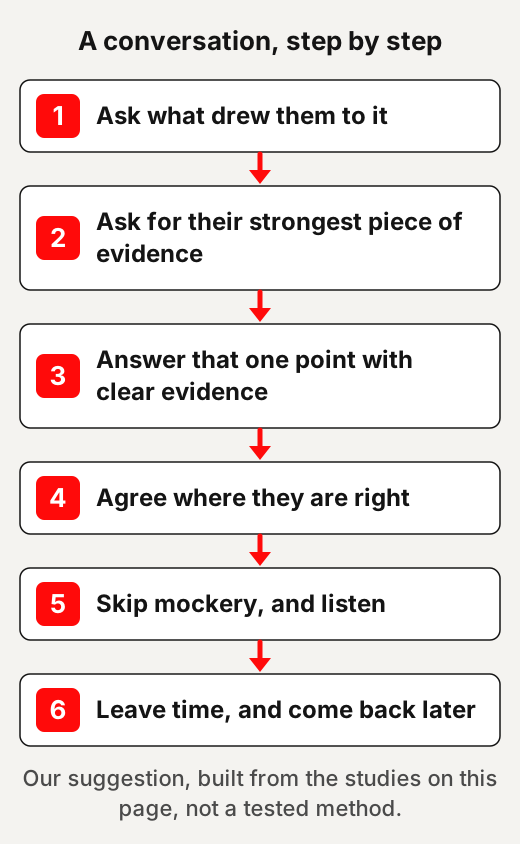
Our suggestions, built from the studies above: listen first, ask about their evidence, answer specifics, and leave time. None of these steps was tested as a set, and no approach in these studies changed every mind.
- Ask what first drew them to the idea, and what worries them about it. The three needs above are a guide to what may be going on.
- Ask which single piece of evidence convinces them most, and ask detailed questions about it.
- Answer that one point with clear evidence, rather than a pile of facts on everything at once.
- Agree where they are right. Some conspiracies were real, and saying so is honest.
- Skip mockery, and listen without judging.
- Leave time, and come back to it another day.
Carl Sagan made a similar plea for gentleness with people in The Demon-Haunted World; our summary of the book covers it. For the general habit of checking a claim before you share it, see the SIFT method.
Quick answers
Why do people believe conspiracy theories?
Researchers group the reasons into three needs, to understand what happened, to feel safe and in control, and to belong and feel good about yourself and your group. A 2017 review found the research so far does not indicate that the beliefs fulfil those needs.
Are all conspiracy theories false?
No. Researchers use the term without deciding whether a theory is true, and real conspiracies have happened. In the Watergate case, a grand jury indicted seven White House aides for perjury and obstruction of justice in March 1974.
Does arguing with someone make them believe a conspiracy theory more?
Usually not. A 2020 review concluded that backfire effects "are not a robust empirical phenomenon". But arguments given afterwards had only small or very small effects in a 2023 review of 25 studies.
How do you talk to someone who believes a conspiracy theory?
In studies, patient conversations built around the person's own evidence lowered belief, and European Commission guidance advises asking detailed questions and not ridiculing. No approach in these studies changed every mind, so leaving time and coming back later is part of it.
Who is more likely to believe conspiracy theories?
Belief is common; half of the American public endorsed at least one in surveys from 2006 to 2011. Studies link stronger belief, on average, to a preference for gut-feeling thinking, less education and feeling powerless, but these are averages, not labels for any one person.
Use this
Our suggestion, built from the studies above, for your next conversation about a conspiracy theory.
What is the evidence for this particular one?
Quick quiz
Nothing is scored or saved. Recalling it once now is what makes it last.
1. In the 2024 study, how much did evidence-based chatbot conversations lower conspiracy belief?
Answer: By about 20%.Read it again ↑
2. What did a 2020 review conclude about backfire effects?
Answer: They are not a robust empirical phenomenon.Read it again ↑
3. In the 2007 study, when were people more likely to back a conspiracy explanation?
Answer: When the fictional president died.Read it again ↑
How we checked this · Last checked November 2026
- We read the full text of the 2017 and 2023 reviews and of the 2023 review of 25 intervention studies through Europe PMC, and the abstracts of the other studies through PubMed and OpenAlex.
- The 2024 chatbot study had an expression of concern (June 2026, now marked rescinded in the publisher's metadata) and a correction (October 2026). The journal's site shows a bot check, so we read the authors' correction materials on Zenodo instead and give both the first and the corrected figures.
- Where researchers disagree, as on whether a lack of control causes these beliefs and whether believers misjudge randomness, we show both readings.
- The European Commission's advice is guidance, not research, and the listening studies tested everyday topics, not conspiracy beliefs; we say so on the page.
- We name a specific conspiracy theory only where a study we cite used it.
Sources
- K. M. Douglas, R. M. Sutton and A. Cichocka, “The Psychology of Conspiracy Theories”, Current Directions in Psychological Science 26(6), 2017 (full text, open access).Scholarly
- M. J. Hornsey, K. Bierwiaczonek, K. Sassenberg and K. M. Douglas, “Individual, intergroup and nation-level influences on belief in conspiracy theories”, Nature Reviews Psychology 2, 2023 (full text).Scholarly
- K. M. Douglas and colleagues, “Understanding Conspiracy Theories”, Political Psychology 40(S1), 2019 (abstract).Scholarly
- National Archives, “Records of the Watergate Special Prosecution Force” (Record Group 460) and “Watergate and the Constitution”.Primary
- US Department of Justice, “Archer Daniels Midland Co. to plead guilty and pay $100 million for role in two international price-fixing conspiracies”, press release, 15 October 1996.Primary
- J. Uscinski and colleagues, “Have beliefs in conspiracy theories increased over time?”, PLOS ONE 17(7), 2022.Scholarly
- P. Leman and M. Cinnirella, “A major event has a major cause: Evidence for the role of heuristics in reasoning about conspiracy theories”, Social Psychological Review 9(2), 2007 (abstract).Scholarly
- J.-W. van Prooijen, K. M. Douglas and C. De Inocencio, “Connecting the dots: Illusory pattern perception predicts belief in conspiracies and the supernatural”, European Journal of Social Psychology 48(3), 2018.Scholarly
- P. Müller and M. Hartmann, “Linking paranormal and conspiracy beliefs to illusory pattern perception through signal detection theory”, Scientific Reports 13, 2023.Scholarly
- K. M. Douglas and R. M. Sutton, “The Hidden Impact of Conspiracy Theories: Perceived and Actual Influence of Theories Surrounding the Death of Princess Diana”, Journal of Social Psychology 148(2), 2008 (abstract).Scholarly
- J. E. Oliver and T. J. Wood, “Conspiracy Theories and the Paranoid Style(s) of Mass Opinion”, American Journal of Political Science 58(4), 2014 (abstract).Scholarly
- J.-W. van Prooijen, “Why Education Predicts Decreased Belief in Conspiracy Theories”, Applied Cognitive Psychology 31(1), 2017 (abstract).Scholarly
- C. O’Mahony, M. Brassil, G. Murphy and C. Linehan, “The efficacy of interventions in reducing belief in conspiracy theories: A systematic review”, PLOS ONE 18(4), 2023 (full text; funded by Google with the Irish Research Council, as the paper states).Scholarly
- B. Swire-Thompson, J. DeGutis and D. Lazer, “Searching for the Backfire Effect: Measurement and Design Considerations”, Journal of Applied Research in Memory and Cognition 9(3), 2020.Scholarly
- T. H. Costello, G. Pennycook and D. G. Rand, “Durably reducing conspiracy beliefs through dialogues with AI”, Science 385(6714), 2024 (abstract); editorial expression of concern, Science, 11 June 2026, as released on EurekAlert; erratum record, 22 October 2026; authors’ “Correction and reproducibility materials”, Zenodo, 27 September 2026; Retraction Watch report, 11 June 2026.Scholarly
- E. Boissin and colleagues, “Dialogues with large language models reduce conspiracy beliefs even when the AI is perceived as human”, PNAS Nexus 4(11), 2025.Scholarly
- A. Modirrousta-Galian and P. A. Higham, “Gamified inoculation interventions do not improve discrimination between true and fake news”, Journal of Experimental Psychology: General, 2023; A. Simchon and colleagues, “A Signal Detection Theory Meta-Analysis of Psychological Inoculation Against Misinformation”, Current Opinion in Psychology 67, 2026.Scholarly
- G. Orosz and colleagues, “Changing Conspiracy Beliefs through Rationality and Ridiculing”, Frontiers in Psychology 7, 2016.Scholarly
- European Commission, “Identifying conspiracy theories”.Primary
- G. Itzchakov, A. N. Kluger and D. R. Castro, “I Am Aware of My Inconsistencies but Can Tolerate Them: The Effect of High Quality Listening on Speakers’ Attitude Ambivalence”, Personality and Social Psychology Bulletin 43(1), 2017 (abstract).Scholarly