Digital products are files people design once and sell as downloads: planners, trackers, journals and templates. Below are 12 common kinds, what each is, who tends to use it and how it is usually sold, followed by the rules that apply to selling them.
This page is for information only. It describes each product and the rules; it makes no promise about sales or income, and it is not legal advice.
1. Planners
These four help people plan time, study, trips or meals, and are usually sold as printable or tablet files.
Daily and weekly planners
Pages for laying out the day or the week, with space for tasks, times and notes.
Example: a two-page weekly spread with a column for each day and a box for the week’s three priorities.
Who uses it: anyone who likes to plan on paper or on a tablet.
How it’s usually sold: as a printable PDF, or as a file with clickable tabs for tablet note-taking apps.
Watch for: if you design one, print a page yourself and use it for a week before you list it.
Study planners
Pages for planning revision: subjects, topics, test dates and review sessions.
Example: a term planner with a row for each subject and boxes for planned review days.
Who uses it: students, and adults studying for an exam or a course.
How it’s usually sold: as a printable PDF or a spreadsheet. Our guide to learning faster explains spaced review, which a study planner can lay out.
Watch for: keep the layout simple enough to fill in within a minute.
Travel planners
Pages for a trip: the itinerary, bookings, a packing list and a budget.
Example: a one-week trip sheet with a day-by-day plan and a packing checklist.
Who uses it: people organising a holiday or a family trip.
How it’s usually sold: as a printable PDF or an editable document. Our directory of travel deal sites lists where people look for fares and discounts.
Watch for: leave space for booking references and emergency contacts.
Meal planners
A weekly grid of meals, often with a shopping list on the same page.
Example: a fridge sheet with seven rows of meals and a shopping list along the side.
Who uses it: households that plan their food shopping.
How it’s usually sold: as a printable PDF, sometimes in a bundle with recipe cards.
Watch for: a meal planner is a layout; keep diet or health claims out of the listing.
2. Trackers and logs
These three record what you do, so progress can be seen at a glance.
Habit trackers
A grid where you tick off each day you do a habit.
Example: a month grid with a row for each habit and a box for each day.
Who uses it: people building a routine, such as reading or walking daily.
Why it works: writing progress down is the part research supports. A 2016 meta-analysis of 138 studies found that monitoring progress helped people reach goals, more so when progress was physically recorded or reported to others.
Watch for: describe it as a tracker; the studies tested monitoring, not any particular design.
Reading logs
A list or chart for books read, with dates and short notes.
Example: a bookshelf-shaped chart you colour in, one spine per book.
Who uses it: readers, book clubs and families with children learning to read.
How it’s usually sold: as a printable page, often in a pack with reading challenges.
Watch for: use your own drawings, not the covers of real books.
Budget templates
A spreadsheet or printable page for listing income and spending by category.
Example: a monthly sheet with rows for rent, food and transport, and a column for what was spent.
Who uses it: anyone keeping track of household money.
How it’s usually sold: as a spreadsheet or printable PDF. Free official versions exist, such as this one from Australia’s government. Australia’s government money site, Moneysmart, offers a budget planner that it says helps you work out where your money is going, with an Excel spreadsheet version.
Watch for: a budget template is a record-keeping tool, not advice, so describe the layout and leave money tips out of the listing.
3. Journals
These two give people pages and prompts to write in, and need the most care in how they are described.
Guided journals
A journal with a short prompt or quotation on each page and space to write.
Example: our own free 7-day Stoic journal, which gives a checked line from Marcus Aurelius, Epictetus or Seneca each day, a question, and room to write. It is one example of the format.
Who uses it: people who want a short writing habit with a starting point.
How it’s usually sold: as a printable PDF or a bound print-on-demand book.
Watch for: if a journal quotes famous people, check each quotation against its source before printing it.
Health and mood journals
Logs for things like sleep, mood, symptoms or food, kept to see patterns over time.
Example: a page with a row for each day and columns for hours slept and a mood rating.
Who uses it: people who want a record to look back on, or to show a doctor.
How it’s usually sold: as a printable PDF or a tablet file.
The rule to know: what the listing says matters. In the US, the FTC’s guidance says claims about the health benefits or safety of foods, dietary supplements, drugs and other health-related products require substantiation in the form of competent and reliable scientific evidence. It adds that the same legal principles apply to the marketing of any health-related product.
Watch for: describe what the pages record; do not say the journal will improve anyone’s health.
4. Templates for work and online
These three are files people edit and reuse, so the software they open in sets some of the rules.
Résumé templates
A ready-made layout for a CV or résumé that the buyer fills in.
Example: a one-page résumé in a word-processor file, with headings for experience and skills.
Who uses it: job seekers.
How it’s usually sold: as an editable document or design-tool template.
Watch for: test the file in the free versions of the programs buyers are likely to use.
Spreadsheet and workspace templates
Pre-built spreadsheets or workspace pages, such as a project tracker or a content calendar.
Example: a content calendar spreadsheet with a tab for each month.
Who uses it: freelancers, small teams and students.
How it’s usually sold: as a downloadable file or a link that copies the template into the buyer’s own account.
Watch for: say in the listing which program and version the template needs.
Social media templates
Editable post and story layouts that people fill with their own words and pictures.
Example: a set of quote-post layouts in one colour scheme.
Who uses it: small businesses and creators who post often.
How it’s usually sold: often as a link to a template inside a design tool. That tool’s licence then matters. Canva’s Content License Agreement lists “design templates solely for use on Canva” among the permitted uses. Among prohibited uses, it lists to “sub-license, re-sell, rent, lend, assign, gift or otherwise transfer or distribute the Content”.
Watch for: read the design tool’s own licence before you sell anything made with its library.
How these products are usually sold
Many are sold as instant downloads, on a marketplace or the maker’s own site.
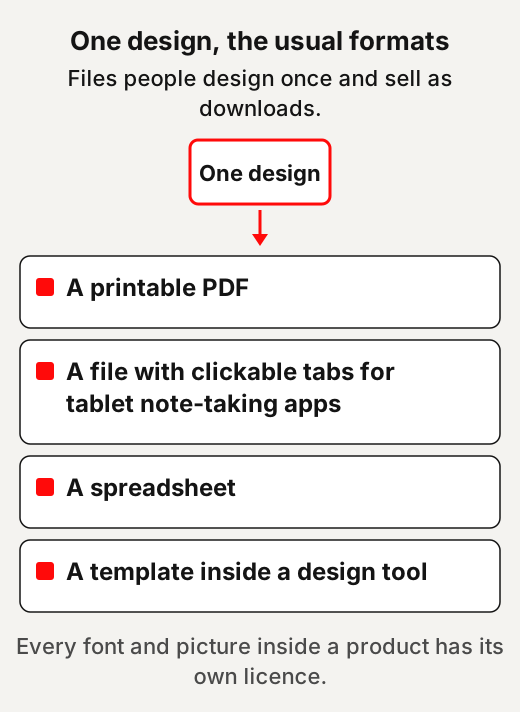
The common formats are a printable PDF, a file with clickable tabs for tablet note-taking apps, a spreadsheet, or a template inside a design tool. Etsy, for example, describes two kinds of digital item: instant downloads, which the buyer can access immediately, and made-to-order downloads, sent once finished.
Marketplace rules are worth reading in full, in their own words:
- Etsy: “Like handmade items, digital items listed in your store must be made and/or designed by you, the seller.”
- Etsy says all items must “incorporate a human touch”, and lists AI prompt bundles among items that don’t count as designed by a seller.
- Etsy: “Sellers must disclose within their listing description if an item is created with the use of AI.”
- Gumroad prohibits “reselling private label rights products”.
Our guide to AI side hustles covers printables made with AI tools, with prompts. A sister page, 18 Assets That Can Earn Over Time, places templates beside other things people make once and sell many times.
The rules that apply
Three sets of rules matter most: what you may claim, what you may use, and what you can protect.
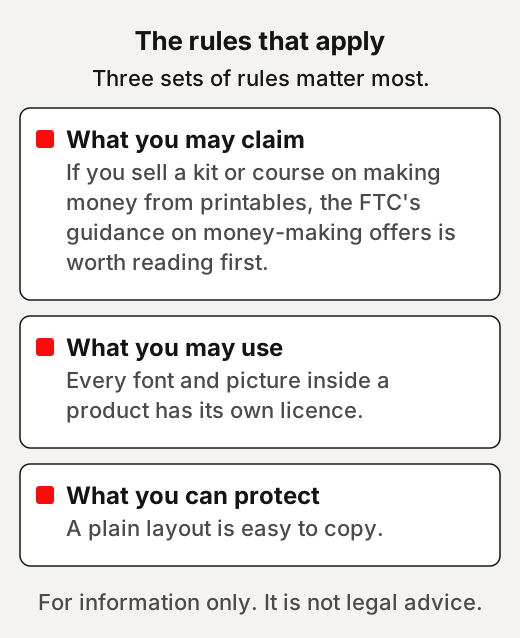
What you may claim. If you sell a kit or course on making money from printables, the FTC’s guidance on money-making offers is worth reading first. The FTC says that if an offer “promises guaranteed income, large returns, or a ‘proven system,’ it’s likely a scam”. Its Business Opportunity Rule bars US sellers of a business opportunity, as the rule defines one, from making an earnings claim without a reasonable basis and written proof. The FTC also advises reading success stories and testimonials with skepticism, because “they might not be true or typical”.
What you may use. Every font and picture inside a product has its own licence. The SIL Open Font License allows fonts to be used, studied, modified and redistributed freely as long as they are not sold by themselves. It says the requirement for fonts to remain under the licence does not apply to any document created using the fonts. For pictures, a Creative Commons licence, or the CC0 public domain dedication, tells you what is allowed. The Attribution-NonCommercial licence says “You may not use the material for commercial purposes”. The CC0 deed says you can copy, modify and distribute the work, even for commercial purposes, all without asking permission.
What you can protect. A plain layout is easy to copy. The US Copyright Office says blank forms that are designed for recording information and do not themselves convey information are uncopyrightable. It also says names, titles and slogans are not copyrightable, but may, under certain circumstances, be protectable under trademark law. Its January 2025 report says copyright “does not extend to purely AI-generated material”. Our reading: original writing, journal prompts, drawings and design choices are what set a product apart.
| Attribution-NonCommercial | "You may not use the material for commercial purposes" |
| CC0 | Copy, modify and distribute the work, even for commercial purposes, without asking permission |
From each deed's own words.
Where to learn more
- US Copyright Office: Works Not Protected by Copyright: blank forms, names and short phrases.
- Creative Commons: About CC Licenses: what each licence allows.
- SIL Open Font License: the licence many free fonts use, with an FAQ.
- FTC: When a Business Offer or Coaching Program Is a Scam: what to ask before paying for a money-making course.
- Related pages: AI side hustles and 20 business models.
- Related idea guides: 18 assets that can earn over time, 20 business models and 20 pricing strategies.
Quick answers
Can I sell printables made with free fonts?
It depends on each font's licence. The SIL Open Font License allows fonts to be used, studied, modified and redistributed freely as long as they are not sold by themselves, and says the requirement for fonts to remain under the licence does not apply to any document created using the fonts.
Can I sell templates I made in Canva?
Read Canva's own licence first. Its Content License Agreement lists "design templates solely for use on Canva" among the permitted uses, and among prohibited uses lists to "sub-license, re-sell, rent, lend, assign, gift or otherwise transfer or distribute the Content".
Can a planner or journal be copyrighted?
The US Copyright Office says blank forms that are designed for recording information and do not themselves convey information are uncopyrightable. Original writing, journal prompts and drawings are what set a product apart.
Do I have to say I used AI?
On Etsy, yes: "Sellers must disclose within their listing description if an item is created with the use of AI." Other marketplaces have their own rules.
Use this
Our suggestion, built from the rules above, before you list a first product.
Could I show the licence for every part of this file, and a source for every claim in the listing?
Quick quiz
Nothing is scored or saved. Recalling it once now is what makes it last.
1. What does the SIL Open Font License say about selling the fonts?
Answer: They may not be sold by themselves.Read it again ↑
2. What does the US Copyright Office say about blank forms designed for recording information?
Answer: They are uncopyrightable.Read it again ↑
3. In the 2016 meta-analysis, when did monitoring progress help more?
Answer: When progress was physically recorded or reported.Read it again ↑
How we checked this · Last checked November 2026
- Licences are quoted from their own texts: the SIL Open Font License, the Creative Commons deeds and Canva's Content License Agreement.
- Marketplace rules are quoted from Etsy's and Gumroad's own pages. Etsy's creativity standards page blocks scripts, so its rules are reused from our reviewed guide to AI side hustles.
- The FTC pages block scripts, so they were read through a browser tool.
- The habit-tracking research is the abstract of a 2016 meta-analysis, read on PubMed.
- The examples are our own and name no seller. No sales or income figure appears on purpose.