

An asset that earns over time is something you own or make once that can keep bringing in money, through rent, fees, royalties or sales. Below are 18 of them, grouped by how they earn. Each comes with work, costs and rules, and we set those out beside each one.
This page is for information only. It explains each idea; it does not suggest buying, building or investing in any of them. It gives no income figures. The US Federal Trade Commission advises reading success stories and testimonials with skepticism, because “they might not be true or typical”.
Two words worth knowing first
“Passive” and “asset” are used loosely, so it helps to know what each one means.
In the US, “passive” is a tax label, not a promise of no work. The IRS says a rental activity is a passive activity even if you materially participated in that activity, unless you did so as a real estate professional. Our reading: the word names a tax category, not how much effort something takes.
One popular way to put the idea of an asset comes from the Rich Dad books. In the company’s words, an asset “puts money into your pocket, while a liability takes money out of your pocket”. Our summary of Rich Dad Poor Dad looks at the book’s ideas.
When someone sells you one of these, a promise of certain returns is a warning sign. Investor.gov lists “promises of great wealth and guaranteed returns” among the red flags of investment fraud. It also says to be skeptical about an investment that regularly generates positive returns regardless of overall market conditions.
| Passive | In the US, a tax label, not a promise of no work |
| Asset | In the Rich Dad company's words, something that puts money into your pocket |
Both are used loosely when people talk about earning over time.
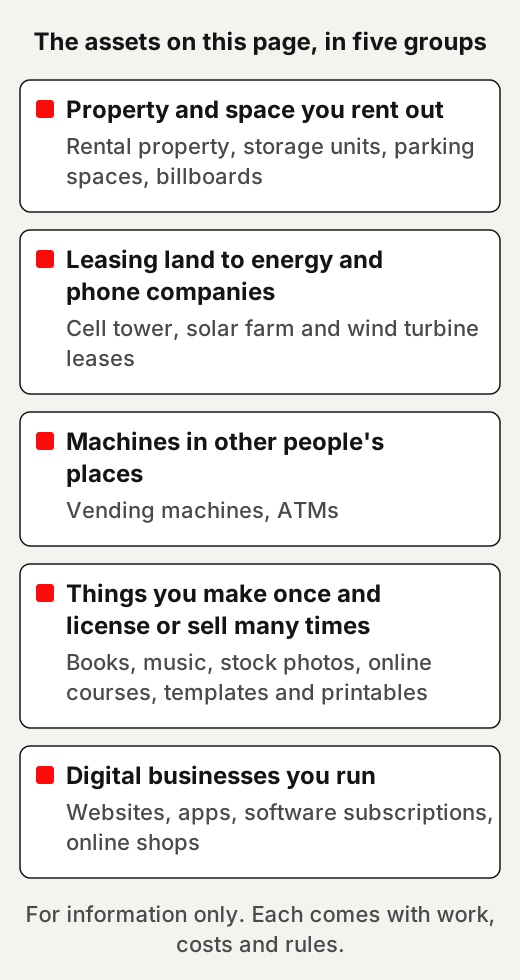
1. Property and space you rent out
These four earn rent for the use of space, and each comes with upkeep and rules.
Rental property
A house or flat you own and rent to a tenant.
Example: a one-bedroom flat let to the same tenant on a yearly lease.
How it earns: rent. In the US, the IRS says cash or the fair market value of property or services you receive for the use of real estate or personal property is taxable to you as rental income.
The work and costs: renting has running costs as well as income. The IRS says that, in general, you can deduct expenses of renting property from your rental income. There are rules on who you rent to. In the US, the Fair Housing Act prohibits discrimination by direct providers of housing, such as landlords and real estate companies. Our page on AI property tools explains what automated home valuations can and can’t tell you.
Watch for: before counting the rent, ask who handles repairs at night and what an empty month would cost.
Storage units
A building or yard of lockable spaces that people rent to keep their things in.
Example: a row of garage-sized units at the edge of town, rented month to month.
How it earns: rent for each unit. Washington State’s law, for example, defines a self-service storage facility as property used for renting individual storage space to occupants who store and remove their things on a self-service basis.
The work and costs: unpaid rent is handled under local law. The same state’s law gives the owner a lien on stored property for rent, labor, late fees and the costs of a sale, enforced as the law sets out. Our reading: those rules are part of the job, and they differ from place to place.
Watch for: read how your own state or country handles unpaid storage rent before you look at a facility.
Parking spaces
A space, garage or lot rented to drivers by the hour, day or month.
Example: a spare driveway near a train station, rented to a commuter on weekdays.
How it earns: fees for using the space. In the US, the IRS counts what you receive for the use of real estate as rental income.
The work and costs: Our reading: even one space needs a way to collect payment and to deal with drivers who overstay.
Watch for: ask your local planning office, and check your lease or homeowners’ rules, before renting a space out.
Billboards
Advertising space on a sign on your land or wall, rented to advertisers.
Example: a sign beside a busy road, leased to an outdoor advertising company.
How it earns: rent for the sign or the site, paid by advertisers or by a company that leases it.
The rules: in the US, signs near major roads are controlled. The Federal Highway Administration notes that President Lyndon B. Johnson signed the Highway Beautification Act on October 22, 1965. The law’s first section says outdoor advertising signs near the Interstate System and the primary system “should be controlled”.
Watch for: check your state’s and town’s sign rules before agreeing to anything.
Each card on the page sets out the work, costs and rules beside the income.
2. Leasing land to energy and phone companies
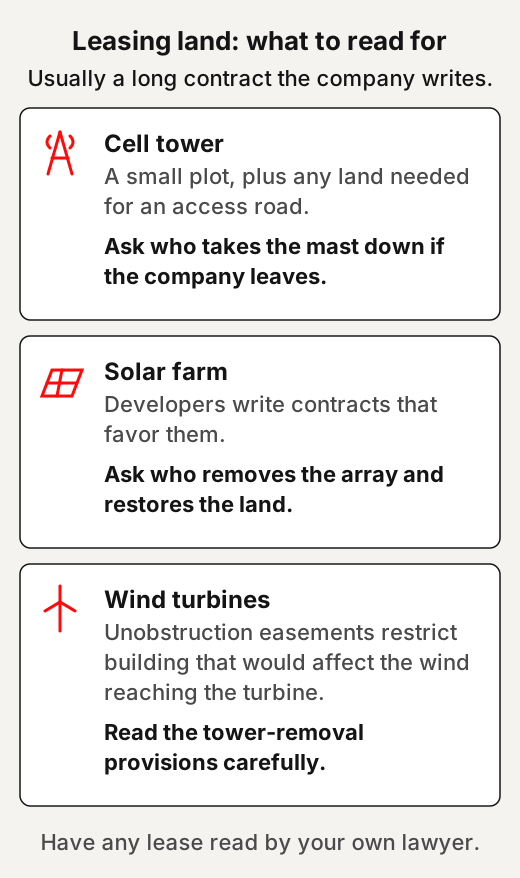
These three rent land to a company for its equipment, usually under a long contract the company writes.
Cell tower leases
Renting a small plot to a company that puts up a mobile phone mast.
Example: a corner of a farm field, with a fenced mast and an access track.
How it earns: lease payments from the tower company. A Farm Progress article notes that a cell tower lease may only use 10,000 square feet for the tower, plus any land needed for an access road.
The work and costs: The same article says the lease is negotiable and will contain provisions that are legally technical. It adds that most cell tower leases are 25 to 50 years long, so any bad terms are lived with for a long time.
Watch for: the article calls removal of the tower another important consideration, so ask who takes the mast down if the company leaves.
Solar farm leases
Renting farmland to a developer that builds a large solar array.
Example: several fields leased to a developer for rows of solar panels.
How it earns: lease payments over the life of the contract. The University of Wisconsin–Madison Extension, in a guide to solar leasing in Wisconsin, says leasing land for solar can be financially beneficial, but that it is important to research, ask questions and negotiate terms.
The work and costs: Its guide notes that developers write contracts that favor them. It suggests asking who removes the array and restores the land when the lease ends, and who pays if the developer sells or goes bankrupt.
Watch for: the guide says it is not a substitute for hiring legal counsel, so have any lease read by your own lawyer.
Wind turbine leases
Renting land, or granting an easement, so a developer can put up wind turbines.
Example: two turbines on a hilltop pasture, with the field still farmed around them.
How it earns: payments under a wind energy agreement. Iowa State University’s Center for Agricultural Law and Taxation notes that every landowner who leases or sells an easement does so under a detailed contract drafted by the developer.
The work and costs: It describes “unobstruction” easements, which restrict landowners from building or doing things that would affect the wind reaching the turbine. It notes that many of these agreements dictate land use for the next 50 years or so.
Watch for: the center says landowners should read the tower-removal provisions carefully, including when that duty starts.
3. Machines in other people’s places
These two are often sold as ready-made businesses, and the FTC has a rule on how such deals are sold.
Vending machines
Machines that sell snacks or drinks, placed in someone else’s building.
Example: a snack machine in an office break room, restocked every week.
How it earns: sales from the machine.
The work and costs: Our reading: restocking, repairs and finding good sites take time. In the US, a vending deal can count as a business opportunity under the FTC’s rule. The FTC’s Business Opportunity Rule covers a seller who says it will provide locations for vending machines or similar devices. It requires the seller to give you a disclosure document at least seven calendar days before you sign a contract or pay. In a 2006 sweep, the FTC said the bogus business opportunities it targeted included vending machines, ATM and Internet terminals. The FTC warned then that legitimate business ventures involve risks, and that start-up businesses require a lot of work.
Watch for: ask for the disclosure document, and phone past buyers yourself rather than the references you are given.
ATMs
A cash machine you own, placed in a shop, bar or other site.
Example: a machine just inside the door of a corner shop.
How it earns: fees on withdrawals. In the US, Regulation E says an ATM operator that imposes a fee must give a notice that discloses the amount of the fee.
The work and costs: Our reading: someone has to keep the machine filled with cash and working. ATM placement deals are among those the FTC has acted on, as the vending card above shows.
Watch for: ask a seller who supplies the cash, who services the machine, and who chooses the site.
4. Things you make once and license or sell many times
These five turn one piece of work into many sales, through royalties, licences or downloads.
Books
A book you write, published so you are paid each time a copy sells.
Example: a short guide to a local walking trail, sold as an ebook and a paperback.
How it earns: royalties. Cornell’s Legal Information Institute defines a royalty as compensation to the owner of intellectual property or natural resources for the right to use or profit from the property. Amazon’s Kindle Direct Publishing, for example, lets you choose between two royalty options for each ebook.
The work and costs: Our reading: writing, editing, a cover and telling people the book exists all take time or money. KDP notes that a delivery cost may apply depending on the royalty option you choose. In the US, copyright in works created after January 1, 1978 generally lasts for the life of the author plus 70 years. Our guide to AI side hustles covers the self-publishing rules.
Watch for: read who owns which rights in any publishing contract before you sign.
Music
Songs or recordings you own, licensed for others to play, stream or use in videos.
Example: a short piece of background music licensed for use in podcasts.
How it earns: royalties and licence fees. The US Copyright Office explains that sound recordings and musical compositions are considered two separate works for copyright purposes. It has designated the Mechanical Licensing Collective to collect and distribute mechanical royalty payments under the Music Modernization Act. Since January 1, 2021, songwriters and music publishers must register with The MLC to receive royalty payments under its blanket license.
The work and costs: Our reading: registering each work and keeping records is ongoing work.
Watch for: before you license a track, check that you own both the song and the recording, or have permission for both.
Stock photos
Photos you take and license through an agency, so buyers can use them for a fee.
Example: a set of photos of hands typing on laptops, uploaded to a stock agency.
How it earns: a share of the fee each time a buyer licenses an image.
The work and costs: paperwork for people and places. Shutterstock’s contributor rules say commercial submissions may require model or property releases when a person or property is recognizable. They require a separate model release for each recognizable person. Model releases are not required for recognizable people in editorial content.
Watch for: carry a release form whenever you plan to photograph people for stock.
Online courses
Lessons you record or write once and sell, on your own site or on a course platform.
Example: a six-part video course on basic bookkeeping for freelancers.
How it earns: course sales or subscriptions.
The work and costs: Our reading: a course needs updating as its subject changes, and answering students takes time. Courses about making money carry a known risk. The FTC says that if an offer “promises guaranteed income, large returns, or a ‘proven system,’ it’s likely a scam”.
Watch for: whether you buy a course or sell one, check that every result in the pitch has a source.
Templates and printables
Planners, trackers and design files that buyers download and print or reuse.
Example: a weekly meal planner sold as a printable file.
How it earns: a sale for each download.
The work and costs: a plain layout is easy to copy. The US Copyright Office says blank forms that are designed for recording information and do not themselves convey information are uncopyrightable. Our companion guide, Digital Products People Make and Sell, covers the formats and the rules in more detail.
Watch for: check the licence of every font and image inside a template before you sell it.
5. Digital businesses you run
These four run online, and each depends on a platform’s or a payment company’s rules.
Websites
A site with useful content that earns from ads, affiliate links or its own products.
Example: a site of gardening guides that carries a few ads.
How it earns: ads, sales, or commissions. The OpenStax marketing textbook defines affiliates as people or companies that earn a commission for driving traffic to another company’s website where they make a purchase.
The work and costs: Our reading: writing and updating pages, hosting and a domain name. In the US, the FTC’s guidance says an affiliate should disclose the relationship to the retailer clearly and conspicuously.
Watch for: read the rules of any ad or affiliate programme before you apply.
Apps
A phone app that people pay for, either up front or inside the app, through an app store.
Example: a simple habit-tracker app with a paid version.
How it earns: sales, subscriptions or in-app purchases. Apple’s App Review Guidelines say that to unlock features or functionality within an app, “you must use in-app purchase”. They list exceptions, such as real-time person-to-person services like tutoring, and the rules on links to other ways to pay differ by country, with the United States storefront treated separately.
The work and costs: the store takes a share. Google Play says apps and in-app products sold through its billing system are subject to a service fee, and that there isn’t a single service fee. Our reading: apps also need updates as phones change.
Watch for: read the store’s payment rules before you plan how the app will charge.
Software subscriptions
Software people pay for monthly or yearly, usually run online.
Example: a small booking tool for hairdressers, paid monthly.
How it earns: The OpenStax textbook on entrepreneurship describes a business model that offers subscriptions rather than a payment for an item purchased. It notes that subscriptions give the seller cash up front, with the buyer receiving benefits throughout the year.
The work and costs: Our reading: hosting, security, fixes and support carry on for as long as people pay. Our page on 20 business models explains subscriptions and freemium.
Watch for: ask how many hours a week support would take before you build anything.
Online shops
A shop that sells physical or digital goods online, on its own site or a marketplace.
Example: a small shop selling hand-dyed scarves through a marketplace.
How it earns: sales.
The work and costs: shipping promises and tax records. In the US, the FTC’s guide to its mail-order rule says that with no shipping time stated, the seller must have a reasonable basis for believing it can ship within 30 days. The IRS describes Form 1099-K as a report of payments you received for goods or services from payment cards, payment apps or online marketplaces. It says that whether or not you receive a Form 1099-K, you must still report any income on your tax return.
Watch for: decide your shipping time and write it on your shop page before you list the first item.
Where to learn more
- Investor.gov: Red Flags of Investment Fraud: the warning signs, from the US Securities and Exchange Commission.
- FTC: When a Business Offer or Coaching Program Is a Scam: what to ask before you pay for any money-making offer.
- IRS Topic 414, Rental income and expenses: how US tax treats rent. Your own tax agency has its own pages.
- UW–Madison Extension: Solar Leasing Contracts and Iowa State CALT on wind agreements: questions to ask before leasing land.
- US Copyright Office: How long does copyright last?: the basics for books, music and photos.
- Related pages: money habits people talk about, 20 business models and AI side hustles.
- Related idea guides: 12 digital products people make and sell, 20 business models and industries built on lasting needs.
Quick answers
What does "passive" mean when people talk about income from an asset?
In the US, "passive" is a tax label, not a promise of no work. The IRS says a rental activity is a passive activity even if you materially participated in that activity, unless you did so as a real estate professional.
Are vending machine and ATM businesses regulated?
In the US, the FTC's Business Opportunity Rule covers a seller who says it will provide locations for vending machines or similar devices, and requires a disclosure document at least seven calendar days before you sign a contract or pay. In a 2006 sweep, the FTC said the bogus business opportunities it targeted included vending machines, ATM and Internet terminals.
What should I ask before signing a land lease for a cell tower, solar farm or wind turbines?
The Wisconsin extension guide suggests asking who removes the array and restores the land, and who pays if the developer sells or goes bankrupt. A Farm Progress article notes that most cell tower leases are 25 to 50 years long. The Wisconsin guide says it is not a substitute for hiring legal counsel.
How much can these assets earn?
This page gives no income figures. The US Federal Trade Commission advises reading success stories and testimonials with skepticism, because "they might not be true or typical".
Use this
Our suggestion, built from the cards above, for any idea on this list that catches your eye.
If no one could show me where a promised figure comes from, would I still look at this?
Quick quiz
Nothing is scored or saved. Recalling it once now is what makes it last.
1. In US tax, what does "passive" mean for a rental?
Answer: A tax category, even if you take part.Read it again ↑
2. Under the FTC's Business Opportunity Rule, when must a seller give the disclosure document?
Answer: At least seven calendar days before you sign or pay.Read it again ↑
3. For copyright purposes, how does the US Copyright Office treat a song and a recording of it?
Answer: As two separate works.Read it again ↑
How we checked this · Last checked November 2026
- Rules come from official pages: the IRS, the US Department of Justice, the FTC and its Business Opportunity Rule, Regulation E, the Federal Highway Administration, the US Copyright Office and Washington State's storage law.
- Land-lease points come from university extension guides (UW-Madison, Iowa State) and, for cell towers, a farm-press article, because we found no university guide on cell tower leases.
- Platform rules are quoted from Apple, Google Play, Amazon KDP and Shutterstock's own help pages, read in November 2026; they change.
- Some FTC pages block scripts, so they were read through a browser tool. Several state law sites showed a bot check, so they were not used.
- The examples are our own and name no company. No income, rent or return figure appears on purpose.