

Hobbies like chess, puzzles, languages and music mostly make you better at the hobby itself. Whether they sharpen your mind more broadly is still argued, and the studies we read lean towards narrow gains. Below are ten such hobbies: what each involves, what the studies found, how sure the findings are, and one small thing to try.
None of this is a reason to drop a hobby you enjoy. It is a reason to choose one for itself.
1. What a hobby trains: near and far
Practice mostly improves the thing you practise; spread to quite different skills is still argued. Researchers call that spread far transfer. For example, getting quicker at sudoku is a near gain; remembering names better because you did sudoku would be a far one.
A 2016 review of brain-training studies found extensive evidence that training improves performance on the trained tasks. It found less evidence for closely related tasks, and little evidence for distantly related tasks or for everyday cognitive performance. In 2017 Giovanni Sala and Fernand Gobet reviewed studies of chess, music and working-memory training. The better the experimental design, the smaller the effect. They “conclude that far transfer of learning rarely occurs”.
The weight of the evidence we read leans towards far transfer being rare, with action games and music training the main exceptions claimed. Our Range summary covers that debate. So for each hobby below, the useful question is what it trains directly, and whether you enjoy it.
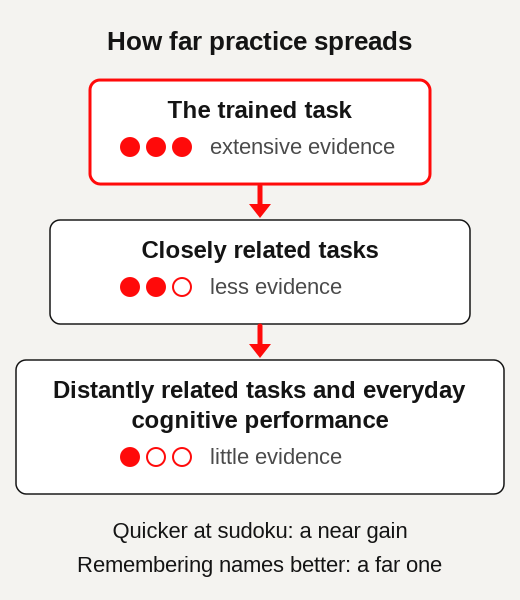
How sure: Moderate large reviews agree that gains stay close to the trained task; a few exceptions are still argued.
| Near gain | Getting quicker at sudoku |
| Far gain | Remembering names better because you did sudoku |
Researchers call the spread to quite different skills far transfer.
2. Games and puzzles
Games and puzzles sharpen the skills they use; the evidence for wider gains is mixed. For action video games, two large reviews disagree.
Chess
Chess is a game of planning and of spotting patterns on the board.
What it involves: learning the moves, then playing games and solving puzzles until familiar positions start to look like single patterns. A 1996 study supported the usual estimate that chess masters store some 50,000 chunks, familiar patterns of pieces, in memory.
Example: a short chess puzzle on your phone over breakfast, then one longer game at the weekend.
What the studies found: chess lessons were one of the three kinds of training in the 2017 review above. The gains looked smaller in the better-designed studies, and the authors concluded that far transfer rarely occurs.
How sure: Moderate a meta-analysis of chess lessons for children found small to moderate effects that shrank in better-designed studies.
Try this: after a game, look again at the one move you felt least sure about.
Crosswords, sudoku and brain-training games
Puzzles and brain games mostly make you better at those puzzles.
What it involves: a daily puzzle on paper or in an app, often at rising levels of difficulty.
Example: the newspaper crossword on the train, or a sudoku before bed.
What the studies found: the 2016 review above looked at the studies that brain-training companies cite. It found that many had major shortcomings in design or analysis that preclude definitive conclusions. One trial compared two kinds of puzzle in people with mild cognitive impairment. In a 2022 trial with 107 people who had mild cognitive impairment, scores on a thinking test improved for those given online crosswords and worsened slightly for those given online brain games, 78 weeks later. The trial compared crosswords with games; it had no group that did neither.
How sure: Limited one trial, in people with mild cognitive impairment, comparing two kinds of puzzle.
Try this: pick the puzzle you look forward to; that is the one you will keep doing.
Action video games
One large review found that fast action games boost attention and judging space; another found little or no effect.
What it involves: games where you track many moving things at once and react quickly.
Example: a fast game where you follow several moving targets on screen at once.
What the studies found: a 2018 meta-analysis of intervention studies found an average effect of a third of a standard deviation (g = 0.34). That is a small-to-medium boost. Its authors wrote that action video game play robustly enhances top-down attention and spatial cognition. They also estimated that published effects were 30% larger than in the full literature. The studies compared action games with other kinds of game. Another 2018 meta-analysis, of training with all kinds of video game, found small or null effects and “no evidence of a causal relationship between playing video games and enhanced cognitive ability”. So the two large reviews disagree.
How sure: Unsettled two large reviews disagree; one found a boost to attention and spatial skills, the other small or null effects.
Try this: if you play, notice whether you scan a busy street or a crowded shelf any differently.
3. Languages and music
A language and an instrument give you the skill itself; studies of broader thinking gains are argued.
Learning a new language
Learning a language gives you the language; studies found little gain beyond it.
What it involves: words, listening and speaking practice, little and often. Our language learning guide covers methods.
Example: naming the things in your kitchen in Spanish while you cook.
What the studies found: two lines of research point the same way. A 2018 meta-analysis of 152 studies compared adults who use two languages with those who use one. No evidence for a bilingual advantage remained after correcting for bias. In a 2020 randomised trial, 160 healthy people aged 65 to 75 spent 11 weeks learning Italian or doing relaxation training. The differences in memory and intelligence between the groups were negligible. The authors wrote that language learning “may expand the behavioral repertoire”. In plain words: you gain the language.
How sure: Moderate a large meta-analysis and a randomised trial agree; researchers had long disagreed on the bilingual question.
Try this: learn the ten phrases you would need on a first day abroad, and say them aloud.
Playing an instrument
An instrument trains your ears and hands; whether it lifts general thinking is still argued.
What it involves: scales, short pieces and regular practice, with an ear for small mistakes.
Example: picking out a song you know on a keyboard, one hand at a time.
What the studies found: music training is one of the two main exceptions claimed. A 2020 meta-analysis of 54 studies of music training with children concluded that “Once the quality of study design is controlled for, the overall effect of music training programs is null”. A 2022 re-analysis of the same data found “a significant effect size (g = .234)”. Neither side finds more than a small effect. A 2024 review concluded that “the evidence that music training causes nonmusical benefits is weak or nonexistent”. Our page on music beliefs covers the dispute, and our hobby picker covers a small study of older adults who took piano lessons.
How sure: Unsettled reviews disagree on whether a small effect survives; the latest review we read leans against.
Try this: learn one short tune by ear before you look at the notes.
4. Making things
Making things trains the skills the making uses. Coding has the most research of the three.
Coding
Learning to code teaches you to break a problem into steps a computer can follow.
What it involves: a beginner language, small projects, and a lot of finding and fixing mistakes.
Example: a short script that renames a folder of holiday photos by date.
What the studies found: a 2018 meta-analysis of 105 studies found a moderate overall transfer effect from learning to program. It found the strongest effects on skills close to programming, and positive transfer to creative thinking, maths and metacognition. The effects were larger when the comparison group did nothing than when it did another activity. Published studies also showed larger effects than “gray literature”. That is one more claim of far transfer, from a single meta-analysis.
How sure: Moderate one large meta-analysis found an effect; it was smaller against comparison groups that did something else.
Try this: write a tiny program that does one chore you repeat each week.
Drawing
Drawing is a skill, and also a way to remember things.
What it involves: looking closely, then putting lines on paper, again and again.
Example: a quick sketch of your coffee cup each morning.
What the studies found: in seven lab experiments published in 2016, words that people drew were better remembered than words they wrote out. An independent team found the same “drawing effect” in 2025. Both were lab tests of memory for words. Drawing helped people remember what they drew.
How sure: Moderate two teams found it, in lab tests of memory for words.
Try this: next time you make a shopping list, sketch three of the items instead of writing them.
Origami
Origami is folding paper into shapes, step by step from a diagram.
What it involves: following folds, picturing how a flat sheet becomes a shape, and fixing a fold that went wrong.
Example: folding a paper crane from a diagram, then a paper box.
What the studies found: origami itself has little research that we found. Spatial skills in general do. A 2013 meta-analysis of 217 studies found an average effect of training, compared with control groups, of g = 0.47. That is close to a medium-sized effect. Training effects were stable, and training also transferred to other spatial tasks that were not directly trained. One small 2009 classroom study of 56 students found a difference on one of three spatial tests, which depended on whether students were boys or girls. It found no significant differences in geometry knowledge.
How sure: Limited strong evidence for spatial training in general, but little on origami itself.
Try this: fold one simple model from a diagram, then fold it again without looking.
5. Numbers and new skills
Mental maths trains arithmetic; learning a demanding new craft has some evidence for memory in later life.
Mental maths
Mental maths is working out sums in your head, without paper or a calculator.
What it involves: practising tricks such as splitting numbers, or picturing an abacus and moving its beads in your mind.
Example: adding up the items in your basket before you reach the till.
What the studies found: in a three-year randomised trial with 204 children aged 5 to 7 at the start, those taught mental abacus outperformed the others on arithmetic. The training did not alter basic cognitive abilities. It made them better at sums, the thing they practised.
How sure: Moderate one long randomised trial, in children, with a clear result.
Try this: work out the total at the shop in your head, then check it against the receipt.
A demanding new craft
Learning something new and hard, like photography or quilting, may help memory in later life.
What it involves: a skill with real steps to learn, practised for many hours over months.
Example: a beginner quilting class, or learning to take photos in manual mode.
What the studies found: in a 2014 study, older adults learned digital photography, quilting or both, for an average of 16.51 hours a week over 3 months. Their episodic memory improved, compared with groups who did social or low-demand activities. Episodic memory is memory for events. The authors also found limited cognitive benefits of the social activities.
How sure: Limited one study of older adults over three months.
Try this: pick a craft you have never tried, and give it a set time each week for a month.
6. Later life and memory
In some studies, people with more thinking hobbies had lower dementia rates, but a link is not proof.
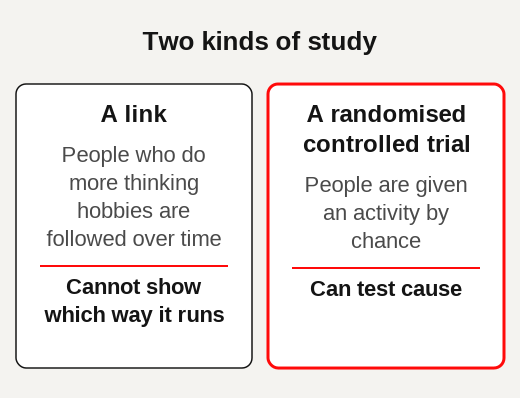
In a 2003 study that followed 469 people over 75 for a median of 5.1 years, reading, playing board games, playing musical instruments and dancing were associated with a reduced risk of dementia. The authors wrote that “Controlled trials are needed”. A link cannot show which way it runs. For example, early changes that no one has noticed yet might lead someone to give a hobby up. The link held even after the study left out people who might already have had early dementia.
A randomised controlled trial, where people are given an activity by chance, is the kind of study that can test cause. The language-course, crossword and mental abacus studies above were trials of that kind.
How sure: Limited the link comes from following people over time, not from trials.
If you notice memory changes that worry you, a doctor is the right person to talk to.
7. Choosing one
Pick a hobby for itself, then practise it well. Our hobby picker helps you find one that fits your life, with 30-day starters for ten hobby families.
To get better at the hobby itself, the same tools help as for any learning. A 2013 review of ten study techniques gave its highest rating to two: practice testing and spaced practice. For example, test yourself on chess openings or new words, and come back to them a few days later. Our learning guide has a 4-week plan.
Try this: choose one hobby from this page and give it two short sessions this week.
From the cards on this page.
Where to learn more
- Range summary: the debate on far transfer, in more depth.
- Pick a Hobby That Fits Your Life: a quick way to choose, with 30-day starters.
- How to Learn Faster: study techniques that help with any skill.
- Eleven music beliefs and the evidence: the music-and-IQ dispute, in detail.
- Chess Life Lessons: the game’s history and famous quotes.
- 7 Thinking Skills: the thinking skills that have research behind them, and how to practise each.
- Related idea guides: areas worth learning about and ways of thinking.
Quick answers
Does chess make you smarter?
Chess makes you better at chess. A 2017 meta-analysis of chess lessons for children found small to moderate effects that shrank in better-designed studies, and its authors concluded that far transfer rarely occurs.
Do brain-training games work?
Mostly, they improve the games themselves. A 2016 review found extensive evidence for the trained tasks, less for closely related tasks, and little for distant tasks or everyday cognitive performance. A 2026 analysis of a large trial found that older adults given speed-of-processing training with booster sessions were less likely to be diagnosed with dementia over 20 years; memory and reasoning training showed no such link.
Does learning a language keep your brain sharp?
Learning a language gives you the language. A 2020 randomised trial with people aged 65 to 75 found negligible differences in memory and intelligence after 11 weeks of Italian, and a 2018 meta-analysis found no bilingual advantage in executive functions after correcting for bias.
Can hobbies prevent dementia?
No study we read has shown that a hobby prevents dementia. A 2003 study linked reading, board games, musical instruments and dancing with a lower risk of dementia, and its authors wrote that controlled trials are needed. If memory changes worry you, talk to a doctor.
Use this
Pick a hobby for what it trains directly, and because you enjoy it.
Would I do this even if it trained nothing else?
Quick quiz
Nothing is scored or saved. Recalling it once now is what makes it last.
1. What did a 2016 review find about brain-training programs?
Answer: Extensive evidence for the trained tasks, little for distant ones.Read it again ↑
2. In a 2020 trial, what did 11 weeks of learning Italian do for healthy people aged 65 to 75?
Answer: It gave them some of the language; the differences in memory and intelligence were negligible.Read it again ↑
3. In a three-year trial with children, what did mental abacus training improve?
Answer: Arithmetic.Read it again ↑
How we checked this · Last checked November 2026
- We read each study's abstract on PubMed or OpenAlex in November 2026; the far-transfer, music, action-game, drawing and chess findings use the same sources and wording as our other reviewed pages.
- We found only a few small classroom studies of origami on its own, so the origami card leans on research about spatial training in general.
- A 2004 study of juggling had no abstract we could read, so it is not used.
- The examples, the Try this lines and the How sure levels are our own reading, not research findings.