Start hereAbout 5,300 years ago, in the city of Uruk, people inscribed signs on wet clay to keep the early state's records of workers, rations and taxes. By one estimate, hardly anyone could read them. Today most adults in the world can read. How did that happen?
Reading these words feels ordinary. For most of history it was rare: in the earliest states, by one estimate, fewer than one person in a hundred could read and write. Today 88% of adults can, and 739 million still cannot. Here is how it changed, and one small way to appreciate it.
1. Before: knowing without writing
Before writing, what people knew lived in memory and speech, with a few simple tools to help them count. For example, a promise made at a market lived only in the heads of the people who heard it.
Speech, the Sumerologist Christopher Woods writes, is “temporally fleeting and spatially anchored”. Writing, he adds, lets people record information well beyond what human memory can hold.
People counted long before they wrote. Simple clay tokens were in use in the Middle East from about 8500 BCE. In the century before the first written tablets, Mesopotamian officials also sealed tokens inside hollow clay envelopes, and these tokens were among the precursors to writing.
Other peoples kept records in other ways. The Inca had no writing on paper, but they kept records on knotted cords called khipu. Whether those cords could also record words is still open; our page on the Aztec and Inca empires walks through that debate.
Few could read, even after writing arrived
For thousands of years after writing began, only a few people could read.
In the earliest states, the catalogue’s foreword estimates, literacy was limited to less than 1 percent of the population. It was rare, it says, for even kings to read and write. No wonder writing would have seemed, in its words, “mysterious, powerful, and even inspired by the gods”.
2. How it changed
Writing was invented at least four times; then alphabets, printing and schools slowly put it in more hands.
The first writing, about 3300 to 3200 BCE
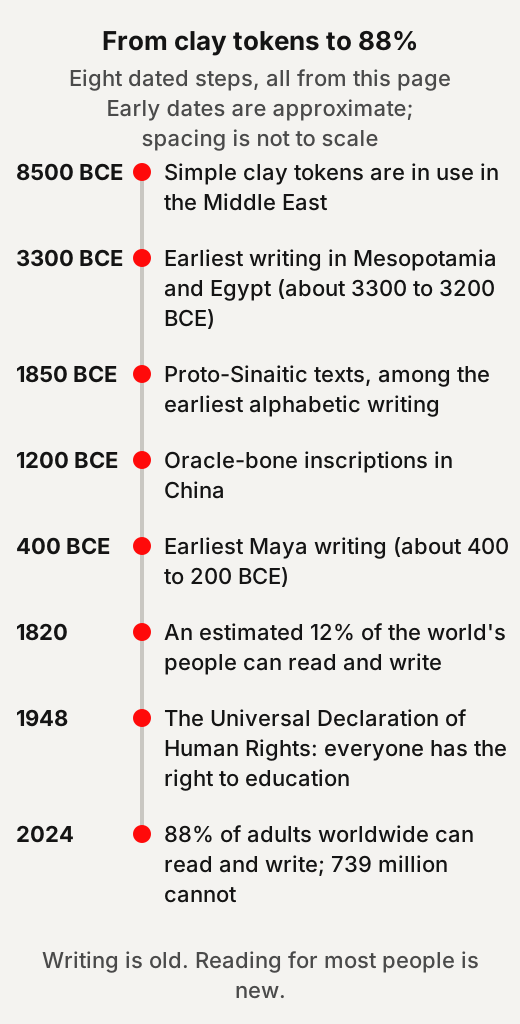
The oldest writing we know comes from Mesopotamia and Egypt, from around 3300 to 3200 BCE.
The earliest writing in Mesopotamia and Egypt dates to about 3300–3200 BCE, in the time line of the 2010 catalogue Visible Language, which notes that all its dates are approximate. Mesopotamia’s script is called cuneiform, from the Latin for “wedge”, after the wedge-like signs made with a reed stylus in wet clay.
About 90 percent of the earliest texts are administrative, mostly receipts and expenditures of animals, goods and raw materials. So much of the first writing was bookkeeping. Cuneiform was later adapted to write a wide variety of unrelated languages across the ancient Middle East.
In Egypt, the earliest hieroglyphic texts appear about 3320 BCE, and the last dated hieroglyphic inscription comes from AD 394. Hieroglyphs stayed in use for more than three thousand years. Which of the two, Egypt or Mesopotamia, wrote first is still open: the catalogue notes that recent finds at Abydos, in Upper Egypt, may challenge the primacy of writing in Mesopotamia.
Four separate starts
Writing began on its own in at least four places: Mesopotamia, Egypt, China and Mesoamerica.
The catalogue says writing “was invented independently at least four times”. Besides Mesopotamia and Egypt, it names China at the end of the second millennium BCE and Mesoamerica by the middle of the first millennium BCE.
In China, writing is first found mostly recording royal divinations at the Shang court, written on turtle shells and ox shoulder blades. The catalogue’s time line dates these oracle-bone inscriptions to about 1200 BCE, and the earliest Maya writing to about 400 to 200 BCE.
It leaves out the Indus valley script, because both its status as a writing system and the influence of Mesopotamian cuneiform on it remain uncertain. Future research may change that count, the catalogue adds.
Alphabets: tens of signs, not hundreds
Alphabets cut the number of signs to learn from hundreds to tens. For example, the letters on this page are a small set you learned once and reuse in every word.
An alphabet writes single sounds, so typical alphabets have tens of signs, where word-based and syllable-based scripts have hundreds. The earliest evidence for alphabetic writing comes from the second millennium BCE, in the Sinai and Egypt. The scholar Joseph Lam writes that it was invented among Semitic speakers in the Egyptian realm, inspired by the look of hieroglyphs.
Around the turn of the first millennium BCE, the letters and the right-to-left direction settled into a fixed system, a step generally associated with the Phoenicians and their 22-letter alphabet. By classical tradition the Greeks borrowed their alphabet from the Phoenicians, which fits the oldest Greek inscriptions, from the eighth century BCE.
The catalogue’s time line dates Proto-Sinaitic alphabetic texts to about 1850 BCE.
Lam notes that, apart from Chinese and Japanese, the world’s most common languages use scripts descended from that early alphabet, including Latin, Cyrillic, Arabic and Devanagari.
Printing, schools and a right to education
Reading stayed rare for most of history, and became normal for most people only in the last two centuries.
Printing came much later. The Diamond Sutra, printed from wooden blocks in China, is dated 11 May 868, and the Gutenberg Bible was printed between about 1452 and 1455. Our page on the printing press finds that cheaper books helped reading spread, but not that printing on its own caused the rise.
Literacy rose particularly fast across Northwest Europe between 1600 and 1800, according to Our World in Data. In England, by 1840, about two-thirds of men and about half of women were literate, judged by who could sign their name.
Worldwide, only about one person in ten could read and write in 1820; Our World in Data’s best estimate is 12%. By 1870, it says, one person in four attended school, and one in five could read. Rates came close to everyone only in the 19th and 20th centuries, and then only in the early-industrialised countries.
In 1948 the Universal Declaration of Human Rights stated that “Everyone has the right to education”, and that elementary education “shall be compulsory”. Our World in Data says the fastest gains came after the middle of the 20th century, when basic schooling became a global priority. UNESCO puts the global adult literacy rate at 65% in 1975 and 88% in 2024.
3. What the numbers say now
In 2024, 88% of adults worldwide could read and write; 739 million could not. The adult literacy rate is the share of people aged 15 and over who can read and write.
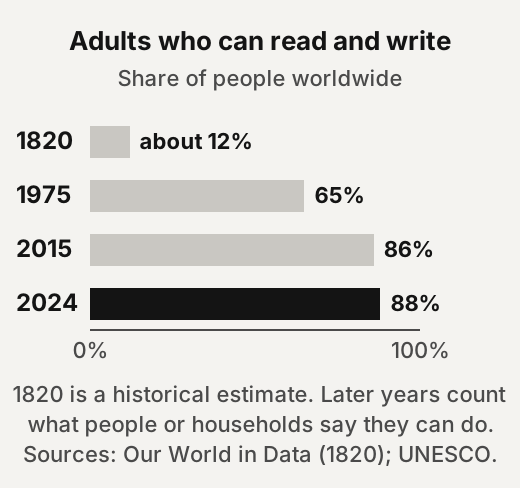
Between 2015 and 2024, UNESCO says, the literacy rate among adults rose slightly, from 86% to 88%. Among young people aged 15 to 24, it reached 93% in 2024. UNESCO links the higher rate among the young to the spread of basic schooling.
In 2024, 739 million adults still lacked basic literacy skills. Women made up nearly two-thirds of them, 466 million. Nearly 77% lived in sub-Saharan Africa or in Central and Southern Asia. More than half, 441 million people, lived in just 10 countries, many of them with large populations.
The count fell from 754 million in 2023. UNESCO says that fall reflects revised population estimates and updated national literacy figures.
These counts rest on what people say, not on a test. UNESCO says this measure focuses on basic literacy: reading and writing. For example, the bar in UNESCO’s definition is a short, simple sentence about your day, not a long official form.
The usual literacy rates are calculated from what people, or the head of their household, declare about whether they are literate. The new global measure is the ability to read and write, with understanding, a short, simple sentence about one’s everyday life.
4. Things people often repeat
Five ideas about writing and reading, and what the sources say.
“Writing was invented once, in Mesopotamia”
Doesn't hold up Writing began in Mesopotamia and spread everywhere else from there. Mesopotamia’s writing is among the oldest, but it was not the only beginning. Egypt, China and Mesoamerica each began their own. Egypt’s case was once argued the other way; the catalogue says the Abydos finds further undermine the old idea that Egyptian writing arose under Sumerian influence.
How sure: Moderate it is the current view in a major museum catalogue, which says future finds could change the count.
That one-origin idea was the theory of the day when Ignace Gelb published A Study of Writing in 1952. Since then, Woods writes, no one would seriously question that Maya script is true writing, and finds at Abydos have made Egypt’s writing as old as Mesopotamia’s.
“Writing grew out of clay counting tokens”
Partly Writing began as a way of copying the shapes of clay counting tokens. Tokens were among the steps toward writing, but the idea that the signs copy token shapes is doubted. Most word signs, Woods writes, were invented with the writing system itself. A few shapes were borrowed from the tokens, he adds, such as the sign for sheep and goats.
How sure: Unsettled the link to number signs is better supported; the catalogue’s editor doubts the word-sign matches.
Denise Schmandt-Besserat made clay tokens and envelopes famous with her 1992 theory of the origins of writing. By comparing their shapes with early cuneiform signs, she assigned meanings to fifty complex tokens. Woods writes that some number signs appear to have been made by pressing tokens into wet clay. But he calls the likeness between tokens and cuneiform signs subjective, and many of her identifications “simply not plausible”. The catalogue also cites the archaeologist Paul Zimansky, who pointed out in 1993 that her supposed sheep token turns up only fifteen times over seven thousand years.
“Egyptian hieroglyphs are picture-writing”
Doesn't hold up Each hieroglyph is a picture that stands for the thing it shows. The signs are pictures, but many stand for sounds, and the oldest Egyptian texts already use them that way. A sign that stands for a whole word is called a logogram; hieroglyphs mix those with sound signs.
How sure: Strong the catalogue’s Egyptologist finds sound signs in the earliest texts, and its editor says all four first scripts used them.
Each hieroglyph is a picture of a real object from daily life, Johnson writes; the question is what the picture stands for. The Egyptologist Janet H. Johnson explains that the Egyptians used the rebus principle: a picture can write another word with the same sound. In English, her example goes, a picture of a bee followed by a leaf can spell “belief”. A picture of a mouth, read r, could write the Egyptian word for “to, at, against”, which was also r.
The script combined word signs, sound signs and “determinatives”, signs that show what kind of word it is. The brief texts from Tomb U-j at Abydos, from before Egypt’s first dynasty, already use signs for their sound values.
“An easier script makes people literate”
Doesn't hold up Because alphabets are easy to learn, they made whole societies literate. A simpler script may have made training scribes easier, but it did not by itself turn people into readers. In practice, schooling and a reason to read matter, Lam suggests.
How sure: Moderate two scholars in the same catalogue say so; we found no study that measures it directly.
Lam writes that one should not suppose a simpler writing system led automatically to a high level of literacy, “as is sometimes suggested”. Learning to read and write takes years, he notes, and depends on access to education and on the role writing plays in society. Woods adds that Japan shows heavy use of word signs in no way lowers literacy rates.
“Almost everyone can read now”
Partly Almost everyone in the world can read and write today. Most adults can, but 739 million cannot, and the counts cover only basic skills. So the global share is real progress, and reading well is a further step.
How sure: Strong these are UNESCO’s official global counts, though they rest on what people say about themselves.
Among countries with recent data, UNESCO’s fact sheet puts adult literacy in the 15 with the lowest rates at 29% to 60%. Its own list of those countries puts Chad slightly lower, at 28%. When skills are tested directly, UNESCO notes, even in the 31 developed countries in the OECD’s adult skills survey, 18% of adults are reported to lack the most basic levels of proficiency in literacy, numeracy and adaptive problem solving.
5. One small way to appreciate it
Look at some of the world’s oldest writing online, then pick up something old to read. For example, find a tablet that is mostly numbers and picture the official who kept it.
The Cuneiform Digital Library Initiative puts the form and content of cuneiform texts online. The University of Chicago’s Institute for the Study of Ancient Cultures (ISAC) offers its Visible Language catalogue, used throughout this page, as a PDF download on its publication page.
Project Gutenberg offers more than 79,000 free eBooks, with a focus on older works whose U.S. copyright has expired. UNESCO has marked International Literacy Day every 8 September since 1967.
Our suggestion: the next time you read a label or a message without thinking, remember that for most of history only a small minority could.
Quick answers
When was writing invented?
The earliest writing in Mesopotamia and Egypt dates to about 3300–3200 BCE, in the time line of the University of Chicago's catalogue Visible Language. It notes that all its dates are approximate, and that recent finds at Abydos may challenge Mesopotamia's claim to be first.
Was writing invented more than once?
Yes. The catalogue says writing was invented independently at least four times: in Mesopotamia, Egypt, China and Mesoamerica. It leaves out the Indus valley script, because both its status as a writing system and the influence of Mesopotamian cuneiform on it remain uncertain.
What share of the world can read today?
In 2024, 88% of adults aged 15 and over could read and write, and 93% of young people aged 15 to 24, according to UNESCO. That still left 739 million adults without basic literacy skills, nearly two-thirds of them women.
Did the alphabet come from Egyptian hieroglyphs?
In part. The earliest alphabetic writing, from the second millennium BCE in the Sinai and Egypt, was invented among Semitic speakers, inspired by the look of hieroglyphs. Its letters stood for sounds of a Semitic language, not Egyptian ones.
Use this
Three small ways to see and use what took five thousand years to spread, drawn from the sources above.
Who could not have read this, a few generations ago?
Quick quiz
Nothing is scored or saved. Recalling it once now is what makes it last.
1. In the earliest states, about how many people could read and write, by the catalogue's estimate?
Answer: Less than 1 percent.Read it again ↑
2. Which of these is NOT one of the four places the catalogue says invented writing on its own?
Answer: Greece.Read it again ↑
3. How are most national literacy rates worked out, according to UNESCO?
Answer: What people or households declare.Read it again ↑
How we checked this · Last checked October 2026
- We read the University of Chicago's 2010 catalogue Visible Language in its own PDF, the foreword and the chapters we cite, and cite it by page.
- Today's numbers are UNESCO's figures for 2024, from its International Literacy Day 2025 fact sheet; the UNESCO Institute for Statistics' February 2026 update gives the same 88% and 93%.
- The 1820 figure is Our World in Data's historical estimate; it is measured differently from today's counts, so the chart says so.
- We read only the catalogue's account of the clay-token theory, not the 1992 book that set it out.
- The Inca record-keeping lines use the same wording and source as our page on the Aztec and Inca empires.
Sources
- Christopher Woods (ed.), with Emily Teeter and Geoff Emberling, Visible Language: Inventions of Writing in the Ancient Middle East and Beyond, Oriental Institute Museum Publications 32, Chicago: The Oriental Institute of the University of Chicago, 2010 (foreword by Gil J. Stein; chapters by Christopher Woods, Janet H. Johnson and Joseph Lam).Scholarly
- Max Roser and Esteban Ortiz-Ospina, “Literacy”, Our World in Data.Scholarly
- UNESCO, Youth and Adult Literacy: International Literacy Day 2025 fact sheet, September 2025 (data: UIS education database, September 2025).Scholarly
- UNESCO, “What you need to know about literacy” and “International Literacy Day”.Scholarly
- United Nations, Universal Declaration of Human Rights, 1948.Primary
- Sabine Hyland, “Writing with Twisted Cords”, Current Anthropology 58(3), 2017, author’s accepted manuscript.Scholarly
- Cuneiform Digital Library Initiative.Scholarly
- Project Gutenberg.Primary
Reading for most is new
In the earliest states, by one estimate, fewer than one person in a hundred could read. Our World in Data's best estimate is that 12% of the world could read in 1820. UNESCO puts adult literacy in 2024 at 88%. The two are measured differently, but the change is plain. Our view: reading for most people is recent and hard-won, so it is worth using on purpose.
Read a literacy figure in a minute
- Check the age group. The adult rate counts people aged 15 and over. UNESCO gives young people aged 15 to 24 separately.
- Ask how it was measured. UNESCO says the usual rates come from what people, or the head of their household, declare.
- Note the bar. UNESCO's new global measure is the ability to read and write, with understanding, a short, simple sentence about everyday life.
- Look at the spread. Among countries with recent data, UNESCO puts adult literacy in the 15 lowest at 29% to 60%. Its own list of those 15 puts Chad slightly lower, at 28%.
- Our suggestion. Before you compare two literacy figures, check the year, the age group and how each was measured.
This week: read one sign as a sound
Our suggestion: set aside half an hour this week. Download the Visible Language catalogue PDF; the last section says where. Read the chapter by Janet H. Johnson, the Egyptologist this page quotes on hieroglyphs. Find one hieroglyph that stands for a sound, not the thing it shows. Then make your own English rebus, as her bee-and-leaf "belief" example does.
Keep going
- The printing pressWoodblocks in China, clay type, metal type in Korea, then Mainz: what Gutenberg added, and nine claims.
- Turning points in historyFrom the first farms onward, when each turning point happened, why it mattered, and one popular claim.
- Things we take for granted: electric lightWhat light cost before electricity, how it changed, and who still lives without it.
- Things we take for granted: clean tap waterHow tap water went from dangerous to normal, and where it still is not.
- Things we take for granted: vaccinesWhat life was like before vaccines, how it changed, and what the numbers say now.
- Things we take for granted: refrigerationHow food was kept before fridges, how mechanical cold arrived, and what food agencies say about it now.
- Things we take for granted: the internetHow messages travelled before the internet, how the network and the web arrived, and who is online now.
- GlossaryPlain meanings of cuneiform, hieroglyph, logogram and adult literacy rate, the terms used on this page.