

AI tools now run from chat assistants anyone can open in a browser to coding agents that edit files and run commands on your computer. This page groups some well-known ones by what they do, using each tool’s own description and its own address. Where a tool’s terms matter for how you use it, we quote them.
It ranks nothing, and a tool being here is not a recommendation. We earn nothing from these links. Tools change fast, so treat this as a snapshot from November 2026.
At a glance
| Kind of tool | Tools on this page | You give it | You get back |
|---|---|---|---|
| Chat assistant | ChatGPT, Claude | A question or a task in plain words | Answers, drafts, images, analysis |
| Voice | ElevenLabs | Text or a recording | Speech, transcripts, a changed voice |
| Video and media | Higgsfield, OpusClip, Artlist | A prompt, an image or long footage | Clips, images, music and stock media |
| App builder | Emergent | A description of an app or site | A working app or site |
| Coding agent | Claude Code, Codex | A coding task and your code | Edits, tests and fixes to review |
| Task agent | Manus | A goal | Slides, sites and finished tasks |
| Data | Apify, Clay | A website or a list of companies | Collected or enriched data |
| Not AI tools | Stripe, MCP | — | Payments; a standard way to connect AI apps to other tools |
Our reading, drawn from each tool’s own pages below.
Chat assistants
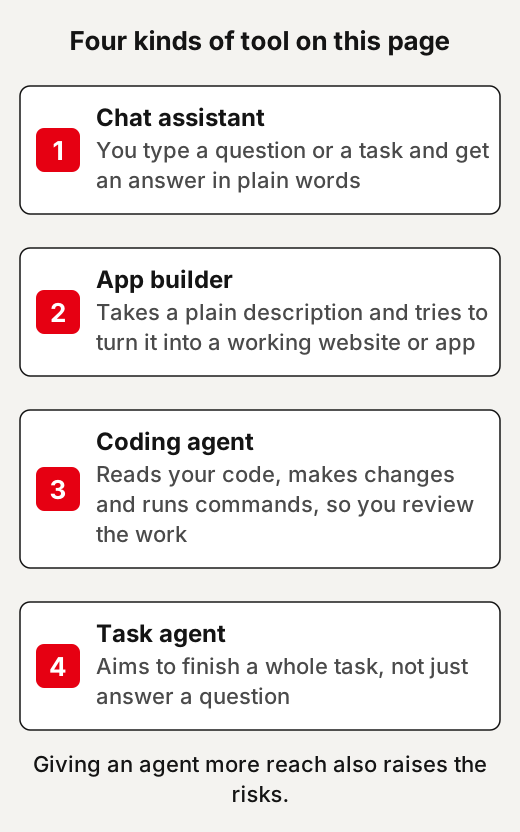
With a chat assistant, you type a question or a task and get an answer in plain words.
ChatGPT
chatgpt.com is OpenAI’s assistant. OpenAI says it helps with everyday questions and ideas, explaining concepts and drafting messages. It also lists searching the web, generating an image, comparing options or thinking through a decision.
Claude
claude.ai is Anthropic’s assistant, which Anthropic calls “the AI assistant for work”. It says you can hand off tasks on the go or on a schedule, steer from anywhere, and edit anything before it goes out.
Which models sit behind each assistant changes often; our page on who makes today’s leading AI models keeps track.
Try this: give both the same small task, such as summarising a page you know well, and see which answer you could check more easily.
Voice
Voice tools turn text into speech, speech into text, or one voice into another.
ElevenLabs
elevenlabs.io is an AI voice generator. Its menus list text to speech, speech to text, a voice changer, sound effects and voice cloning.
Worth knowing: cloning a real person’s voice needs their permission. ElevenLabs’ prohibited use policy bars cloning “the voice, identity, or likeness of any living individual without their explicit and informed consent or other valid authorization”. It also says you may not submit voice recordings of anyone under 18 to create or train a voice model.
Try this: if you want a cloned voice, start with your own.
Video, clips and media
These tools make new images and video from prompts, or cut and package footage you already have.
Higgsfield
higgsfield.ai calls itself an AI-native creative suite. It describes creating images, videos and voice content from text prompts or references. Its pages also offer video models made by other companies, such as Kling and Seedance.
OpusClip
opus.pro is an AI clipping tool. You paste a link or drop in a raw recording, and OpusClip clips, edits and sizes it, then can publish the clips to social platforms.
Worth knowing: OpusClip’s terms limit use to “your own internal, personal, non-commercial use, and not on behalf of or for the benefit of any third party”. They say users of paid services are licensed for commercial uses. Our guide to free tools for cutting clips covers its free plan in more detail.
Artlist
artlist.io offers stock media and AI tools. It says its AI tools bring image, video, music and voiceover generation together in one workspace. It describes its stock assets as royalty-free, so you can use them in your videos without paying royalty fees.
Worth knowing: Artlist’s FAQ says a free account can “access watermarked songs and footage”. It adds: “To download unlimited unwatermarked assets and use them in your projects, you’ll need a paid subscription.”
Our guide to AI tools for short videos and visuals explains who owns what you make with tools like these.
Try this: before you post anything made with these tools, read the one paragraph of the terms that covers commercial use.
As quoted on this page; read each tool's own terms for the full wording.
Building apps without code
App builders take a plain description and try to turn it into a working website or app.
Emergent
emergent.sh builds web and mobile apps from a conversation. Its home page says you describe your idea and Emergent builds it in minutes, and its menus list website, landing page and app builders.
Our page on building something without code walks through tools like this, and what you own afterwards.
Try this: describe a one-page tool you would use yourself, such as a packing list, and see how much you need to fix.
Coding agents
Coding agents read your code, make changes and run commands, so you review their work rather than type every line.
Claude Code
Claude Code is Anthropic’s coding tool. Anthropic describes it as an agentic coding tool that reads your codebase, edits files, runs commands, and integrates with your development tools. It works in a terminal, an IDE, a desktop app and a browser.
Codex
Codex is OpenAI’s coding agent, and OpenAI says it is included in your ChatGPT plan. You can give it coding tasks to work through in the cloud, from investigating bugs to building features. You then review the changes from the web, mobile or desktop app.
Our page on AI coding and agent tools that changed their names or owners covers related tools and what to check before you let an agent run commands.
Try this: start an agent on a copy of a small project, never on work you can’t afford to lose.
Agents that carry out tasks
General agents aim to finish a whole task, not just answer a question.
Manus
manus.im describes itself as an action engine that goes beyond answers to execute tasks and automate workflows. Its home page offers to create slides, build a website or make games.
Our page on the difference between a chatbot and an AI agent explains why giving an agent more reach also raises the risks, including prompt injection.
Try this: give an agent a task whose result you can check in a minute, before you trust it with longer ones.
Data and scraping
These tools collect data from websites or add details to a list of companies and people.
Apify
apify.com calls itself a marketplace of ready-to-run tools for AI. It hosts ready-to-run tools, called Actors, that automate tasks on websites, including scraping. Its terms say a personal account gets a limited free version.
Worth knowing: Apify’s terms say you must use the services to process only the customer data that you are authorized to access. That data must also comply with all applicable laws and regulations.
Clay
clay.com is a data tool for finding and researching target companies and people. It says you can centralise your first and third party data sources in Clay, buy data from many providers in one place, and track job changes and promotions.
Try this: read a site’s own terms of use before you collect anything from it.
Two names that often appear in AI tool lists
Neither of these is an AI tool, but both turn up beside them, so here is what each one is.
Stripe
stripe.com is a payments company, not an AI tool. It says it helps businesses accept payments, handle business banking and build billing models.
MCP (Model Context Protocol)
MCP is a protocol, not a tool you install. Its own documentation calls it an open-source standard for connecting AI applications to external systems, such as files, databases and search engines. It compares MCP to a USB-C port for AI applications. Some tools on this page, including Higgsfield and Apify, offer MCP connections.
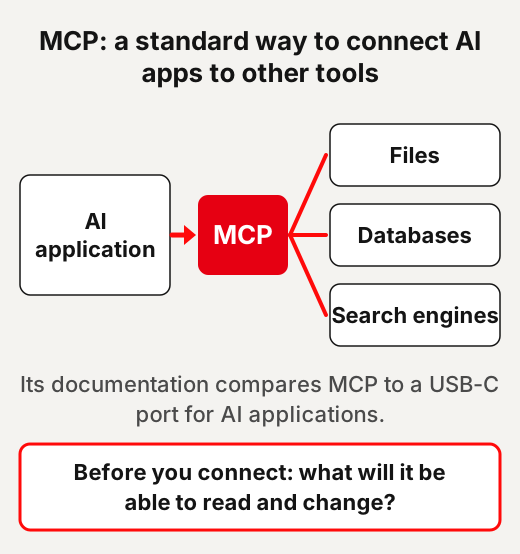
Try this: before you connect an assistant to anything, ask what it will be able to read and change.
| Stripe | A payments company. It says it helps businesses accept payments, handle business banking and build billing models. |
| MCP | A protocol, not a tool you install: an open-source standard for connecting AI applications to external systems. |
Where to learn more
- Our AI glossary explains the terms these tools use.
- Our guide to AI side hustles looks at the work and the rules behind earning with tools like these.
- Our guide to making 3D-style motion graphics videos and the one on researching a history video with Gemini Notebook show several of them used step by step.
- Our page on Clawdbot, now OpenClaw follows one open-source agent project and the security problems it ran into.
Quick answers
What is the difference between ChatGPT and Claude?
They are chat assistants from two different companies. ChatGPT is OpenAI's and Claude is Anthropic's; both answer questions and help with tasks in plain words. The models behind each change often.
Can I clone someone else's voice with AI?
ElevenLabs' prohibited use policy bars cloning the voice of any living individual without their explicit and informed consent or other valid authorization. It also bars voice recordings of anyone under 18.
What is the difference between Claude Code and Codex?
Both are coding agents. Claude Code is Anthropic's tool that reads your codebase, edits files and runs commands; Codex is OpenAI's coding agent, included in ChatGPT plans, that can work on coding tasks in the cloud.
Is Stripe an AI tool?
No. Stripe is a payments company that helps businesses accept payments, handle business banking and build billing models.
Use this
Before you sign up for an AI tool, know what kind it is and what its terms allow.
What will this tool be able to see or change, and what do its terms let me do with the result?
Quick quiz
Nothing is scored or saved. Recalling it once now is what makes it last.
1. What does ElevenLabs' policy require before cloning a living person's voice?
Answer: Their explicit and informed consent or other valid authorization.Read it again ↑
2. What is MCP?
Answer: An open-source standard for connecting AI applications to external systems.Read it again ↑
3. What do OpusClip's terms say about non-paying users?
Answer: They are limited to their own internal, personal, non-commercial use.Read it again ↑
How we checked this · Last checked November 2026
- We read each tool's own pages on 3 November 2026, by script, and Artlist also in a browser, because it sometimes blocks scripts.
- Terms are quoted from each tool's own policy pages, not summarised. This is not legal advice.
- We did not test or pay for any tool. Listing a tool is not a recommendation, and we earn nothing from these links.
- AI tools change fast; this page is a snapshot as of November 2026.