Start hereIn 1841, London time was 11 minutes ahead of Bristol's own clocks. Today a phone in Bristol and one in Tokyo agree to the second. How did that happen?
Look at the time on your phone and it agrees, to the second, with clocks on the other side of the world. That agreement is new. Below: life before shared time, how it changed, the numbers now, five popular claims, and one small way to check your own clock.
1. Before shared calendars and clock time
Before the railways, towns kept sun time, and calendars did not agree on when the year began.
Clocks were set by the sun, so towns to the west ran a few minutes behind London. The Science Museum Group notes that, depending on the time of year, the sun rises in Plymouth 20 minutes later than in London. An 1841 Great Western Railway timetable, quoted by Network Rail, said London time was 11 minutes before Bath and Bristol time.
Calendars drifted too. Suetonius says the pontiffs’ freedom to add months or days had so disordered it that the harvest festivals no longer came in summer. That was the Roman calendar before Caesar. Even the first day of the year varied. In England, the legal year began on 25 March from 1155 until the calendar reform of 1752. Scotland counted the year from 1 January from 1600, and France from 1564.
For example, a letter written in London in February 1700 and one written in Edinburgh on the same day could carry different years.
2. How it changed, from Caesar to atomic clocks
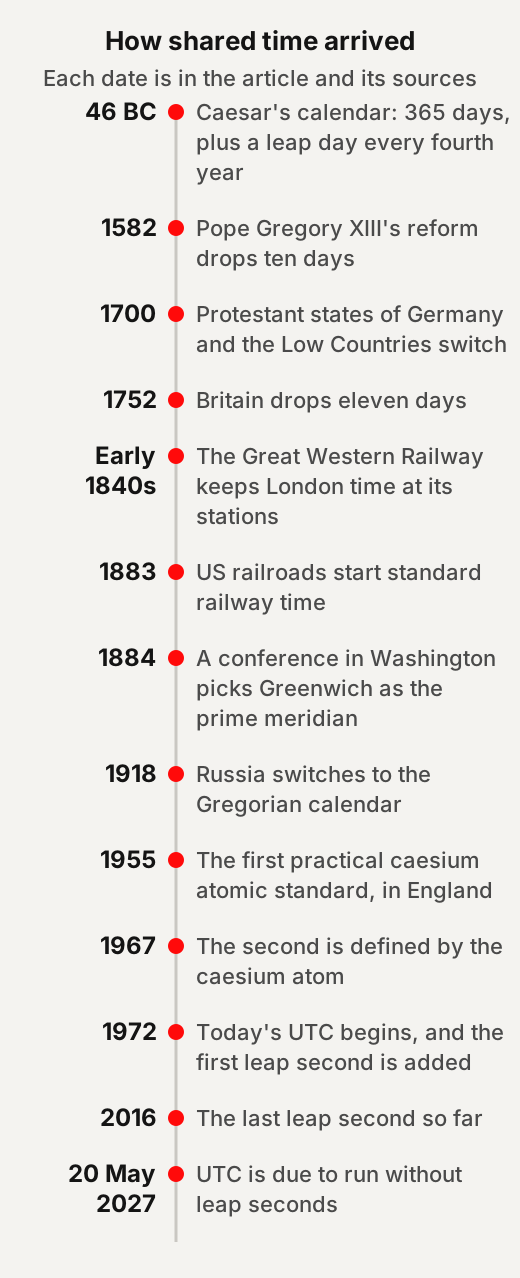
Shared time arrived in steps over about two thousand years, and every country moved at its own pace.
Caesar’s calendar, 46 BC
Caesar gave Rome a year set by the sun: 365 days, with a leap day every fourth year.
Caesar made the year three hundred and sixty-five days, with one day added every fourth year. Allen and Greenough’s Latin grammar dates the reform to 46 BC. Pliny the Elder names the astronomer Sosigenes as the expert behind it. The rule did not work as planned at first, and the sources differ on why; our Julius Caesar myths page sets out both accounts.
The year itself was a little too long. Earnest Cary, Dio’s translator, notes that the Julian year is about eleven minutes too long, a day in 128 years. By the sixteenth century, the Catholic Encyclopedia says, the calendar was ten days behind, so the spring equinox fell on 11 March.
For example, a church feast fixed by the calendar slowly moved against the seasons, a day every few generations.
The Gregorian reform, 1582, and its slow spread
Pope Gregory XIII corrected the drift in 1582, but some countries took more than three centuries to follow.
In 1582 Pope Gregory XIII had ten days dropped from the calendar. The fourth of October 1582 was followed immediately by the fifteenth. He also left the extra day out of century years, except those divisible by 400.
The new style was speedily adopted by Catholic states, but Protestant states kept the old one for a long time. The Protestant states of Germany and the Low Countries accepted the reform in 1700, Great Britain in 1752 and Sweden in 1753. Britain’s Calendar Act counted the day after 2 September 1752 as 14 September, leaving out 11 days. The same Act started the year on 1 January and said the times for paying rents or reaching the age of 21 were not altered.
Russia’s 1918 decree counted the day after 31 January as 14 February. People paid at the end of each month received their February 1918 pay minus thirteen thirtieths. Through these changes, the days of the week kept their order. The Catholic Encyclopedia notes that in England in 1752, Wednesday 2 September was followed by Thursday 14 September.
For example, someone in Britain who went to sleep on Wednesday 2 September 1752 woke on Thursday the 14th: eleven dates gone, no weekday lost.
Railway time, the 1840s to the 1880s
Trains needed one clock, so railways spread a single standard time across whole countries.
Network Rail dates the Great Western Railway’s switch to London time to November 1840. A Science Museum Group record says the company announced “Railway Time” in November 1841. We could not settle which date is right, so both are given here.
The Science Museum Group says no law was passed, but the railways helped convert cities to standard time by example. It says that by 1855, an estimated 98 per cent of public clocks in Great Britain and Ireland were set to Greenwich Mean Time. In the United States, NIST’s history says, the railroads began a “Standard Railway Time System” on November 18, 1883.
In practice, a train timetabled for noon London time left Bristol when the town’s own clocks still showed 11.49.
One prime meridian, 1884
In 1884, delegates chose Greenwich as the world’s starting line for longitude, but left local time to each country.
In October 1884, delegates met in Washington to fix “a meridian proper to be employed as a common zero of longitude and standard of time-reckoning throughout the whole world”. They proposed the meridian through the Greenwich observatory’s transit instrument, by 22 votes to 1, with 2 abstaining. San Domingo voted against, and Brazil and France abstained. They also proposed a universal day, starting at midnight on the Greenwich meridian.
That universal day was not meant to replace anyone’s clocks. The conference said it “shall not interfere with the use of local or other standard time where desirable”. NIST’s history says the world’s 24 time zones are 15 degrees wide on average, with boundaries adjusted for the convenience of local people.
For example, a map that gives a city’s longitude as so many degrees east is counting from that Greenwich line.
Atomic time and the leap second
Atomic clocks arrived in the 1950s, and from 1972 leap seconds kept them in step with the turning Earth.
The first practical caesium atomic frequency standard was built at the National Physical Laboratory in England in 1955. In 1967 the second was defined as “the duration of 9 192 631 770 periods of the radiation” from a transition in the caesium 133 atom. NIST’s history says the new Coordinated Universal Time, UTC, became effective internationally on 1 January 1972.
UTC runs on atomic clocks, but the Earth’s turning is not perfectly steady. When the gap between the two approaches one second, a one-second adjustment, a “leap second”, is made in UTC. The first leap second was added on 30 June 1972. NIST’s table lists 27 leap seconds, the last on 31 December 2016.
In plain words, a leap second is an extra second the world’s clocks add so the Earth can catch up. For example, the last one made the final minute of 2016 sixty-one seconds long.
The end of the leap second
In 2022 the conference agreed to loosen the leap-second rule by 2035; in 2026 it set 20 May 2027.
In 2022, the General Conference on Weights and Measures said leap seconds risk “serious malfunctions in critical digital infrastructure”. It then made this decision: “decides that the maximum value for the difference (UT1-UTC) will be increased in, or before, 2035”. UT1 is time kept by the Earth’s turning, and UTC is the atomic time on your clock.
At its meeting of 13 to 15 October 2026, the Conference decided that “continuous UTC will become effective on 20 May 2027”. It set the largest allowed gap between UTC and the Earth’s time at 3,600 seconds, one hour. A March 2025 workshop that included experts on the Earth’s rotation estimated a 30% chance of a negative leap second by 2035, something never applied before.
In plain words, from May 2027 the world’s clocks are set to stop adding seconds for the Earth, and the small gap will be allowed to grow. For example, software that once had to cope with a 61-second minute should not meet one after that date.
3. What the numbers say now
The best clocks now drift less than a second in millions of years; the calendar, a day in thousands.
NIST says its NIST-F4 caesium clock ticks so steadily that, had it started 100 million years ago, it would be off by less than a second today. It is one of a small group of such clocks run by just 10 countries. In 2026 the Conference noted that the best optical clocks beat the accuracy possible under the current definition of the second by a factor of up to 100. It asked its International Committee to work towards a proposal for a new definition of the second, to be presented at its 2030 meeting.
The calendar is accurate too, though not perfect. The 1911 Britannica worked out that the Gregorian year is 26 seconds too long, a day in 3,323 years. The Catholic Encyclopedia put it at about thirty-five centuries before a day’s error. Either way, it is more than three thousand years.
UTC is, in the Conference’s words, “the basis of civil time in most countries”. It also noted that in many countries, civil time differs from local sun time by more than an hour because of the choice of time zone.
For example, noon on your clock can be more than an hour away from the moment the sun is highest where you live.
4. Five popular claims, checked
The well-known stories about the calendar and the clock hold a real point, but most leave something out.
“In 1752, people rioted to get their eleven days back”
Doesn't hold up Crowds rioted over the eleven days lost in 1752. A historian’s detailed research found no such riots; the slogan is best known from a satirical painting.
How sure: Moderate it rests mainly on one historian’s detailed research, which other historians accept.
The historians Penelope Corfield and Tim Hitchcock write that Robert Poole’s research “revealed that the popular riots” over the eleven days “did not happen”. They call the riots “a later myth”, built on assumptions that the poor were “superstitious, credulous and automatically hostile to change”.
The slogan is best known from a painting. A banner reading “Give us our Eleven Days” appears in William Hogarth’s painting An Election Entertainment, from his series of 1754 to 1755. The series parodies the 1754 Oxfordshire county election. In 1820, a prosecuting counsel cited Hogarth’s picture to show “the ridiculous folly of a mob”.
What holds up is the change itself, and Parliament’s care over money. For example, the eleven lost days are still a good story to tell, with the riots left out.
“Pope Gregory invented our calendar”
Partly Pope Gregory XIII created the calendar we use. He ordered the 1582 reform of Caesar’s calendar; experts, chiefly Lilius and Clavius, worked out the details.
How sure: Strong a 1913 church encyclopedia, a university history of mathematics and the 1911 Britannica agree.
The Catholic Encyclopedia says the work was done “by Pope Gregory XIII (from whom the Gregorian reform takes its name) with the aid chiefly of Lilius, Clavius, and Chacon”. MacTutor, the University of St Andrews history of mathematics, says Clavius was the most senior of the Pope’s mathematical experts. It credits Clavius with proposing the jump from 4 to 15 October 1582 and the rule for century years. The Linda Hall Library says Aloysius Lilius, and after his death Christoph Clavius, worked out the details of the reform. The 1911 Britannica says the Julian leap-day rule was found to be off by three days in every 400 years.
For example, “the Gregorian calendar” is best read as “Caesar’s calendar, corrected in 1582”.
“The 1884 conference created the world’s time zones”
Partly The 1884 meridian conference set up the time zones. It chose Greenwich as the common starting line, but left local and standard time to each country.
How sure: Strong the conference’s own Final Act says so, and NIST’s history agrees.
The conference’s universal day was to sit beside local time, not replace it. NIST’s history says US standard time was made official by an Act of Congress in March 1918, some 34 years after the conference. It notes that the US railroads had adopted standard railway time in 1883, before the international accord.
For example, the hour your country keeps was set by your country, measured from the line chosen in 1884.
“A leap year comes every four years”
Partly Every fourth year is a leap year. Almost: a century year is a leap year only if it divides by 400.
How sure: Strong NIST and the 1582 rule itself say so.
NIST notes that 2000 was a leap year, but 1900, 1800 and 1700 were not. It says leap years are needed because the year is 365.2422 days long, not 365.
For example, on the same rule, 2100 will not be a leap year.
“Leap seconds will be scrapped in 2035”
Partly Leap seconds end in 2035. 2035 was the latest date set in 2022; in October 2026 the Conference set 20 May 2027.
How sure: Strong both decisions are in the Conference’s own published resolutions.
The 2022 text said “in, or before, 2035”, and the 2026 meeting chose the earlier path. The 2026 resolution says the one-hour limit ensures “the long term continuity for UTC for several centuries”. People who need the Earth’s own time can still find the difference between UT1 and UTC from the IERS, national metrology institutes and satellite navigation messages.
For example, a headline saying leap seconds end in 2035 is now out of date.
5. One small way to appreciate or use it
Check your own clock against an official time service; it takes a few seconds.
NIST’s time.gov shows your device’s clock beside the official time, with its error compared to NIST time. NIST says time.gov lets you see the official US time in several time zones at once. In the UK, the National Physical Laboratory’s MSF radio signal carries UK civil time to radio-controlled clocks, and can be received in most of northern and western Europe. National measurement laboratories such as NIST produce their own versions of UTC, used to synchronise the clocks and networks of daily life.
You may not need to do anything at all. NIST notes that internet time setting is built into most computer operating systems. And now and then, it is worth remembering that the second on your screen was once a matter of where you stood.
For example, open time.gov on your phone and see how far your phone’s clock is from NIST’s time.
Other pages in this series look at clean tap water, vaccines and life expectancy, electric light, writing and literacy, and maps and GPS.
Quick answers
Why did Britain lose 11 days in 1752?
Britain adopted the Gregorian calendar late. It switched in 1752, when the day after 2 September became 14 September, to catch up with a reform Pope Gregory XIII had made in 1582.
Were there riots in Britain over the lost days in 1752?
Robert Poole's research, which other historians accept, found no such riots. The slogan Give us our Eleven Days is best known from a banner in a Hogarth painting about the 1754 Oxfordshire election.
What is a leap second?
An extra second added to UTC so it stays in step with the Earth's turning. Leap seconds have been added 27 times since 1972, the last at the end of 2016.
Are leap seconds ending?
They are due to. In October 2026 the General Conference on Weights and Measures decided that continuous UTC will become effective on 20 May 2027, with the gap to the Earth's time allowed to reach one hour.
Use this
Three small ways to notice the time you have and check it, drawn from the sources above.
Who had to agree before this could feel ordinary?
Quick quiz
Nothing is scored or saved. Recalling it once now is what makes it last.
1. In Britain in 1752, what date followed 2 September?
Answer: 14 September.Read it again ↑
2. Which of these years was NOT a leap year?
Answer: 1900.Read it again ↑
3. What did the 1884 conference in Washington choose?
Answer: Greenwich as the prime meridian.Read it again ↑
How we checked this · Last checked October 2026
- We read the 1884 meridian conference's own Final Act, the section headings of Britain's 1750 Calendar Act on legislation.gov.uk, and the 1918 Russian decree in English translation.
- Robert Poole's article on the 1752 riots sits behind a bot check, so we used its abstract and two historians' summary of his findings.
- Network Rail and a Science Museum Group record date the Great Western Railway's switch to London time a year apart, so the page gives both.
- The Caesar and 1582 facts reuse the wording of our reviewed Julius Caesar myths page.
- The leap-second decisions come from the BIPM's own pages for the 2022 and October 2026 meetings.
Sources
- Suetonius, Life of Julius Caesar 40, trans. J. C. Rolfe (Loeb), LacusCurtius; Pliny the Elder, Natural History 18.211, Perseus; Cassius Dio, Roman History 43, trans. E. Cary, note to 43.26; Allen and Greenough, New Latin Grammar, “Reckoning of Time” (Dickinson College Commentaries).Primary
- Encyclopaedia Britannica (1911), “Calendar: Civil Calendar”, Wikisource.Popular
- Catholic Encyclopedia (1913), “Reform of the Calendar” and “General Chronology”, Wikisource.Popular
- MacTutor History of Mathematics, University of St Andrews, “Christopher Clavius”.Scholarly
- Linda Hall Library, “Pope Gregory XIII”.
- Calendar (New Style) Act 1750, legislation.gov.uk.Primary
- Council of People’s Commissars, “Introduction of a New Calendar” (February 1918), in Seventeen Moments in Soviet History, Michigan State University.Primary
- Penelope J. Corfield and Tim Hitchcock, Becoming a Historian, chapter 5 (University of London Press); Robert Poole, “Give us our eleven days!”, Past & Present 149 (1995), 95–139.Scholarly
- Sir John Soane’s Museum, “The Humours of an Election I: An Election Entertainment” (SM P53).Scholarly
- Network Rail, “180 years of railway time”; Science Museum Group, “‘Railway Time’ clock”.Popular
- International Conference Held at Washington for the Purpose of Fixing a Prime Meridian and a Universal Day, October 1884: Protocols of the Proceedings, Project Gutenberg.Primary
- NIST, A Walk Through Time: “World Time Scales” and “The Atomic Age” (archived pages, accurate as of 2004).Primary
- NIST, “Leap Seconds” and “Leap Seconds FAQs”; “New Atomic Fountain Clock Joins Elite Group That Keeps the World on Time” (April 2025); “About time.gov”; “Auld Lang ‘Time’”.Primary
- BIPM, General Conference on Weights and Measures: “Resolution 4 (2022)”; 28th meeting (2026), “Resolution 4” and “Resolution 5”.Primary
- National Physical Laboratory, “MSF radio time signal”.Primary
The time on your clock was agreed
Before the railways, towns kept sun time. An 1841 Great Western Railway timetable, quoted by Britain's Network Rail, put London 11 minutes ahead of Bristol. Today the international General Conference on Weights and Measures calls UTC "the basis of civil time in most countries". Our view: shared time is a recent agreement people built step by step, not something the sun hands us.
Read an old date in a minute
- Ask which calendar. The Catholic Encyclopedia (1913) says Catholic states adopted the 1582 reform speedily. Protestant states kept the old style for a long time.
- Find the place's switch date. It gives 1700 for the Protestant states of Germany and the Low Countries. It gives 1752 for Great Britain and 1753 for Sweden.
- Expect late switches. Russia's 1918 decree counted the day after 31 January as 14 February.
- Check when the year began. The Catholic Encyclopedia says England's legal year began on 25 March until 1752. It gives 1 January for Scotland from 1600.
- Check the weekday. In England, Wednesday 2 September 1752 was followed by Thursday 14 September. The dates jumped; the weekdays kept their order.
- Our suggestion. For any date before a place switched, note which calendar and which new-year rule the writer used.
Goes with: 2. How it changed, from Caesar to atomic clocks ↑
This week: check your clock twice
Our suggestion: on one day this week, compare your phone's clock with an official time service. The page's last section says where, including NIST's time.gov. NIST is a US national measurement laboratory; such labs produce their own versions of UTC. Note the gap, then check again a few days later. Our view: knowing the gap is the point, not chasing it to zero.
Check a calendar story before you repeat it
- Find the date of the decision. In 2022 the General Conference on Weights and Measures chose to loosen the leap-second rule "in, or before, 2035". In October 2026 it set 20 May 2027 for UTC to run without leap seconds.
- Ask who did the work. The Catholic Encyclopedia credits Pope Gregory XIII, "with the aid chiefly of Lilius, Clavius, and Chacon".
- Separate an agreement from a law. The 1884 conference chose Greenwich but left local time to each country. NIST's history says an Act of Congress made US standard time official in March 1918.
- Our suggestion. Before you share a calendar story, check its year, who did the work, and whether a law followed.
Keep going
- Things we take for granted: maps and GPSHow people found their way before satellites, how it changed, and what a phone can do now.
- Julius Caesar myths, checkedCaesar stories set beside the ancient writers, with both accounts of why his leap-year rule went wrong at first.
- Things we take for granted: electric lightWhat light cost before electricity, how it changed, and who still lives without it.
- Things we take for granted: clean tap waterHow tap water went from dangerous to normal, and where it still is not.
- Things we take for granted: vaccinesWhat life was like before vaccines, how it changed, and what the numbers say now.
- Things we take for granted: writing and literacyWhen writing began, why reading stayed rare for so long, and how many people still cannot read.
- Things we take for granted: refrigerationHow food was kept before fridges, how mechanical cold arrived, and what food agencies say about it now.
- Things we take for granted: the internetHow messages travelled before the internet, how the network and the web arrived, and who is online now.
- GlossaryPlain meanings of Coordinated Universal Time and leap second, the terms used on this page.